Extension of Manual Fitness Tests for Commercial Vehicles
Source:Indian Express ↗
Why It Matters
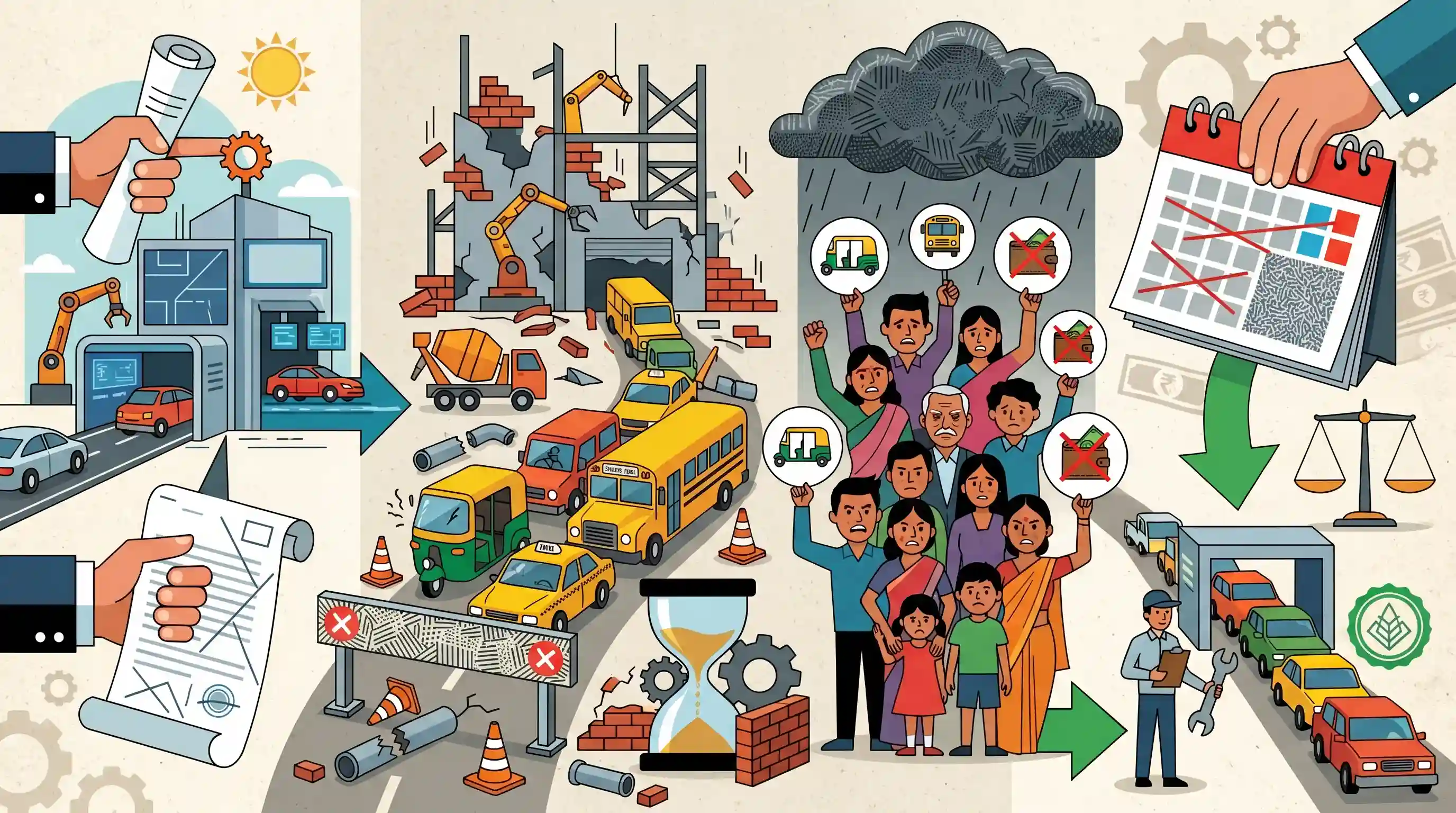
This case exemplifies the friction between top-down technological policy mandates and state-level infrastructure realities. It illustrates how premature enforcement of automation (like the ATS system) can disrupt unorganized sector livelihoods and emphasizes the need for user-centric design and ground-level readiness in governance initiatives.
Summary
The Union Ministry of Road Transport and Highways has extended the deadline for manual fitness tests for commercial vehicles until October 2026. The decision comes after the mandated transition to the Automated Testing Station (ATS) system caused a standstill in fitness certifications across 11 RTO regions in Maharashtra due to a severe lack of functional infrastructure. The premature enforcement of the ATS mandate threatened the livelihoods of nearly 15 lakh families dependent on auto-rickshaws, taxis, and school buses, highlighting significant bottlenecks in policy implementation when technological mandates outpace on-ground readiness.
Key Points
- The Union Government extended the deadline for manual fitness tests for commercial vehicles to October 1, 2026.
- The extension was necessitated after a mid-March mandate for mandatory automated testing via the Automated Testing Station (ATS) system stalled vehicle certifications in Maharashtra.
- Eleven RTO regions in the state lacked the functional ATS infrastructure required to comply with the new rules.
- The implementation bottleneck caused significant disruption and financial distress to commercial vehicle operators, including drivers of auto-rickshaws, taxis, and school buses.
- The issue underscores the challenges of enforcing technological transitions in public policy without ensuring adequate state-level infrastructure readiness.
Important Terms
Automated Testing Station (ATS)

A facility using mechanical equipment to automate vehicle fitness checks (brakes, emissions, etc.), reducing human intervention and corruption to improve road safety.
UPSC context
GS Paper 2 & 3: Infrastructure and E-governance. Tests understanding of technology-driven regulatory reforms in road safety.
Motor Vehicles (Amendment) Act, 2019
2019 legislation amending the 1988 Act to enhance road safety through higher penalties, standardized testing (ATS), and digital integration like the VAHAN database.
UPSC context
GS Paper 2: Government Policies. Essential for questions on legislative frameworks and road safety administration.
Regional Transport Office (RTO)
A state-level government bureau responsible for vehicle registration, licensing, and enforcing transport regulations under the Motor Vehicles Act.
UPSC context
GS Paper 2: Governance. Represents the grass-roots implementation challenges of central transport policies.
Ministry of Road Transport and Highways (MoRTH)
The apex Union body in India responsible for formulating and administering laws related to road transport, safety, and national highway development.
UPSC context
GS Paper 2 & 3: Executive/Infrastructure. Relevant for policy-making and transport logistics in India.
Fitness Certificate (FC)
An official document certifying a vehicle's roadworthiness; mandatory for commercial vehicles to operate legally and ensure they meet safety/emission norms.
UPSC context
GS Paper 2: Public Service Delivery. Concerns the administrative compliance required for public safety.
Vehicle Scrappage Policy
A central government policy aimed at phasing out old, unfit, and polluting vehicles to modernize the fleet and reduce vehicular emissions.
UPSC context
GS Paper 3: Economy/Environment. Vital for discussions on the circular economy and sustainable transportation.
Prelims Trap
"The Union Ministry of Road Transport is strictly responsible for establishing and operating Automated Testing Stations across India."
The Centre sets the rules under the Motor Vehicles Act, but the physical establishment of ATS and administration of RTOs is a State responsibility.
Static Concepts Connected
What are the key pillars of the Vehicle Scrapping Policy?
- Fitness Testing: Commercial vehicles must undergo mandatory automated fitness tests after 15 years; private vehicles after 20 years.
- End of Life: Vehicles failing the ATS test are deregistered, declared End-of-Life Vehicles (ELV), and sent to Registered Vehicle Scrapping Facilities (RVSF).
- Incentives: Owners receive scrap value, discounts on new vehicle purchases, and road-tax rebates to encourage voluntary scrapping.
How is jurisdiction over Motor Vehicles divided under the Seventh Schedule?
- Concurrent List: 'Mechanically propelled vehicles' falls under Entry 35 of the Concurrent List.
- Central Mandates: The Union government formulates uniform standards, policies, and laws (e.g., the Motor Vehicles Act) for the entire country.
- State Execution: State governments are responsible for enforcement, tax collection, RTO administration, and building infrastructure like ATS.
Cross-Topic Patterns
Tech Mandates vs State Capacity
The ATS bottleneck mirrors Aadhaar-PDS or early FASTag rollouts, where centralized tech mandates caused abrupt livelihood disruptions due to inadequate state-level physical infrastructure and capacity.
ATS as Circular Economy Chokepoint
Without functional ATS, the Vehicle Scrapping Policy stalls. This delays the official classification of End-of-Life Vehicles (ELVs), directly hindering India's circular economy goals and scrap-metal recovery targets.

Vehicle Scrapping Policy linked with ATS mandates and Centre-State administrative friction is a high-probability multi-statement question.
Linked PYQs · 2
Linked PYQs · 2
- 2025MainsGS2
e-governance projects have a built-in bias towards technology and back-end integration than user-centric designs. Examine.
- 2024MainsGS3
What is the technology being employed for electronic toll collection on highways? What are its advantages and limitations? What are the proposed changes that will make this process seamless? Would this transition carry any potential hazards?
