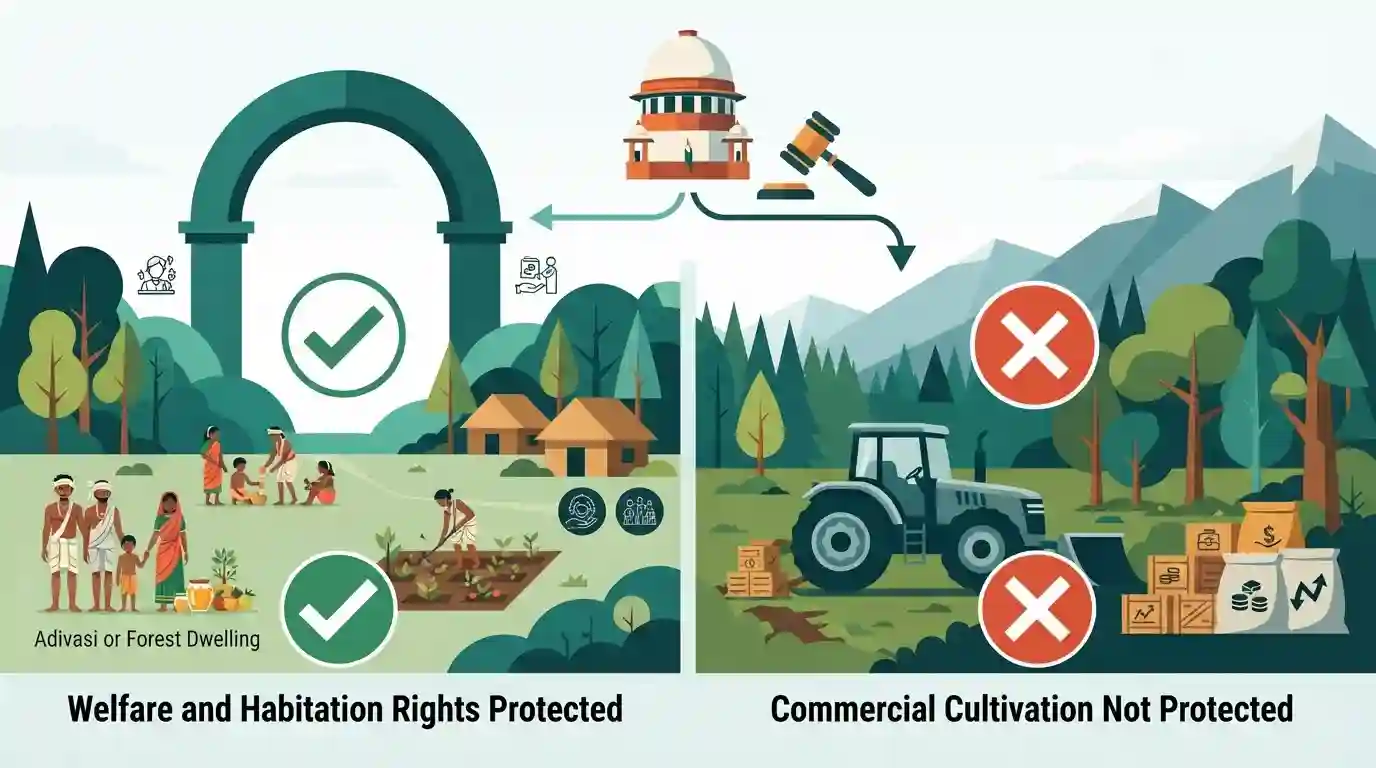
Supreme Court rules commercial farming unprotected under FRA
Source:The Hindu ↗
Why It Matters
This judicial interpretation sets an important precedent regarding the limits of rights granted under the Forest Rights Act, balancing tribal welfare and livelihood needs with environmental conservation and forest protection.
Summary
The Supreme Court of India ruled that commercial cultivation within forest land does not enjoy legal protection under the Scheduled Tribes and Other Traditional Forest Dwellers (Recognition of Forest Rights) Act, 2006. The ruling clarifies that the legislation is designed to safeguard the livelihood and habitation rights of marginalized forest dwellers rather than facilitate commercial enterprises on forest land.
Key Points
- The Supreme Court ruled that commercial cultivation within forest land is not protected under the Forest Rights Act (FRA), 2006.
- The court emphasized that FRA rights are intended for livelihood security and habitation of forest-dwelling communities rather than commercial exploitation.
- This clarification distinguishes bona fide livelihood needs from large-scale or commercial agricultural ventures on forest land.
Important Terms
Scheduled Tribes and Other Traditional Forest Dwellers (Recognition of Forest Rights) Act, 2006

A landmark 2006 legislation that recognizes and vests forest rights and occupation in forest land in forest-dwelling Scheduled Tribes and Other Traditional Forest Dwellers who have resided in such forests for generations.
UPSC context
Crucial for GS Paper II (Welfare Schemes/Vulnerable Sections) and GS Paper III (Environment and Conservation). Tests understanding of tribal rights and conservation laws.
Static Concepts Connected
What is the statutory role of the Gram Sabha under the Forest Rights Act, 2006?
- Statutory Authority: Initiating process, The Gram Sabha is the statutory authority to initiate the process for determining individual and community forest rights through its Forest Rights Committee.
- Nodal Ministry: Nodal Ministry, The Ministry of Tribal Affairs is the designated nodal ministry responsible for the effective implementation of the FRA at the national level.
- Rights Recognized: Ownership scope, FRA recognizes individual forest rights (IFR) for habitation/self-cultivation and community forest rights (CFR) for grazing, fishing, and access to minor forest produce.
Cross-Topic Patterns
FRA vs Forest Conservation Act amendments
While the FRA guarantees rights to minor forest produce, commercial cash crops grown on forest land intersect with the Forest Conservation Act and Wildlife Protection Act restrictions.

Expect statement-based questions on whether FRA extends to commercial cultivation and the statutory role of Gram Sabhas in its implementation.
Linked PYQs · 3
Linked PYQs · 3
- 2021PrelimsGS1
At the national level, which ministry is the nodal agency to ensure effective implementation of the Scheduled Tribes and Other Traditional Forest Dwellers (Recognition of Forest Rights) Act, 2006?
- 2013PrelimsGS1
Under the Scheduled Tribes and Other Traditional Forest Dwellers (Recognition of Forest Rights) Act, 2006, who shall be the authority to initiate the process for determining the nature and extent of individual or community forest rights or both?
- 2019PrelimsGS1
Consider the following statements: 1. As per recent amendment to the Indian Forest Act, 1927, forest dwellers have the right to fell the bamboos grown on forest areas. 2. As per the Scheduled Tribes and Other Traditional Forest Dwellers (Recognition of Forest Rights) Act, 2006, bamboo is a minor forest produce. 3. The Scheduled Tribes and Other Traditional Forest Dwellers (Recognition of Forest Rights) Act, 2006 allows ownership of minor forest produce to forest dwellers. Which of the statements given above is/are correct?
