Uttar Pradesh PWD to Construct Helipads at Tehsil and Block Levels
Source:hindustantimes ↗
Why It Matters
This project highlights local infrastructure planning, state-funded governance schemes, and emergency decentralization in Uttar Pradesh. UPPSC frequently questions state-specific welfare, development, and infrastructure programs (such as the Ganga Expressway tested in UPPSC Prelims 2023).
Summary
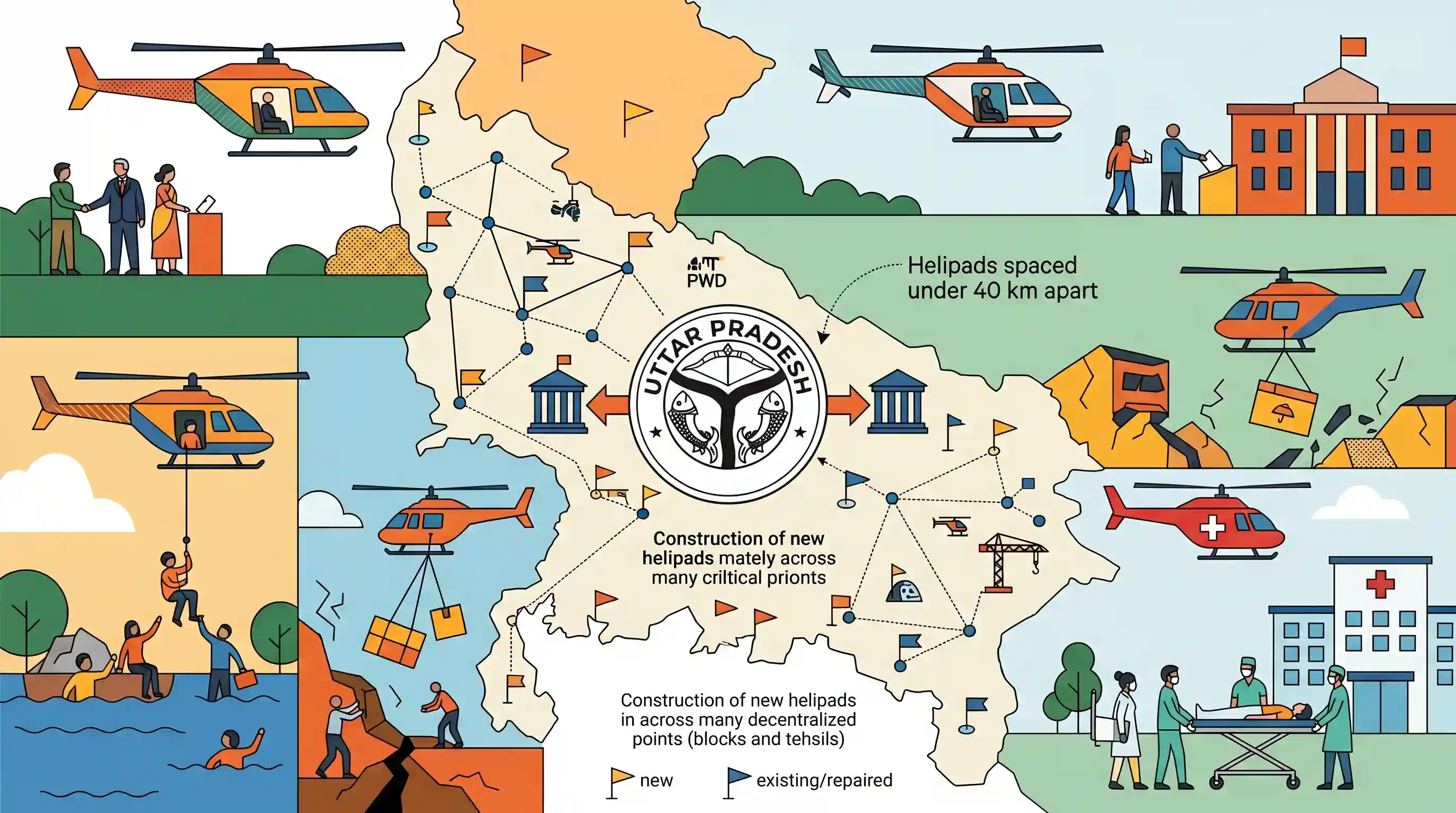
The Uttar Pradesh government is initiating a major state-funded infrastructure drive to build 736 new helipads and repair 17 existing ones across blocks and tehsils. Executed by the State Public Works Department (PWD) at an estimated cost of ₹1 crore per facility, this decentralized network aims to keep the distance between helipads under 40 km. The infrastructure is designed to drastically improve disaster response, medical evacuation capabilities, and emergency rescue times while facilitating VIP and election transport.
Key Points
- The Uttar Pradesh government has launched an initiative to construct 736 new helipads and repair 17 existing ones across block and tehsil levels within six months.
- The initiative aims to meet a state-wide requirement of over 900 helipads, strategically establishing facilities near block, tehsil, and district headquarters.
- Each helipad will be built on a 100-meter-by-100-meter plot of land provided by respective district administrations, with an estimated construction cost of approximately ₹1 crore per helipad.
- To ensure dense coverage, the maximum distance between any two helipad facilities is being kept below 40 km, with strong connectivity to state highways and expressways.
- Managed by the Uttar Pradesh Public Works Department (PWD), the infrastructure is primary designated for disaster management, rescue operations, medical emergencies, VIP movement, and election logistics. Private use will also be permitted upon payment of prescribed fees.
Important Terms
Public Works Department (PWD), Uttar Pradesh

The state government agency responsible for planning, designing, constructing, and maintaining public assets like roads, bridges, and government buildings, which are crucial for daily connectivity and emergency response.
UPSC context
GS Paper II & III (Governance, Infrastructure); tests implementation of state-funded infrastructure assets and public service delivery mechanisms.
Uttar Pradesh State Disaster Management Authority (UPSDMA)
The statutory apex body in Uttar Pradesh established under the Disaster Management Act, 2005, responsible for formulating, coordinating, and implementing disaster mitigation, preparedness, and response strategies across the state.
UPSC context
GS Paper III (Disaster Management); tests knowledge of sub-national institutional frameworks for disaster risk reduction and state-level governance.
Helicopter Emergency Medical Services (HEMS)
A specialized emergency medical response and trauma care delivery system utilizing aeromedical transport to bypass road infrastructure bottlenecks and rapidly evacuate critically ill or injured patients.
UPSC context
GS Paper III (Aviation & Infrastructure, Disaster Management); tests understanding of emergency medical connectivity and last-mile disaster rescue technology.
Disaster Resilient Infrastructure (DRI)
Infrastructure systems designed, built, and maintained to withstand or quickly recover from natural or man-made hazards, ensuring that essential services like transport, energy, and healthcare remain functional during disasters.
UPSC context
GS Paper III (Infrastructure, Disaster Management); tests comprehension of structural and non-structural adaptation strategies for sustainable development.
Tehsil and Block Administration
Sub-district levels of administrative division in India, where tehsils focus primarily on land revenue and magisterial duties, and blocks act as the key planning and execution units for rural development.
UPSC context
GS Paper II (Governance); tests understanding of local-level administrative hierarchy, land revenue governance, and decentralized development models.
Prelims Trap
The 736-helipad construction program across Uttar Pradesh is fully funded under the World Bank's Green National Highways Corridor Project (GNHCP).
GNHCP is a central-sector project assisted by the World Bank across 4 states (HP, Rajasthan, AP, UP). UP's helipad program is state-funded. Do not confuse the technical paving standards (CTSB) derived from GNHCP as being funded by GNHCP.
Static Concepts Connected
What is the decentralized structure under the Disaster Management Act, 2005?
- NDMA (National): Chaired by the Prime Minister; lays down national plans, policies, and guidelines for timely disaster response.
- SDMA (State): Chaired by the Chief Minister; coordinates state-level mitigation, preparedness, and resource allocation.
- DDMA (District): Chaired by the District Magistrate/Collector; acts as the local planning, implementing, and coordinating body.
What are Cement Treated Sub-Base (CTSB) and Cold Mix Asphalt technologies?
- CTSB Technology: A semi-rigid pavement layer using soil/aggregate stabilized with cement, lowering dependency on scarce natural aggregates.
- Cold Mix/MSS+: Enables asphalt paving at ambient temperatures without heating aggregates, significantly reducing carbon emissions and fuel usage.
- Climate Resilience: Provides higher load-bearing capacity and superior resistance to water-logging compared to traditional flexible pavements.
Cross-Topic Patterns
Decentralized DM + Rural Infrastructure
Building localized air-connectivity assets like helipads at tehsil levels bridges the critical 'golden hour' medical evacuation gap during extreme climate disasters in rural India.
Green Technology + Multilateral Funding
Adopting World Bank-backed CTSB standards for state-level projects shows how multilateral climate-resilient engineering guidelines shape local-level public works execution.

Mains 2026 may test how decentralized local infrastructure networks (like micro-helipads) integrate with District Disaster Management Plans.
Linked PYQs · 1
Linked PYQs · 1
- 2023UPPSC_PRELIMSGS1
Which of the following Scheme/Programme is not the Central Government Programme and it is Uttar Pradesh Government's Programme?
