Consumer protection law and professional accountability of doctors
Source:Indian Express ↗
ఇది ఎందుకు ముఖ్యం
Crucial for understanding accountability mechanisms for professions like medicine and law under consumer welfare legislation in India.
సారాంశం
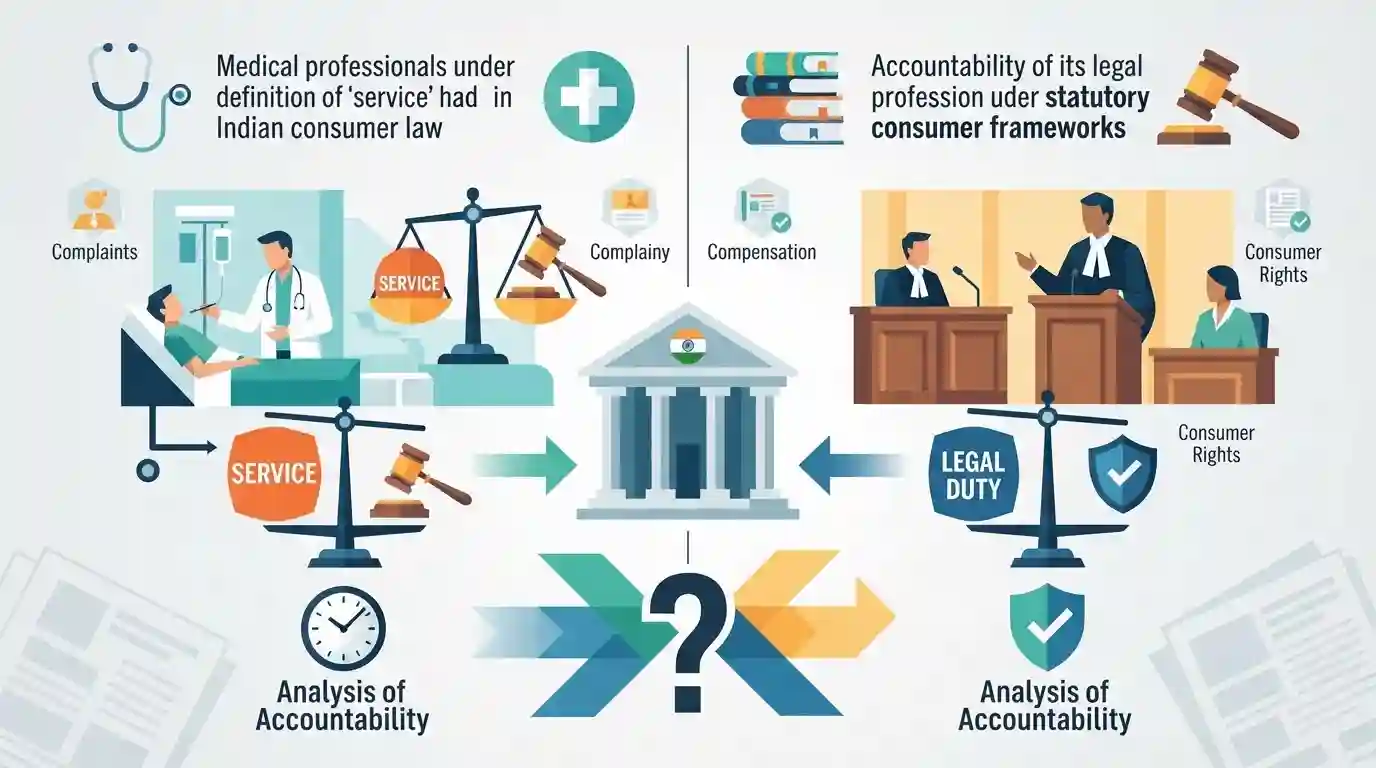
An analysis of why Indian consumer law holds medical professionals accountable for negligence under the definition of 'service', and how it compares to the legal profession's accountability under statutory consumer frameworks.
ముఖ్య అంశాలు
- Indian consumer law holds professionals like doctors accountable under the Consumer Protection Act by defining medical services as 'services' hired for consideration.
- The exclusion or inclusion of legal professionals under consumer laws has been a matter of debate, contrasting the fiduciary duties of lawyers and doctors with commercial transactions.
- Supreme Court jurisprudence has historically affirmed that medical negligence can be challenged as a deficiency in service under consumer protection legislation.
ముఖ్యమైన పదాలు
Consumer Protection Act, 2019

A comprehensive legislation enacted to replace the 1986 Act, strengthening consumer rights, establishing regulatory authorities like the CCPA, and providing for a three-tier quasi-judicial redressal mechanism.
UPSC context
UPSC GS Paper II (Polity & Governance) and GS Paper III: tests statutory frameworks, rights of citizens, and consumer dispute redressal mechanisms.
Consumer Protection Act, 1986
The landmark legislation that first introduced consumer councils and disputes redressal agencies in India, under which the Supreme Court famously brought medical services within the ambit of 'service'.
UPSC context
UPSC GS Paper II: tests evolution of social legislation, welfare schemes, and landmark judicial interpretations expanding statutory definitions.
Supreme Court of India
The apex judicial body in India that interprets constitutional and statutory provisions, having established medical practitioner accountability under consumer law through landmark rulings.
UPSC context
UPSC GS Paper II (Indian Constitution, Judiciary, and Institutional Framework): tests constitutional powers, judicial review, and landmark rulings.
Consumer Disputes Redressal Commission
Quasi-judicial bodies established at the district, state, and national levels under consumer protection laws to adjudicate consumer grievances and disputes regarding deficiency in services.
UPSC context
UPSC GS Paper II: tests statutory quasi-judicial bodies, alternative dispute resolution, and administrative justice delivery mechanisms in India.
అనుసంధానమైన స్థిర భావనలు
What are the key tiers and pecuniary jurisdiction of the Consumer Protection Act, 2019?
- District Tier: District Commission handles consumer disputes where the value of goods or services paid does not exceed ₹50 lakhs.
- State Tier: State Commission handles claims exceeding ₹50 lakhs up to ₹2 crores, alongside appellate jurisdiction over district orders.
- National Tier: National Commission handles claims exceeding ₹2 crores and exercises appellate jurisdiction over state commission orders.
అంతర-అంశ నమూనాలు
Professional Accountability: Medical vs Legal Services
While doctors face civil liability under the Consumer Protection Act, advocates were explicitly exempted by the Supreme Court in 2024, highlighting the nuanced distinction between different professional obligations.
Civil Tort vs Criminal Negligence in Law
Medical negligence intersects civil claims of deficiency in service under consumer law and criminal liability requiring gross negligence under the Bharatiya Nyaya Sanhita.

Expect a multi-statement Prelims question comparing the applicability of the Consumer Protection Act to medical practitioners vs advocates.
అనుసంధాన PYQలు · 1
అనుసంధాన PYQలు · 1
- 2023PrelimsGS1
Consider the following organizations/bodies in India: 1. The National Commission for Backward Classes 2. The National Human Rights Commission 3. The National Law Commission 4. The National Consumer Disputes Redressal Commission How many of the above are constitutional bodies?
