Judicial Precedent and the Doctrine of Stare Decisis in India
Source:Indian Express ↗
हे का महत्त्वाचे आहे
It addresses core questions of judicial accountability, the rule of law, and the sanctity of precedents in constitutional interpretation, which are vital components of GS Paper 2 (Polity and Governance).
सारांश
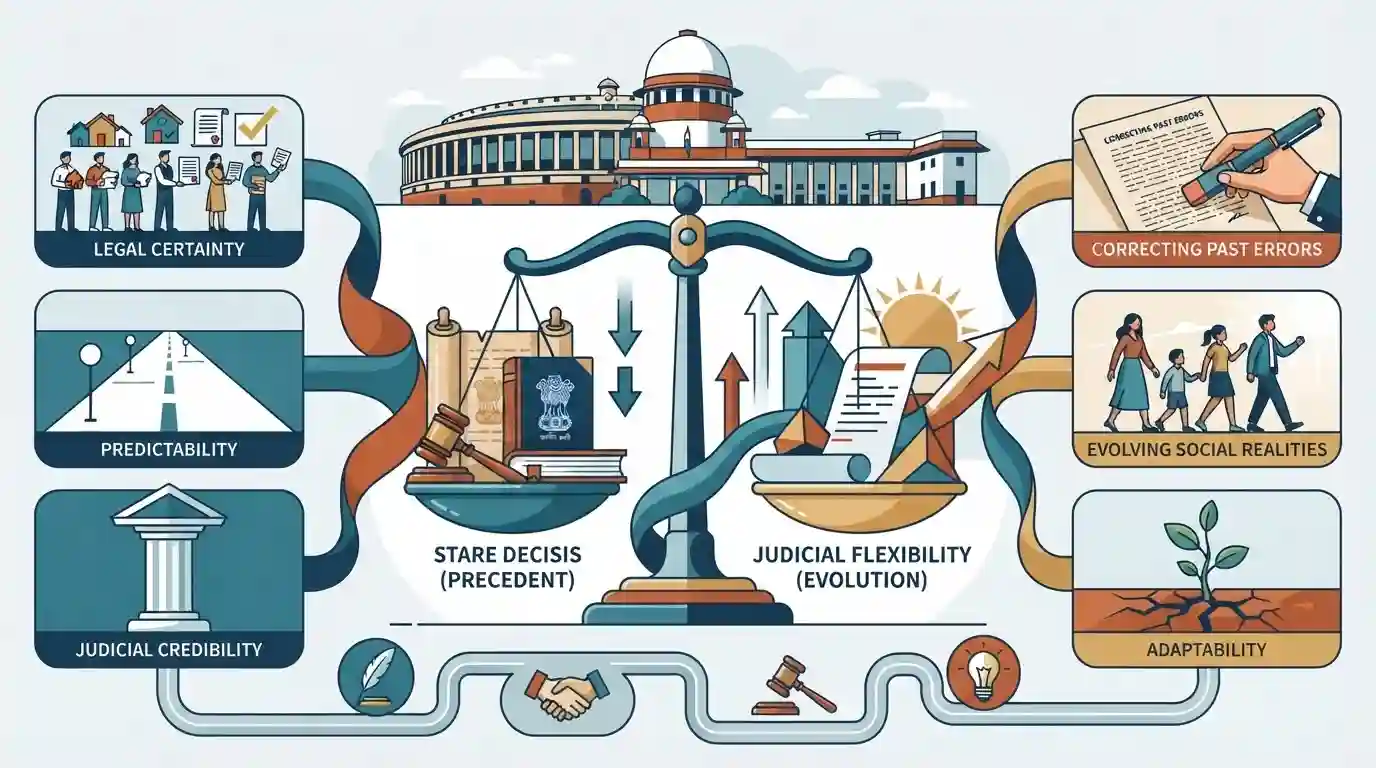
The article discusses the legal and philosophical debate surrounding the doctrine of 'stare decisis' (adherence to precedent) versus judicial flexibility. It analyzes how frequent reversals of judgments by higher courts can impact legal certainty, predictability, and judicial credibility, while acknowledging the necessity of correcting past errors to suit evolving social realities.
मुख्य मुद्दे
- The article examines the tension between the doctrine of stare decisis (adherence to precedent) and the need for judicial flexibility, exploring the consequences of frequent flip-flops in judicial rulings.
- Stare decisis provides legal certainty, predictability, and stability, ensuring that citizens and lower courts can rely on established law.
- Excessive or unprincipled departures from precedent can lead to judicial chaos, unpredictability, and erosion of public trust in the judiciary.
- The balance between judicial adaptability to changing societal needs and the stability of legal interpretation remains a central challenge for constitutional courts.
महत्त्वाच्या संज्ञा
Stare Decisis

A legal doctrine meaning 'to stand by things decided,' requiring courts to follow judicial precedents from earlier rulings to ensure predictability, consistency, and stability in the legal system.
UPSC context
UPSC Mains GS Paper 2 (Indian Judiciary, Structure & Functioning). Tests the understanding of judicial precedents, certainty of law, and institutional credibility.
Supreme Court of India
Article 141 of the Constitution establishes that the law declared by the Supreme Court is binding on all courts within the territory of India, cementing the doctrine of precedent.
UPSC context
UPSC Mains GS Paper 2 (Structure, Organization and Functioning of the Judiciary). Crucial for questions on judicial supremacy, authority, and binding rulings.
संबंधित स्थिर संकल्पना
What are the constitutional provisions and legal doctrines governing judicial precedents in India?
- Article 141: Article 141 mandates that law declared by the Supreme Court is binding on all courts within the territory of India.
- Ratio Decidendi: Only the ratio decidendi (essential legal reasoning) forms the binding precedent, while obiter dicta (incidental observations) have persuasive value.
- Exceptions: Decisions rendered per incuriam (in disregard of a statute or binding precedent) or sub-silentio lack binding precedential value.
- SC Power: Unlike lower courts, the Supreme Court is not bound by its own previous decisions and can overrule them for constitutional growth.
आंतर-विषय नमुने
Stare Decisis vs Judicial Activism and Basic Structure
Frequent reversal of bench decisions underscores the tension between judicial activism, basic structure evolution, and the stability of Article 141 precedents.

Expect a statement-based prelims question on Article 141, distinguishing between ratio decidendi, obiter dicta, and the SC's power to overrule.
संबंधित PYQ · 2
संबंधित PYQ · 2
- 2025MainsGS2
"Constitutional morality is the fulcrum which acts as an essential check upon the high functionaries and citizens alike...." In view of the above observation of the Supreme Court, explain the concept of constitutional morality and its application to ensure balance between judicial independence and judicial accountability in India.
- 2023MainsGS2
“Constitutionally guaranteed judicial independence is a prerequisite of democracy.” Comment.
