White-Collar Crime Jurisprudence and Modern Bail Strategy
Source:Indian Express ↗
কেন এটি গুরুত্বপূর্ণ
Crucial for understanding contemporary developments in criminal jurisprudence, the balance between state powers to curb economic crimes, and the protection of fundamental rights like personal liberty under Article 21.
সারসংক্ষেপ
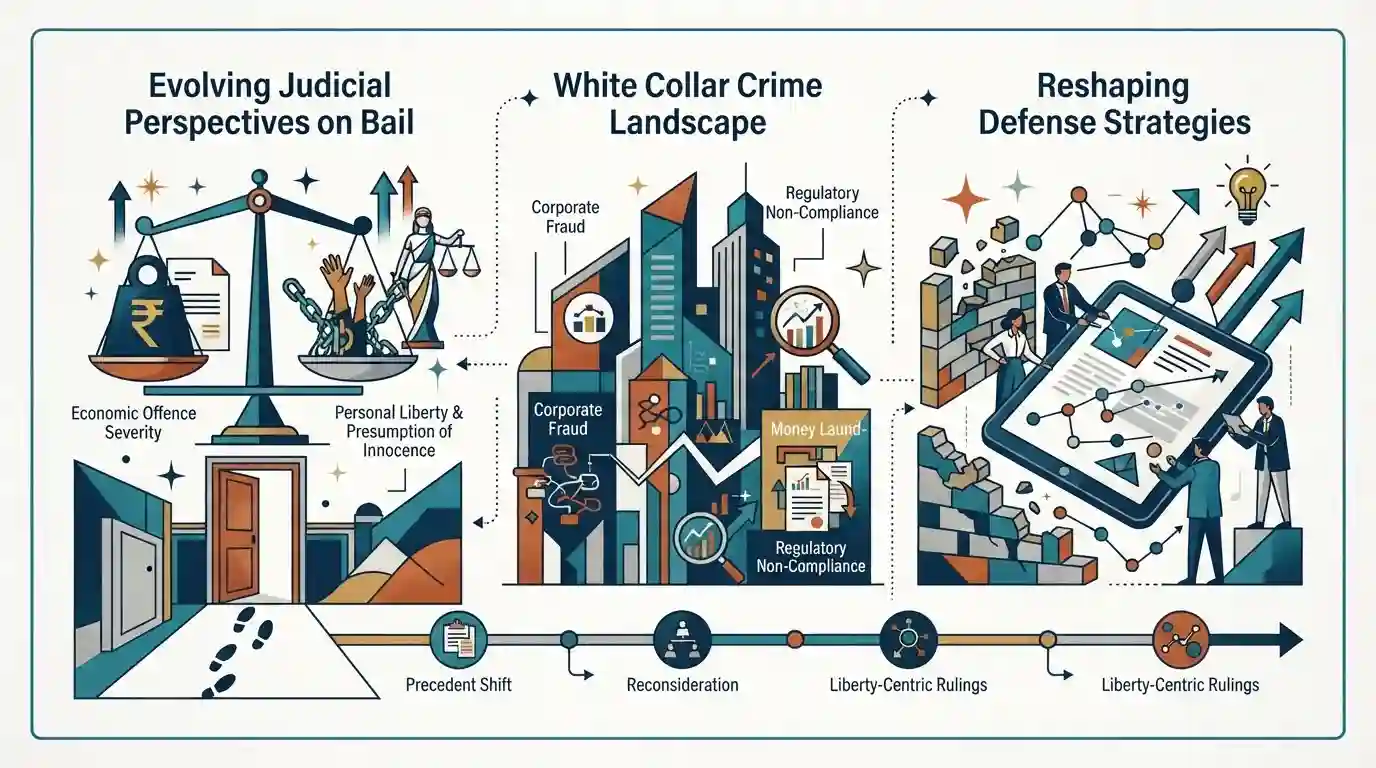
An analysis of the changing contours of white-collar jurisprudence in India, focusing on how evolving judicial perspectives on bail and personal liberty are reshaping defense strategies in economic and corporate crimes.
মূল বিষয়
- The landscape of white-collar crime jurisprudence in India is shifting, impacting legal defense and bail strategy in economic offenses.
- Stringent statutory conditions (such as twin conditions under the PMLA) historically made securing bail in economic offences exceptionally difficult.
- Recent judicial interventions emphasizing personal liberty under Article 21 are prompting a recalibration of how bail applications are structured and argued in white-collar cases.
- Defense strategies now increasingly rely on prolonged incarceration as a ground, balancing the gravity of economic harm against fundamental rights.
গুরুত্বপূর্ণ শব্দ
Prevention of Money Laundering Act (PMLA)

A specialized legislation aimed at preventing money laundering and confiscating proceeds of crime, notorious for stringent bail provisions like the twin conditions under Section 45.
UPSC context
UPSC GS Paper II & III: Statutory bodies, economic offences, and the balance between state investigative powers and individual liberty under Article 21.
Bharatiya Nagarik Suraksha Sanhita (BNSS)
The new criminal procedure code replacing the CrPC, introducing updated norms on police custody, undertrial detention periods, and bail eligibility.
UPSC context
UPSC GS Paper II: Significant provisions of new criminal laws, separation of powers, and reforms in the Indian criminal justice system.
Directorate of Enforcement (ED)
A specialized financial investigation agency under the Ministry of Finance that probes economic offences and money laundering violations under the PMLA.
UPSC context
UPSC GS Paper II & III: Role of investigative agencies, federalism, misuse allegations, and enforcement of anti-corruption laws.
প্রিলিমস ফাঁদ
Once the twin conditions under Section 45 of the PMLA are invoked, the Supreme Court cannot grant bail under any circumstances.
Aspirants often assume special acts like PMLA automatically exclude Article 21 review; while stringent, constitutional courts retain writ jurisdiction and power to grant bail if pre-trial incarceration becomes punitive.
সংযুক্ত স্থির ধারণা
What are the constitutional and statutory contours of the 'Twin Conditions' for bail under the PMLA?
- Prosecutor Oppose: Section 45 of PMLA requires the court to give the Public Prosecutor an opportunity to oppose bail.
- Prima Facie Guilt: The court must be satisfied that there are reasonable grounds for believing that the accused is not guilty of such offence.
- No Offence on Bail: The accused must not commit any offence while on bail; these stringent conditions were partially relaxed for women, sick, or infirm persons.
- Judicial Validation: In Vijay Madanlal Choudhary (2022), the Supreme Court upheld the constitutional validity of these strict twin conditions.
আন্তঃবিষয় প্যাটার্ন
White-Collar Crime + International Legal Cooperation
Economic offences involve complex financial trails and transnational assets, bringing cross-border mutual legal assistance treaties (MLATs) and Interpol red corner notices into the defense matrix.
Judicial Review + Legislative Overreach
As statutory restrictions in special acts like PMLA collide with Article 21, the judiciary frequently interprets legislative intent against fundamental rights, a core separation-of-powers theme.

Expect a statement-based prelims question on the PMLA twin conditions or a mains analytical question on liberty vs economic harm.
সংযুক্ত PYQ · 2
সংযুক্ত PYQ · 2
- 2017MainsGS2
The Indian Constitution has provisions for holding joint session of the two Houses of the Parliament. Enumerate the occasions when this would normally happen and also the occasions when it cannot, with reason thereof.
- 2026PrelimsGS1
Match List I with List II and select the answer using the code given below the Lists : List I (INTERPOL Notice) A. Silver Notice B. Blue Notice C. Black Notice D. Green Notice List II (Description) 1. To seek information on unidentified bodies 2. To collect additional information about a person's identity, location, or activities in relation to a criminal investigation 3. To provide warning about a person's criminal activities, where the person is considered to be a possible threat to public safety 4. To identify and trace criminal assets Code :
