First Deep Sea Video Footage of Juvenile Colossal Squid
Source:The Hindu ↗
Why It Matters
This article highlights rare marine biodiversity and the technological advancements in deep-sea exploration. For UPSC aspirants, it connects directly to GS3 topics on scientific awareness, biotechnology, and the environment, as well as the 'Blue Economy' and deep-sea exploration initiatives like India's Deep Ocean Mission (Samudrayaan/Matsya 6000).
Summary
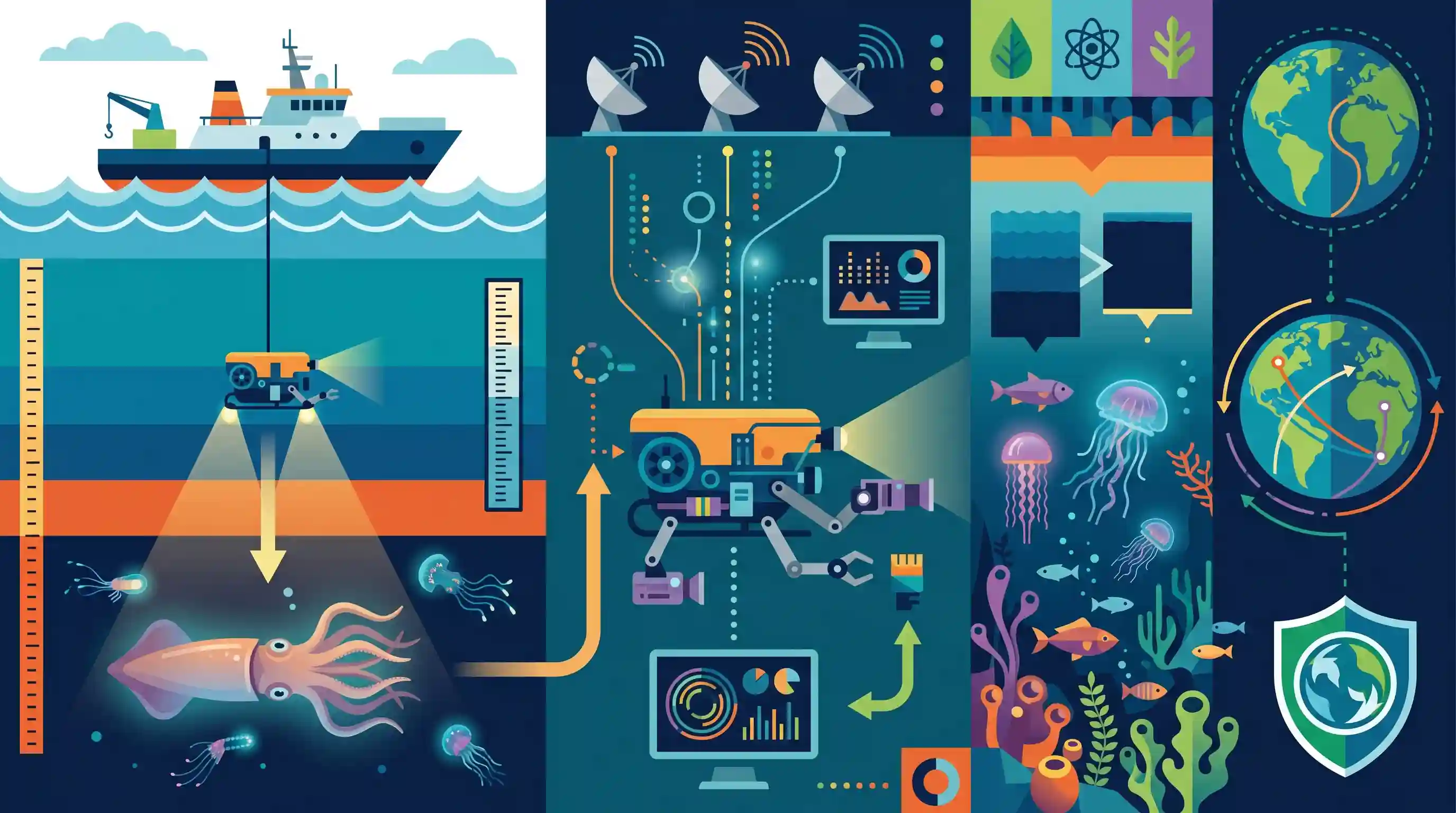
Researchers from the Schmidt Ocean Institute have successfully filmed a juvenile colossal squid in the deep sea for the first time. Spotted near the South Sandwich Islands in the South Atlantic Ocean at a depth of nearly 2,000 feet, the rare footage was captured using a remotely operated submersible. Colossal squids are the largest known invertebrates on Earth, yet their deep and inaccessible habitat makes them incredibly difficult to study. This breakthrough highlights the immense, largely unexplored biodiversity of the deep oceans and the critical role of advanced marine technology in facilitating scientific discovery, an area of growing importance similar to India's own Deep Ocean Mission.
Key Points
- A juvenile colossal squid (Mesonychoteuthis hamiltoni) was caught on camera for the first time in its natural deep-sea environment.
- The sighting occurred at a depth of 1,968 feet (600 meters) near the South Sandwich Islands in the South Atlantic Ocean.
- Colossal squids are the world's largest known invertebrates, with adult specimens reaching up to 23 feet (7 meters) in length.
- The footage was captured by a remotely operated submersible during an Ocean Census flagship expedition by the Schmidt Ocean Institute, highlighting advancements in deep-ocean exploration technologies.
Important Terms
Deep Ocean Mission

India's flagship initiative (2021-2026) to explore deep-sea resources and develop indigenous technology, including the Matsya-6000 manned submersible, to support the sustainable 'Blue Economy.'
UPSC context
GS III: Science & Tech / Economy; critical for resource security and maritime technological self-reliance.
Ocean Census
A global initiative aiming to identify 100,000 new marine species within a decade to close the vast knowledge gap in ocean biodiversity using advanced genetic and imaging tools.
UPSC context
GS III: Environment & Biodiversity; supports international conservation targets like the '30x30' biodiversity goal.
Colossal Squid
The world’s largest invertebrate, native to the Southern Ocean's deep waters; it is a key deep-sea predator and a primary food source for sperm whales.
UPSC context
GS III: Environment; relevant for 'Species in News' and understanding deep-sea food webs and ecosystem health.
Remotely Operated Vehicle (ROV)
A tethered, unmanned underwater robot controlled from the surface, used for exploration, sampling, and data collection in deep-sea environments inaccessible or dangerous to human divers.
UPSC context
GS III: Science & Technology; fundamental tool for marine exploration and industrial applications like deep-sea mining.
Schmidt Ocean Institute
A private non-profit organization that provides researchers with free access to advanced research vessels and robotic technology to accelerate oceanographic discovery and open-access data sharing.
UPSC context
GS III: Science & Tech; illustrates the impact of international philanthropic-scientific partnerships in global environmental research.
Prelims Trap
"Due to its extreme rarity and deep-sea habitat, the Colossal Squid is classified as Critically Endangered on the IUCN Red List."
Aspirants often conflate 'rarely seen' with 'endangered'. The colossal squid is rarely sighted due to the extreme depths of its habitat, not a declining population. It is categorized as 'Least Concern'.
Static Concepts Connected
What are the key components of India's Deep Ocean Mission?
- Manned submersible: Development of MATSYA-6000, a titanium-sphere manned submersible to carry three humans to a depth of 6,000 meters.
- Polymetallic nodules: Exploration and mining of copper, nickel, and cobalt nodules in the Central Indian Ocean Basin.
- Energy & Freshwater: Studying offshore Ocean Thermal Energy Conversion (OTEC) for powered desalination plants.
How are ocean layers classified by depth and light penetration?
- Epipelagic (Sunlight): Surface to 200m depth; contains enough sunlight for photosynthesis and hosts the vast majority of visible marine life.
- Mesopelagic (Twilight): 200m to 1,000m depth; faint twilight penetration, but insufficient for photosynthesis.
- Bathypelagic (Midnight): 1,000m to 4,000m depth; complete darkness and crushing hydrostatic pressure. This is the primary habitat of the colossal squid.
Cross-Topic Patterns
Polymetallic Nodules vs. Marine Ecology
India's ISA contracts for deep-sea mining frequently clash with ecological preservation, testing aspirants on the balance between UNCLOS extraction rights and BBNJ (High Seas Treaty) conservation goals.
South Atlantic Geopolitical Disputes
Like the Chagos Archipelago or Falkland Islands, the South Sandwich Islands reflect lingering post-colonial territorial disputes (UK vs. Argentina) that often appear in Prelims 'Places in News' matching pairs.

Expect a Prelims question mixing India’s MATSYA-6000 capabilities, ocean depth zones (bathypelagic), and UNCLOS deep-sea mining rules.
Linked PYQs · 2
Linked PYQs · 2
- 2021PrelimsGS1
Consider the following kinds of organisms : 1. Copepods 2. Cyanobacteria 3. Diatoms 4. Foraminifera Which of the above are primary producers in the food chains of oceans?
- 2014MainsGS1
Critically evaluate the various resources of the oceans which can be harnessed to meet the resource crisis in the world.
