Colombia US Diplomatic Friction over Regional Interventionism
Source:The Hindu ↗
Why It Matters
The incident highlights the volatile geopolitical climate in Latin America, showcasing aggressive U.S. unilateralism and the resistance from leftist regional leaders. It touches upon crucial aspects of international law, state sovereignty, and the diplomatic ramifications of cross-border drug trade.
Summary
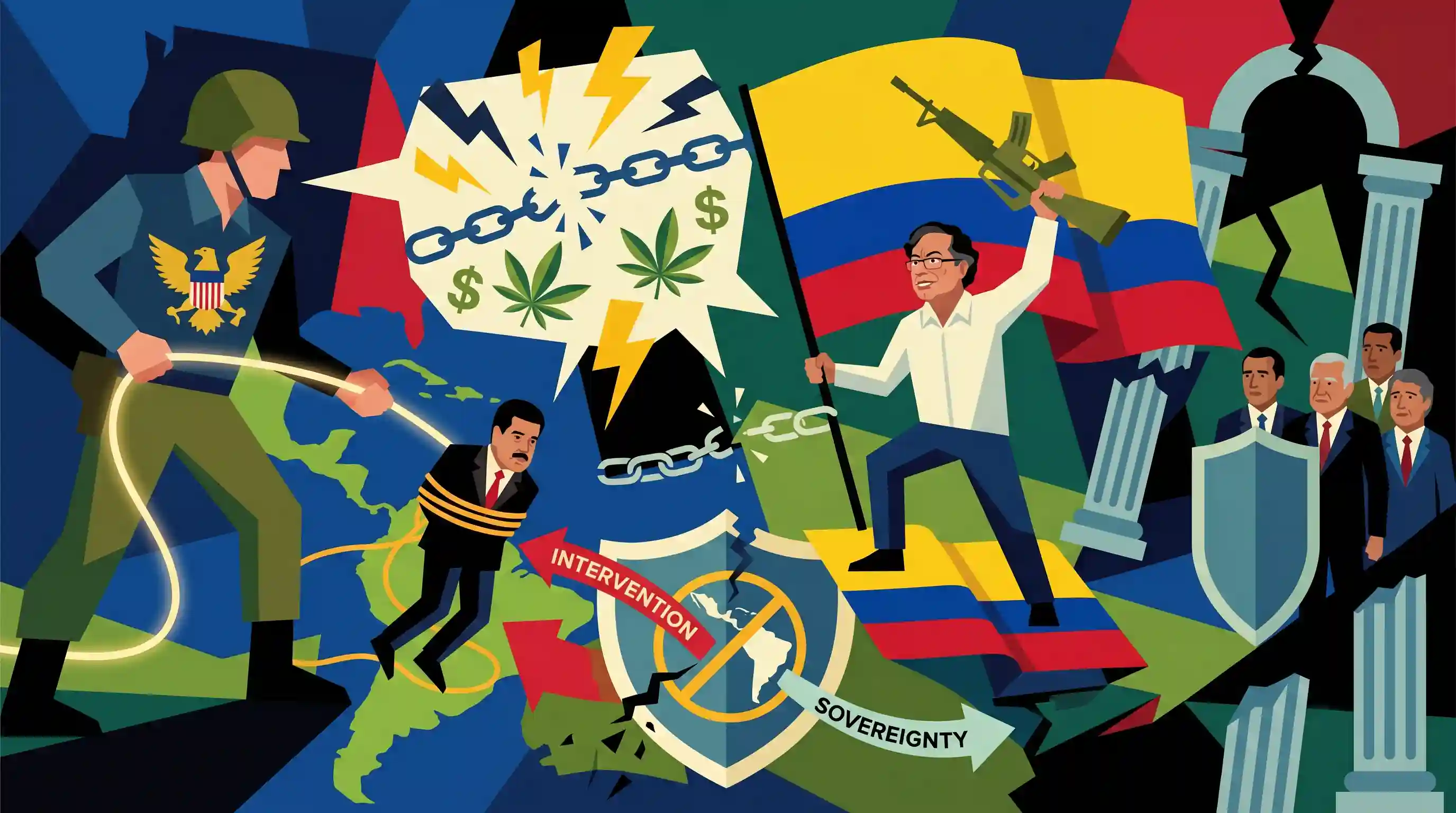
Colombian President Gustavo Petro has declared his readiness to "take up arms" for his country following severe verbal attacks from U.S. President Donald Trump and the controversial U.S. military seizure of Venezuelan leader Nicolas Maduro. The escalation marks a rapid deterioration in U.S.-Colombia relations, fueled by Trump's accusations regarding Colombia's role in the drug trade and Petro's firm denunciation of the U.S. intervention in Venezuela as an illegal abduction.
Key Points
- Colombian President Gustavo Petro declared he would "take up arms" to defend his homeland in response to threats from U.S. President Donald Trump.
- Tensions escalated after the U.S. conducted a military strike to seize Venezuelan leader Nicolas Maduro, an act Petro condemned as an abduction "without legal basis."
- Trump insulted Petro, labeling him a "sick man" involved in the cocaine trade, reflecting a sharp deterioration in U.S.-Colombia diplomatic relations.
Prelims Trap
"Sitting Heads of State can be legally arrested by foreign militaries without UN mandate if indicted for transnational narco-terrorism."
Under customary international law, sitting heads of state enjoy absolute personal immunity (ratione personae) from foreign criminal jurisdiction. Unilateral military seizures blatantly violate this principle.
Static Concepts Connected
What is Head of State immunity under customary international law?
- Ratione Personae: Sitting heads of state enjoy absolute personal immunity from foreign jurisdiction to ensure the unhindered functioning of their state.
- Customary Law Basis: It stems from sovereign equality (par in parem non habet imperium)—the principle that one sovereign cannot exercise jurisdiction over another.
- Exceptions: Immunity can typically only be pierced by international criminal tribunals (like the ICC) or explicit UN Security Council mandates, not unilateral state action.
What is the Monroe Doctrine and how does it relate to the 'Pink Tide'?
- Monroe Doctrine: Originally an 1823 US policy opposing European colonialism, it evolved into a geopolitical framework justifying US hegemony and interventionism in the Western Hemisphere.
- The Pink Tide: A political wave in Latin America where left-leaning governments are elected, often shifting foreign policy away from US alignment and towards multipolarity or regional sovereignty.
Cross-Topic Patterns
Monroe Doctrine vs Rules-Based Order
US unilateralism and military intervention in Latin America starkly contrast with its strict advocacy for a "rules-based international order" and sovereignty in the Indo-Pacific.
Extraterritoriality & Transnational Targeting
Washington's seizure of Maduro elevates the global debate on extraterritorial operations, paralleling recent diplomatic rows involving India, Canada, and the US over transnational targeting and sovereignty.

Expect a 2026 GS2 question contrasting US unilateralism in Latin America (Monroe Doctrine) with its Indo-Pacific rules-based order stance.
Linked PYQs · 2
Linked PYQs · 2
- 2011MainsGS2
Write a short note on the strategies adopted by Colombia to eliminate its drug cartels.
- 2025MainsGS2
"The reform process in the United Nations remains unresolved, because of the delicate imbalance of East and West and entanglement of the USA vs. Russo-Chinese alliance.” Examine and critically evaluate the East-West policy confrontations in this regard.
