Colombia Recalls US Envoy Amid Tariff Threats and Diplomatic Row
Source:Indian Express ↗
Why It Matters
Provides a contemporary example of how major powers use economic coercion (tariffs and aid cuts) and unilateral military action to enforce foreign policy objectives, highlighting themes of sovereign nationalism and the challenges of combating transborder crime (drug trafficking) within bilateral frameworks.
Summary
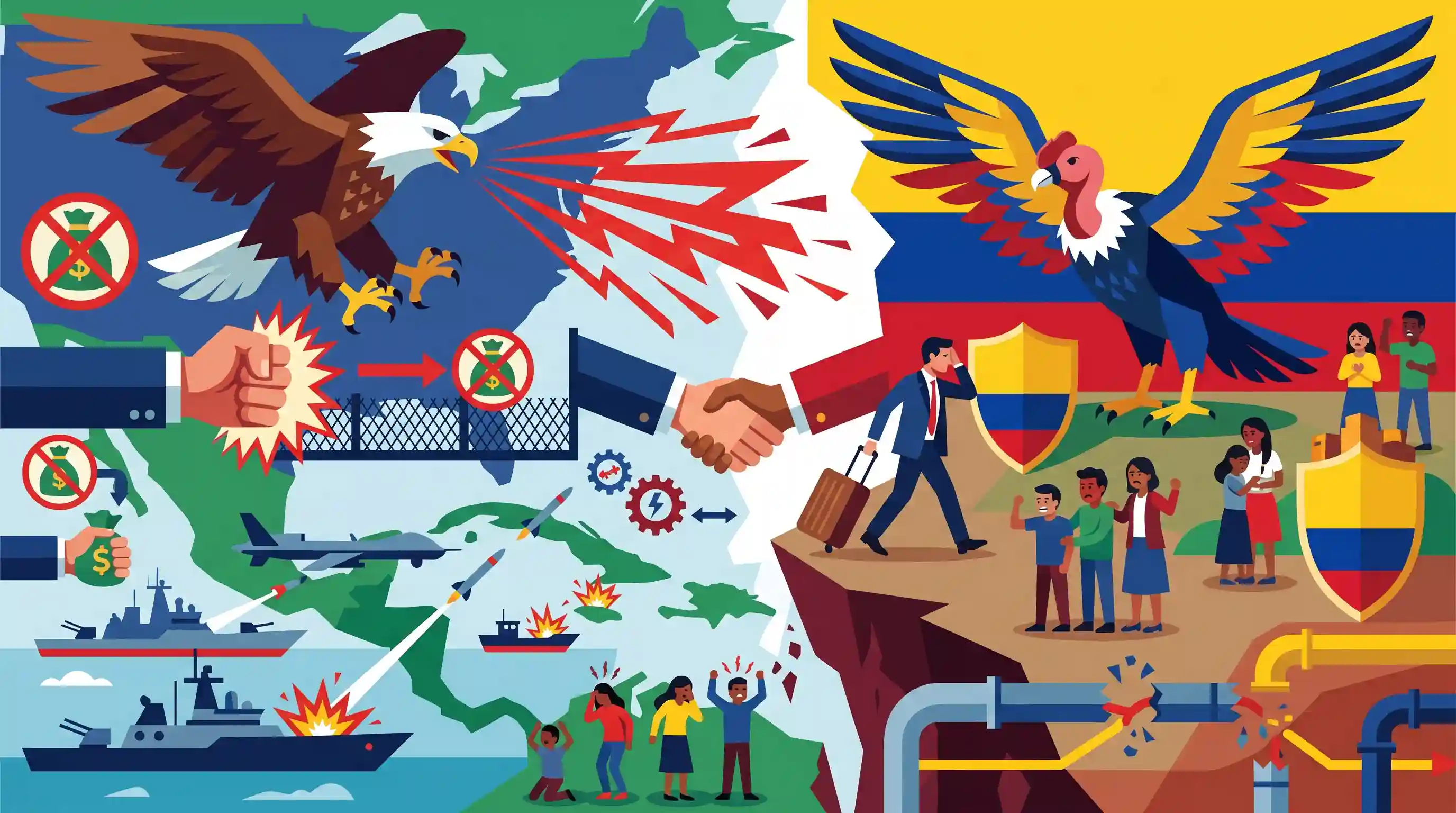
Colombia has recalled its ambassador to the United States following President Donald Trump's threats of new tariffs, suspension of financial aid, and hostile rhetoric calling Colombian President Gustavo Petro a 'drug leader'. The diplomatic fallout is further exacerbated by recent unilateral US military strikes in the Caribbean targeting alleged drug-trafficking vessels, which Colombia claims killed civilians instead of rebels. The rift highlights growing friction over sovereignty, protectionist trade policies, and cross-border anti-narcotic operations, jeopardising ties with Colombia's largest trading partner and primary source of foreign investment.
Key Points
- Colombia recalled its ambassador to the US, Daniel García-Peña, after US President Donald Trump threatened tariffs, cut aid, and labeled Colombian President Gustavo Petro a 'drug leader'.
- The diplomatic row worsened following unilateral US military strikes in the Caribbean aimed at suspected drug traffickers, which Petro asserted targeted innocent civilians rather than the ELN rebel group.
- The US is Colombia's largest trading partner, and US investors accounted for 34% of Colombia's foreign direct investment in early 2025.
- Petro's administration plans to seek international support to defend Colombian sovereignty against US interventions and economic coercion.
Important Terms
National Liberation Army (ELN)

Colombia's last major Marxist guerrilla group, active since 1964. It operates primarily along the Venezuelan border and is designated a terrorist organization by the U.S. due to alleged drug-trafficking links.
UPSC context
GS Paper III (Internal Security); tests understanding of global insurgent networks and their impact on regional stability and international relations.
USAID
The primary U.S. government agency for administering civilian foreign aid and development assistance. Its funding and operations in Colombia were reportedly suspended under the Trump administration's "America First" policy review.
UPSC context
GS Paper II (International Relations); tests knowledge of how foreign aid serves as a tool of soft power and strategic influence.
Colombian-American Chamber of Commerce
A binational business association facilitating trade and investment between Colombia and the U.S. It monitors trade flow and provides data used to evaluate the impact of bilateral diplomatic friction.
UPSC context
GS Paper III (Economy); illustrates the role of private trade bodies in influencing economic policy and navigating geopolitical friction.
DANE
Colombia’s national statistics agency responsible for collecting official economic and demographic data. It provides the official trade figures used to calculate the economic impact of tariffs and trade disputes.
UPSC context
GS Paper III (Economy); relevant for understanding the institutional framework for national statistics and data-driven policy in emerging economies.
Reciprocal Tariffs
A "tit-for-tat" trade policy where a country imposes import duties in direct response to taxes levied by a trading partner. President Petro used this as a deterrent against U.S. protectionism.
UPSC context
GS Paper III (Economy/Trade); tests knowledge of trade wars, protectionism, and the effects of unilateral economic measures on global commerce.
Prelims Trap
"Unilateral military strikes against drug vessels in foreign waters are legally justified under the UN Charter's right to self-defence."
Article 51 (self-defence) applies only to armed attacks by a State or equivalent non-state actors, not transnational crime or routine narco-trafficking. Unilateral strikes violate sovereignty.
Static Concepts Connected
What are the recognized legal grounds for military intervention in foreign territories?
- Self-Defence: Permitted under Article 51 of the UN Charter only if an actual "armed attack" occurs against a member state.
- UNSC Mandate: Interventions authorized by the UN Security Council under Chapter VII to maintain or restore international peace and security.
- Host State Consent: Intervention is lawful if the territorial host nation expressly invites or permits the foreign military operation.
How does the 'Monroe Doctrine' contrast with modern 'Active Non-Alignment'?
- Monroe Doctrine: A 19th-century US policy that claimed Latin America as an exclusive US sphere of influence, rejecting external (European) intervention.
- Active Non-Alignment: A modern Global South strategy prioritizing national interest, resisting great-power hegemony, and diversifying diplomatic and economic partnerships globally.
Cross-Topic Patterns
Economic Coercion + FDI Dependency
The US leveraging its 34% FDI share to force policy shifts exemplifies the weaponization of economic interdependence, driving Global South nations to diversify trade and seek alternatives like BRICS.
Transnational Crime + Extraterritoriality
Unilateral anti-narcotic strikes bypass host-nation sovereignty, raising international law debates similar to extraterritorial anti-terror operations (e.g., targeted strikes) conducted without host state consent.

Expect a GS-2 Mains question linking the 'weaponization of trade/FDI' to the 'Active Non-Alignment' strategy of Global South nations.
Linked PYQs · 4
Linked PYQs · 4
- 2025MainsGS3
What are the challenges before the Indian economy when the world is moving away from free trade and multilateralism to protectionism and bilateralism? How can these challenges be met?
- 2018MainsGS3
How would the recent phenomena of protectionism and currency manipulations in world trade affect macroeconomic stability of India?
- 2018MainsGS3
India's proximity to two of the world's biggest illicit opium-growing states has enhanced her internal security concerns. Explain the linkages between drug trafficking and other illicit activities such as gunrunning, money laundering and human trafficking. What counter-measures should be taken to prevent the same?
- 2025MainsGS2
"With the waning of globalization, post-Cold War world is becoming a site of sovereign nationalism.” Elucidate.
