Colombia Polarised Presidential Runoff Election Dynamics
Source:Indian Express ↗
Why It Matters
The election highlights the broader political shift in Latin America and the challenges of managing internal armed conflicts (relevance to India's own internal security issues). It also underscores the role of US influence and foreign policy in regional elections.
Summary
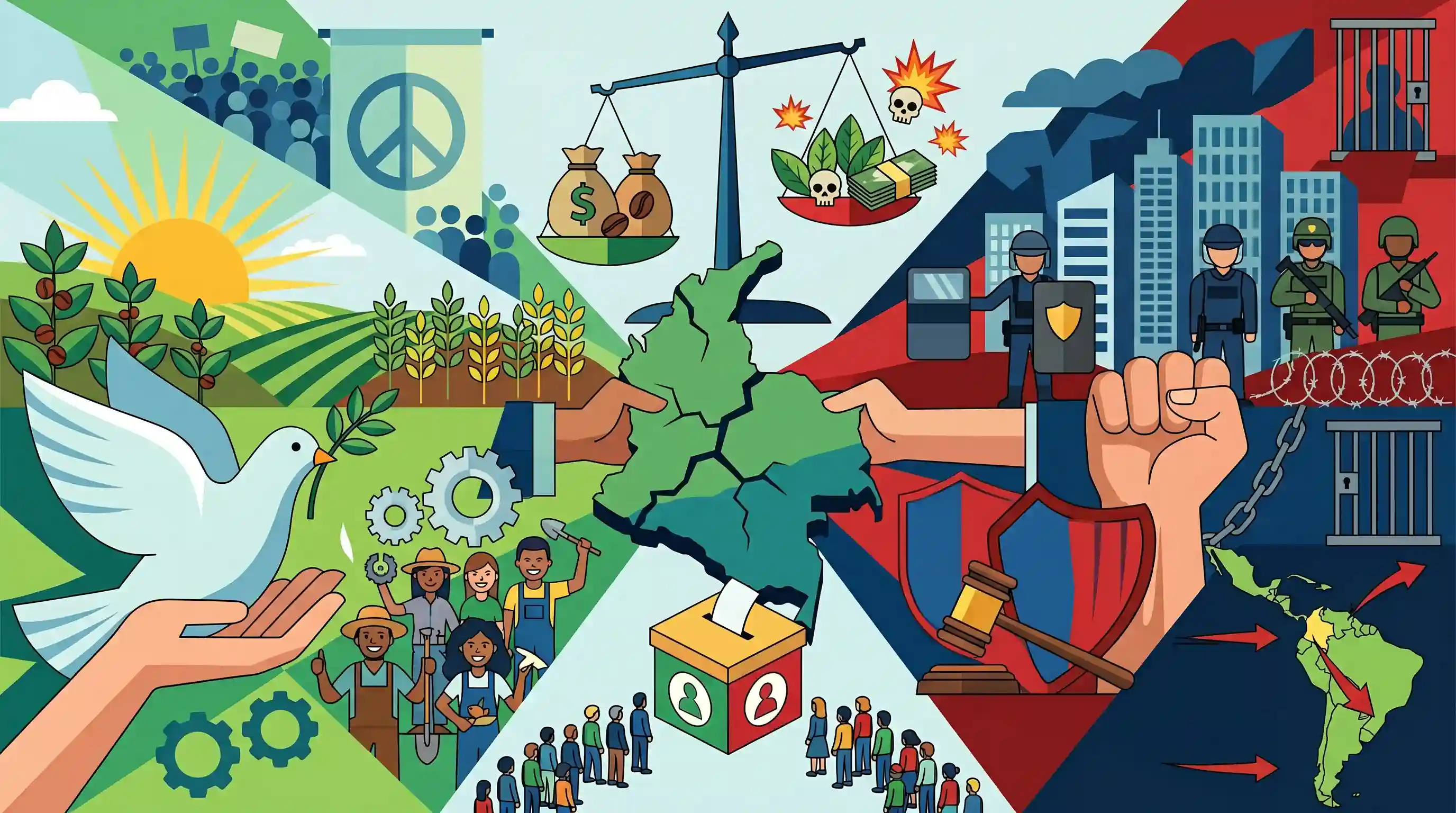
Colombia is holding a highly polarised presidential runoff between leftist senator Iván Cepeda, representing continuity of the current left-wing government's policies like the 'total peace' strategy, and right-wing lawyer Abelardo de la Espriella, who promises a tough-on-crime approach and aligns with other right-wing shifts in Latin America. The election serves as a referendum on outgoing President Gustavo Petro's administration, balancing economic growth against rising violence and drug production.
Key Points
- Colombia is facing a highly polarised presidential runoff election on June 21, 2026, between left-wing candidate Iván Cepeda and right-wing 'outsider' Abelardo de la Espriella.
- In the first round, de la Espriella secured 43.7% of the votes, while Cepeda secured 41%, requiring a runoff as neither crossed the 50% threshold.
- Cepeda is an ally of the outgoing left-wing president, Gustavo Petro, and is a key figure in the 2016 peace deal with FARC and the current 'total peace' strategy aimed at dialogue with armed groups.
- De la Espriella, endorsed by Donald Trump, advocates for a tough stance on crime, building mega-prisons, cutting state costs, and closer cooperation with the US for military support, mirroring other right-wing shifts in Latin America.
- The election is viewed as a referendum on Gustavo Petro’s presidency, which saw economic growth but also record cocaine production and worsening violence from armed groups.
Important Terms
Total Peace Strategy

A policy by President Gustavo Petro seeking comprehensive peace via simultaneous negotiations with all active armed and criminal groups, offering judicial leniency in exchange for disarmament and ending illicit activities.
UPSC context
GS Paper-II (International Relations) and GS Paper-III (Internal Security); relevant for studying peace-building models and state-sponsored reconciliation in conflict zones.
2016 Peace Deal
A landmark accord between the Colombian government and FARC rebels ending 50 years of civil war, facilitating the group's demobilization and transition into a legitimate political party.
UPSC context
GS Paper-II (International Relations); tests knowledge of international peace processes, conflict resolution, and the role of global mediation in internal security.
Historic Pact (Pacto Histórico)
A major Colombian left-wing political party (formerly a coalition) representing progressive and socialist factions. It is the ruling party under President Gustavo Petro, advocating for social justice and peace.
UPSC context
GS Paper-II (International Relations); important for analyzing political shifts in Latin America and their impact on global geopolitics and regional stability.
Revolutionary Armed Forces of Colombia (FARC)
Formerly Latin America's largest Marxist-Leninist guerrilla group. While most members demobilized after 2016, dissident factions remain active, engaging in drug trafficking and ongoing conflict with the state.
UPSC context
GS Paper-III (Internal Security); examines the evolution of non-state armed groups, organized crime links, and challenges of post-conflict reintegration.
Prelims Trap
"The 'Pink Tide' refers to a right-wing, tough-on-crime political shift in Latin America."
The 'Pink Tide' actually refers to the historic wave of left-wing, anti-neoliberal governments in Latin America, not the recent conservative shift.
Static Concepts Connected
What is the 'Pink Tide' in Latin American geopolitics?
- Meaning: A political phenomenon starting in the late 1990s where various Latin American nations elected left-leaning, socialist governments.
- Ideology: Characterized by anti-neoliberalism, wealth redistribution, nationalization of resources, and a desire to distance from US hegemony.
- Current Trend: The region frequently experiences a 'pendulum swing' between this left-wing tide and right-wing leaders emphasizing strict security and free-market economics.
How does Narco-Terrorism sustain insurgencies and Left-Wing Extremism?
- Financial lifeline: Insurgent groups (like FARC) tax or directly control illicit drug trade networks to heavily fund arms, recruitment, and logistics.
- Territorial control: Remote, forested, or underdeveloped regions provide perfect safe havens for both illicit drug cultivation and guerrilla training out of state reach.
- State subversion: Massive cartel profits are used to corrupt local governance and law enforcement, systematically weakening state authority and rule of law.
Cross-Topic Patterns
FARC peace model vs. Indian LWE
Colombia's 2016 FARC peace deal through political reintegration and agrarian reform is often cited as a comparative case study for resolving India's Naxalite insurgency in GS-3 Internal Security.
Narco-terrorism and border security
The link between coca cultivation in Colombia and insurgent violence perfectly parallels how the Golden Crescent and Golden Triangle drug trades fuel terrorism and border instability in India.

Expect Mains questions comparing Colombia's FARC deal and 'Total Peace' strategy with India's approach to Left-Wing Extremism.
Linked PYQs · 4
Linked PYQs · 4
- 2016MainsGS2
Increasing cross-border terrorist attacks in India and growing interference in the internal affairs of several member-states by Pakistan are not conducive for the future of SAARC (South Asian Association for Regional Cooperation)." Explain with suitable examples.
- 2021MainsGS2
“The USA is facing an existential threat in the form of a China, that is much more challenging than the erstwhile Soviet Union.” Explain.
- 2025MainsGS3
What are the major challenges to internal security and peace process in the North-Eastern States? Map the various peace accords and agreements initiated by the government in the past decade.
- 2020MainsGS3
What are the determinants of left-wing extremism in Eastern part of India? What strategy should Government of India, civil administration and security forces adopt to counter the threat in the affected areas?
