Supreme Court Collegium Recommends Five New Judges
Source:Indian Express ↗
Why It Matters
Understanding the Collegium system and the constitutional process of appointing Supreme Court judges is crucial for the UPSC GS Paper 2 syllabus. This includes the direct elevation of Senior Advocates to the Supreme Court bench as per constitutional qualifications (Article 124).
Summary
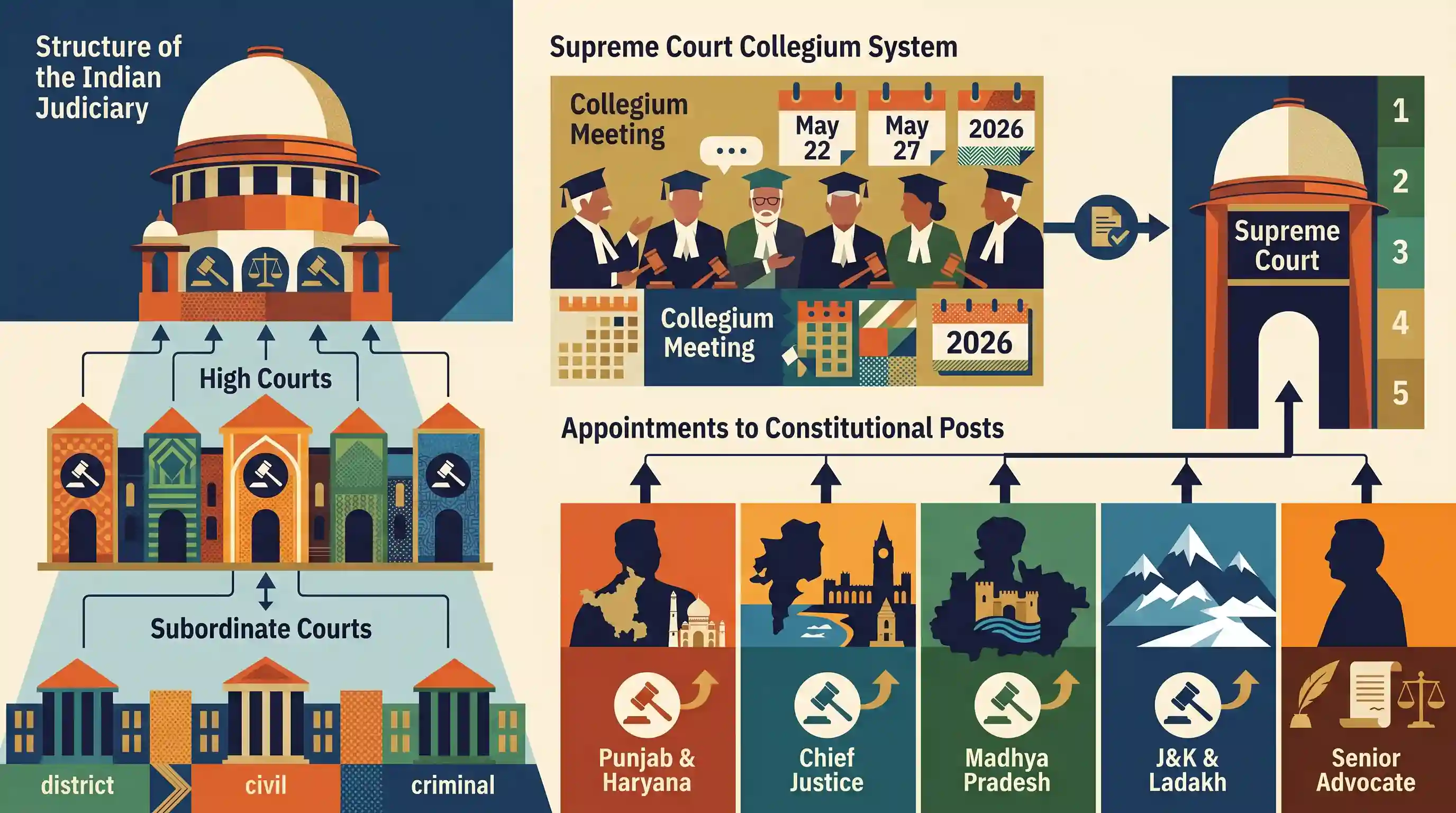
The Supreme Court Collegium has recommended five individuals for elevation to the Supreme Court of India. The recommendations, finalized after meetings on May 22 and 27, 2026, include four Chief Justices of various High Courts—Justice Sheel Nagu (Punjab & Haryana), Justice Shree Chandrashekhar (Bombay), Justice Sanjeev Sachdeva (Madhya Pradesh), and Justice Arun Palli (J&K & Ladakh)—along with Senior Advocate V Mohana.
Key Points
- The Supreme Court Collegium has recommended the elevation of five individuals as Supreme Court judges.
- The recommended candidates include four High Court Chief Justices and one Senior Advocate.
- The elevation of a Senior Advocate directly to the Supreme Court bench is a notable constitutional provision under Article 124.
Important Terms
Supreme Court Collegium

A system for the appointment and transfer of judges where the Chief Justice of India and the four senior-most Supreme Court judges recommend names to the President. It evolved through the "Three Judges Cases."
UPSC context
GS Paper II: Judiciary. Tests knowledge of judicial independence, separation of powers, and the evolution of appointment mechanisms via the Three Judges Cases.
Supreme Court of India
The highest judicial court and final court of appeal under the Constitution of India, acting as the guardian of fundamental rights and the ultimate interpreter of the Constitution.
UPSC context
GS Paper II: Structure and functioning of the Judiciary. Tests understanding of Articles 124–147 and the apex court's various jurisdictions.
Chief Justice (High Court)
The highest-ranking judge of a High Court, appointed by the President. They lead the High Court Collegium and are often elevated to the Supreme Court based on seniority and merit.
UPSC context
GS Paper II: Judiciary. Relevant for Article 217 and the 'outside-state' policy for appointing heads of state judiciaries.
Senior Advocate
A legal designation conferred by the Supreme Court or High Courts upon advocates based on their ability, standing at the bar, and legal expertise under the Advocates Act, 1961.
UPSC context
GS Paper II: Judiciary. Important for understanding the direct elevation of distinguished lawyers from the Bar to the Supreme Court Bench.
Punjab and Haryana High Court
The apex judicial body for the states of Punjab and Haryana and the Union Territory of Chandigarh, serving as a key source of judicial elevation to the Supreme Court.
UPSC context
GS Paper II: Judiciary. Tests knowledge of High Court structure and common courts for multiple territories under Article 231.
Bombay High Court
One of the oldest High Courts in India, having jurisdiction over Maharashtra, Goa, and specific Union Territories. It is a major center for constitutional and commercial litigation.
UPSC context
GS Paper II: Judiciary. Relevant for understanding territorial jurisdiction and the history of the Indian legal system.
Prelims Trap
"An advocate requires 10 years of Supreme Court practice to be directly elevated."
Article 124(3) requires being an advocate of a High Court (or multiple HCs in succession) for 10 years, not specifically the Supreme Court.
Static Concepts Connected
What are the qualifications for an SC Judge under Article 124?
- Citizenship: Must be a citizen of India.
- HC Judge: Must have been a judge of a High Court (or two or more such courts in succession) for at least five years.
- HC Advocate: Must have been an advocate of a High Court (or multiple HCs in succession) for at least ten years.
- Distinguished Jurist: Must be a distinguished jurist in the opinion of the President (this criteria applies only to SC judges, not HC judges).
How did the Collegium System evolve over time?
- First Judges Case: Established executive primacy, ruling that 'consultation' in Article 124 does not mean 'concurrence'.
- Second Judges Case: Overturned the 1981 verdict, establishing judicial primacy. Ruled 'consultation' means 'concurrence' and created the Collegium system.
- Third Judges Case: Expanded the Supreme Court Collegium to a five-member body comprising the Chief Justice of India and the four senior-most judges.
Cross-Topic Patterns
Collegium recommendations vs Executive MoP
The clearance of Collegium files by the executive often triggers separation-of-powers debates regarding the stalled finalization of the Memorandum of Procedure (MoP).
Gender Representation in the Higher Judiciary
The direct elevation of a female Senior Advocate highlights the chronic underrepresentation of women in constitutional courts, a highly recurring GS2 Mains theme.

Expect a prelims statement mixing Art 124(3) qualifications (esp. direct elevation rules) with the exact SC vs HC collegium composition.
Linked PYQs · 3
Linked PYQs · 3
- 2025MainsGS2
Discuss the evolution of collegium system in India. Critically examine the advantages and disadvantages of the system of appointment of the Judges of the Supreme Court of India and that of the USA.
- 2017MainsGS2
Critically examine the Supreme Court's judgement on 'National Judicial Appointments Commission Act, 2014' with reference to appointment of judges of higher judiciary in India.
- 2019PrelimsGS1
Consider the following statements: 1. The 44th Amendment to the Constitution of India introduced an Article placing the election of the Prime Minister beyond judicial review. 2. The Supreme Court of India struck down the 99th Amendment to the Constitution of India as being violative of the independence of judiciary. Which of the statements given above is/are correct?
