Climate Resilient Agriculture Promoted to Counter El Nino
Source:The Hindu ↗
ఇది ఎందుకు ముఖ్యం
With El Nino and climate change increasingly disrupting monsoon patterns, understanding localized adaptive strategies—such as the Pre-Monsoon Dry Sowing (PMDS) and the Half Moon Model for soil conservation—is crucial for addressing food and water security challenges in drought-prone regions.
సారాంశం
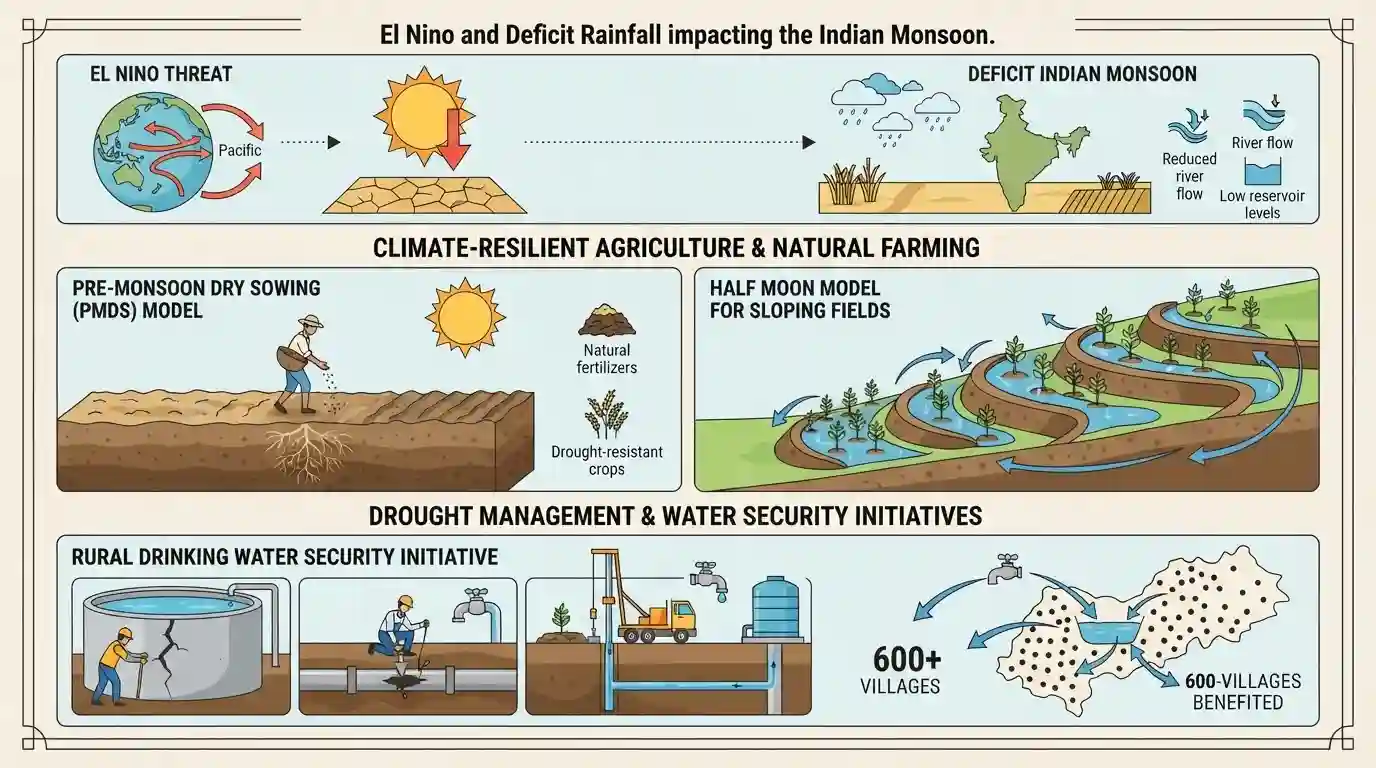
In response to the looming El Nino threat and deficit rainfall, the administration of Andhra Pradesh's Sri Sathya Sai district is pushing for climate-resilient agriculture and robust water management. District Collector A. Shyam Prasad has emphasized the adoption of the Pre-Monsoon Dry Sowing (PMDS) model under natural farming to improve soil health and mitigate drought stress. Furthermore, land conservation techniques such as the Half Moon Model are being implemented on sloping fields to retain rainwater and prevent soil erosion. To ensure drinking water security, a ₹24 crore initiative has been launched to repair reservoirs, fix pipeline leakages, and flush borewells in more than 600 villages.
ముఖ్య అంశాలు
- The Sri Sathya Sai district administration has initiated a two-pronged strategy focusing on climate-resilient agriculture and drinking water security to combat the El Nino threat and deficit rainfall.
- The Pre-Monsoon Dry Sowing (PMDS) model, operating under natural farming principles, is being propagated to improve soil health, reduce cultivation costs, and increase drought resilience.
- Soil and water conservation measures for rainfed agriculture have been deployed, including the 'Half Moon Model' for sloping fields, which helps in rainwater retention and minimises soil erosion.
- A ₹24 crore drinking water management plan was announced to address potential scarcity, covering reservoir repairs, pipeline leakages, and borewell flushing across over 600 villages in the district.
ముఖ్యమైన పదాలు
Pre-Monsoon Dry Sowing (PMDS)

A natural farming technique where a diverse mix of native seeds is sown before the monsoon using residual moisture. It maintains year-round green cover, enhances soil health, reduces cultivation costs, and builds drought resilience.
UPSC context
GS-3 (Agriculture). Crucial for questions on sustainable farming models, soil conservation, and climate adaptation strategies in India.
Half Moon Model
A soil and water conservation method using semi-circular micro-catchments on sloping fields. It intercepts surface runoff, retains rainwater, and minimizes soil erosion, making it highly effective for rainfed and semi-arid regions.
UPSC context
GS-3 (Agriculture, Environment). Highly relevant for watershed management, soil conservation, and combating land degradation and drought.
El Nino
A climate phenomenon marked by abnormal warming of the eastern tropical Pacific Ocean. It disrupts weather patterns globally and is heavily linked to deficit rainfall and drought during the Indian monsoon season.
UPSC context
GS-1 (Geography) and GS-3 (Environment). A fundamental concept for understanding Indian monsoon variability and agricultural disaster management.
ప్రిలిమ్స్ ఉచ్చు
"The Half Moon Model in Indian agriculture involves sowing crops according to specific lunar phases."
The Half Moon Model is an in-situ rainwater harvesting technique (semi-circular pits dug on slopes) for soil conservation, completely unrelated to lunar cycles.
అనుసంధానమైన స్థిర భావనలు
How does El Nino weaken the Indian Monsoon?
- Walker Circulation: It shifts eastward, creating an anomalous high-pressure system and a descending limb of dry air over the Indian subcontinent.
- Trade Winds: This atmospheric alteration suppresses cloud formation and weakens moisture-laden trade winds, leading to delayed onset and deficit rainfall.
- Positive IOD: Warmer western Indian Ocean temperatures (Positive IOD) can enhance moisture flow to India, potentially offsetting El Nino's drought-inducing effects.
What are the core principles of Pre-Monsoon Dry Sowing (PMDS)?
- Residual Moisture: It utilizes pre-monsoon showers and residual summer soil moisture to sow diverse crop mixes using pelletized seeds and bio-stimulants.
- 365-Day Cover: Maintains a continuous crop canopy to reduce soil temperature, preventing the desiccation of vital soil organic carbon.
- Living Root: Active crop roots release exudates year-round, feeding beneficial soil microbes and improving overall drought resilience.
అంతర-అంశ నమూనాలు
Agroecology as Climate Adaptation
Techniques like PMDS link natural farming with the National Mission for Sustainable Agriculture (NMSA), demonstrating how soil health directly builds drought resilience.
Traditional Tech in Topography
The 'Half Moon' model represents how slope-specific, low-cost water harvesting is increasingly prioritized in district-level disaster management to counter erratic monsoon patterns.

Expect a 2026 Prelims question pairing traditional soil conservation methods (Half Moon) and agroecological concepts (PMDS) with El Nino.
అనుసంధాన PYQలు · 3
అనుసంధాన PYQలు · 3
- 2019APPSC_PRELIMSGS1
El-Nino is a complex weather system that appears once every three to seven years. Consider the following statements in this regard : A. The appearance of warm currents off the Coast of Peru in the Eastern Pacific. B. The word El-Nino means 'Christ Child' because the current appears around Christmas in December. C. El-Nino was one of the reasons for the deficit rainfall in India (2014). Which of the statements given above is/are correct ?
- 2023APPSC_PRELIMSGS1
Given below are two statements, one labelled as Assertion (A) and the other labelled as Reason (R). Select your answer from the codes given below. Assertion (A) : National Income growth fluctuates with fluctuations in Agriculture growth in India. Reason (R) : Weather conditions, especially rains, are uncertain in India. Codes :
- 2024APPSC_PRELIMSGS1
Soil formation is controlled by the following factors: I. Parent material II. Topography III. Climate IV. Biological activity V. Time Which of the above are active factors?
