Soil Moisture Indicator: ICAR Innovation for Precision Irrigation
Source:The Hindu ↗
Why It Matters
Highlights a practical, indigenous technological intervention (Soil Moisture Indicator) by ICAR that directly addresses the challenges of water-use efficiency in agriculture. This is highly relevant for GS-3 answers discussing precision farming, technology adoption in agriculture, and solutions for water-intensive crops like sugarcane.
Summary
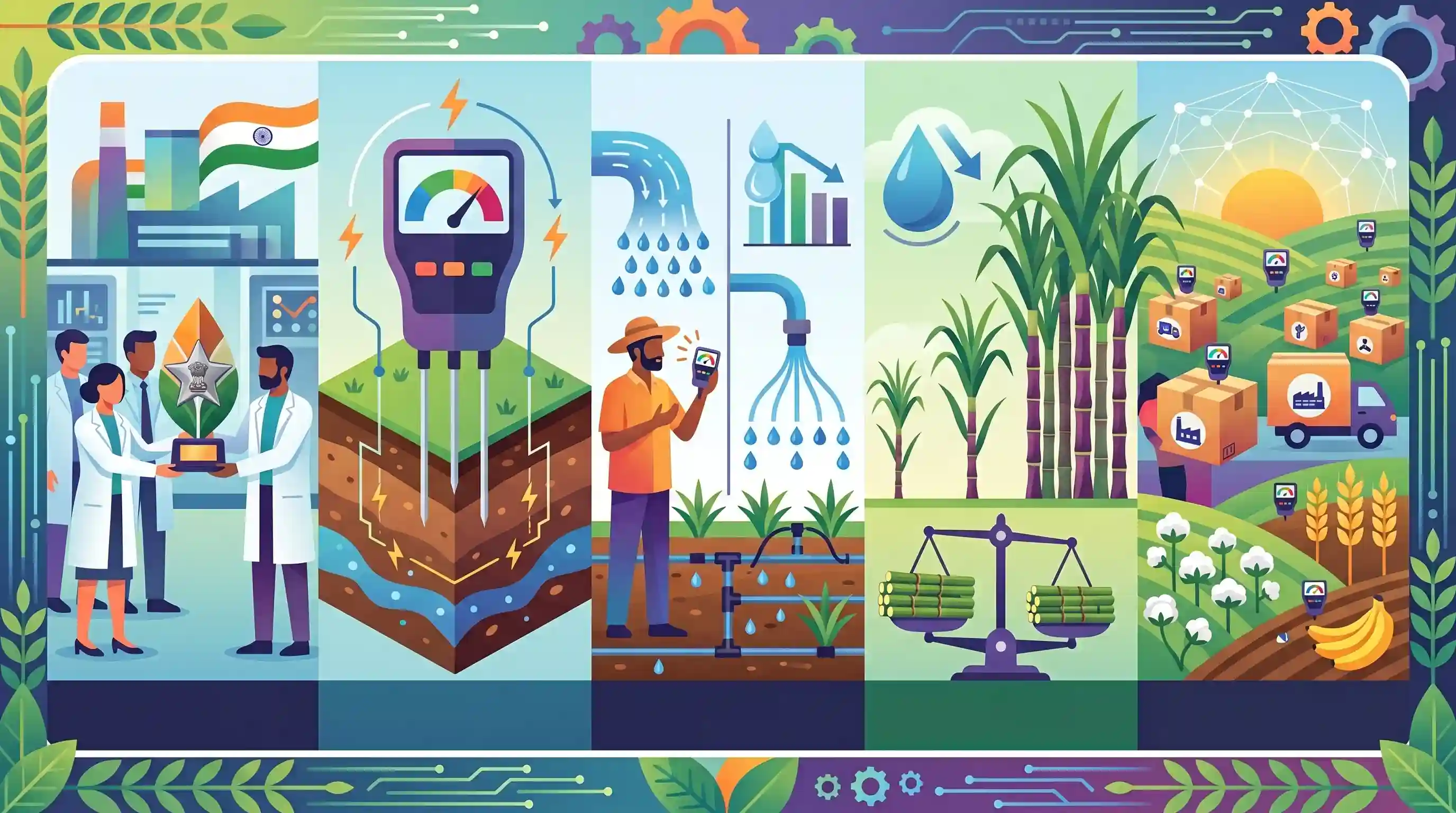
Scientists at the ICAR-Sugarcane Breeding Institute in Coimbatore have been awarded the first Rashtriya Krishi Vigyan Puraskar for their development of the 'Soil Moisture Indicator' (SMI). The device utilizes soil electrical conductivity to inform farmers of exact soil moisture levels, facilitating precise irrigation that saves approximately 15% on water usage. By preventing over-irrigation, it not only conserves resources but has also demonstrated an ability to increase sugarcane yields from 55.8 to 60.4 tonnes per acre. The widespread commercialization of this device and its application to various other crops highlights a critical step forward in Indian precision agriculture and tech-enabled water-use efficiency.
Key Points
- Scientists at the ICAR-Sugarcane Breeding Institute (SBI) won the inaugural Rashtriya Krishi Vigyan Puraskar for inventing the Soil Moisture Indicator (SMI).
- The SMI device measures soil moisture using electrical conductivity, helping farmers optimize irrigation schedules and conserve water.
- Field application of SMI saved around 15% of irrigation water and boosted sugarcane yields from 55.8 to 60.4 tonnes per acre annually.
- Beyond sugarcane, the technology is adaptable for tomatoes, bananas, and groundnuts, and is being adopted across multiple Indian states to promote precision agriculture.
Important Terms
Rashtriya Krishi Vigyan Puraskar

A national award introduced in 2025 to honor outstanding contributions in agricultural innovation, education, and extension. It recognizes researchers whose technological advancements significantly impact farmer productivity and resource conservation.
UPSC context
GS Paper 3: Science & Technology and Agriculture. Tests knowledge of national recognition frameworks for indigenous agricultural research.
Soil Moisture Indicator (SMI)
A portable electronic device that measures soil electrical conductivity to determine moisture levels. It uses color-coded LEDs to guide farmers on precise irrigation timing, saving water and improving crop yields.
UPSC context
GS Paper 3: E-technology in the aid of farmers and Water Conservation. Example of low-cost precision agriculture tools.
ICAR-Sugarcane Breeding Institute (SBI)
A premier research institute under ICAR, established in 1912 in Coimbatore. It is globally renowned for developing high-yielding 'Co' sugarcane varieties that occupy over 90% of India's sugarcane area.
UPSC context
GS Paper 3: Major crops and cropping patterns. Highlighted for its historical and contemporary role in India's Green Revolution.
Farmers' Participatory Action Research Project (FPARP)
An outreach initiative where researchers and farmers collaborate on-field to refine and demonstrate agricultural technologies. This ensures that innovations are practical, site-specific, and easily adoptable by the farming community.
UPSC context
GS Paper 3: Agricultural Extension Services. Tests understanding of bottom-up research models for technology dissemination.
Indian Council of Agricultural Research (ICAR)
An autonomous body under the Ministry of Agriculture and Farmers Welfare, responsible for coordinating agricultural research and education. It is the largest network of agricultural research and education institutes globally.
UPSC context
GS Paper 3: Institutional framework for agriculture. Apex body frequently cited in food security and R&D topics.
Ministry of Jal Shakti
Formed in 2019 by merging the Ministries of Water Resources and Drinking Water & Sanitation. It oversees national water policy, including projects for water-use efficiency in agriculture like FPARP.
UPSC context
GS Paper 2/3: Government Policies and Water Management. Relevant for 'More Crop Per Drop' and sustainable irrigation.
Prelims Trap
The Soil Moisture Indicator works by directly measuring the physical volume of water present in the soil.
It actually measures soil electrical conductivity, not physical volume. Soil electrical resistance is inversely proportional to moisture content, meaning wetter soils conduct electricity better.
Static Concepts Connected
What are the geographical requirements for sugarcane cultivation in India?
- Temperature: Requires a hot and humid climate with temperatures ideally ranging from 21°C to 27°C.
- Rainfall: Needs 75-150 cm of rainfall. It is highly water-intensive and relies heavily on irrigation in drier regions.
- Soil type: Grows best in deep rich loamy soils that can retain moisture well.
How does E-technology facilitate precision agriculture?
- Input optimization: Uses localized data to apply exact quantities of water, pesticides, and fertilizers, preventing resource wastage and environmental runoff.
- IoT integration: Leverages internet-connected sensors (like the Digital Soil Moisture Sensor) for real-time mobile crop monitoring and automated irrigation control.
Cross-Topic Patterns
Sugarcane's massive water footprint
Sugarcane needs 1500–2500 mm of water per cycle. Tech like SMI aligns directly with government efforts to mitigate groundwater depletion in sugarcane and paddy belts.
IoT in Indian agriculture
The evolution of the basic SMI into an IoT-enabled DSMS reflects a broader syllabus theme: deploying real-time data and mobile networks for climate-smart farming.

A 2026 prelims statement will likely test the scientific principle (electrical conductivity) behind precision agriculture moisture sensors.
Linked PYQs · 5
Linked PYQs · 5
- 2020MainsGS3
Suggest measures to improve water storage and irrigation system to make its judicious use under depleting scenario.
- 2024MainsGS3
What are the major challenges faced by Indian irrigation system in recent times? State the measures taken by the government for efficient irrigation management.
- 2016MainsGS3
What is water-use efficiency? Describe the role of micro-irrigation in increasing the water-use efficiency.
- 2023MainsGS3
How does e-Technology help farmers in production and marketing of agricultural produce? Explain it.
- 2011PrelimsGS1
With reference to micro-irrigation, which of the following statements is/are correct? 1. Fertilizer/nutrient loss can be reduced. 2. It is the only means of irrigation in dry land farming. 3. In some areas of farming, receding of ground water table can be checked. Select the correct answer using the codes given below:
