Microclimatic impacts of wind energy installations on agriculture
Source:The Hindu ↗
Why It Matters
As India rapidly scales up its renewable energy capacity to meet climate targets, understanding the localized environmental and microclimatic impacts of large green infrastructure projects is crucial. The conflict between local agricultural interests and clean energy promoters underscores the need for robust, location-specific Environmental Impact Assessments (EIAs).
Summary
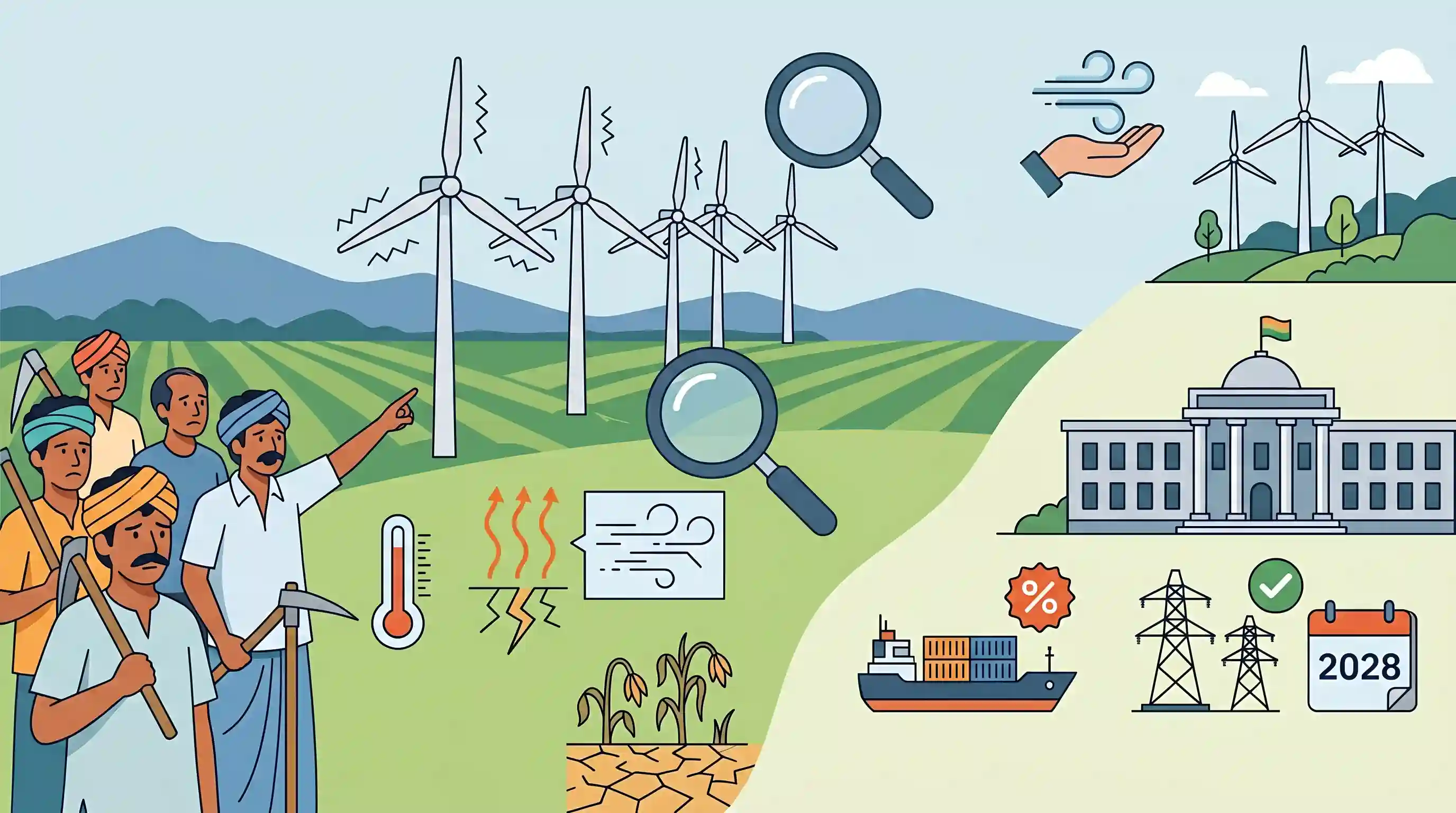
Farmers in Coimbatore, led by the Tamizhaga Vivasayigal Sangam, are urging a scientific study on the microclimatic impacts of wind turbines, disputing the Tamil Nadu Pollution Control Board's claim that they pose no environmental threat. While the government heavily promotes wind energy through initiatives like concessional customs duties and an Inter-State Transmission System (ISTS) charges waiver until 2028, farmers argue that the proliferation of turbines alters local wind speeds, increases land surface temperatures, and affects rainfall patterns.
Key Points
- Farmers under the Tamizhaga Vivasayigal Sangam are demanding a location-specific scientific study to assess the impact of wind turbines on local climate and rainfall in Southern Coimbatore.
- Farmers contend that the concentration of wind turbines increases land surface temperatures, affects rainfall patterns, and reduces local wind speeds.
- The Tamil Nadu Pollution Control Board (TNPCB) maintains that wind turbines do not cause environmental impact, which the farmers contest.
- The central government incentivizes wind farms through concessional custom duty on components and a graded waiver of Inter-State Transmission System (ISTS) charges until June 2028.
- The National Institute of Wind Energy (NIWE) provides technical support for wind energy initiatives.
Important Terms
Inter-State Transmission System (ISTS) charges waiver

A financial incentive exempting renewable energy projects from paying fees to use the national grid for transporting electricity across state lines, currently extended in graded form until 2028.
UPSC context
GS III (Energy & Infrastructure). Tests understanding of policy tools used to incentivize green energy and lower costs for power procurers.
National Institute of Wind Energy (NIWE)
An autonomous R&D institution under the Ministry of New and Renewable Energy (MNRE) providing technical support, wind resource assessment, and certification for the wind energy sector.
UPSC context
GS III (Renewable Energy). Relevant for institutional framework supporting India's 500GW non-fossil fuel capacity target by 2030.
Environmental Impact Assessment (EIA)
A statutory process to evaluate the potential environmental consequences of a proposed project before granting developmental approvals, ensuring sustainable development and mitigation of negative impacts.
UPSC context
GS III (Environment). A core topic regarding the balance between industrial growth and ecological preservation in sustainable development.
Tamil Nadu Pollution Control Board (TNPCB)
A statutory body established under the Water Act, 1974, responsible for enforcing environmental laws and monitoring industrial pollution levels within the state of Tamil Nadu.
UPSC context
GS II/III (Environment & Statutory Bodies). Tests knowledge of the decentralized structure of environmental governance and pollution management in India.
Microclimate
The local atmospheric conditions (temperature, humidity, wind) of a small, specific area that differ from the surrounding regional climate due to factors like topography or infrastructure.
UPSC context
GS I/III (Geography & Environment). Relevant for understanding localized ecological changes caused by infrastructure projects like wind farms or urban heat islands.
Prelims Trap
Large onshore wind energy projects mandate Environmental Impact Assessment (EIA) clearance before installation due to scale.
Wind energy projects fall under the CPCB's 'White' category (practically non-polluting) and are currently exempt from mandatory EIA and public hearings under the EIA Notification 2006.
Static Concepts Connected
How does the CPCB categorize industries for environmental clearances?
- Pollution Index (PI): The Central Pollution Control Board classifies industries into Red, Orange, Green, and White based on a Pollution Index (PI) assessing emissions, effluents, and hazardous wastes.
- White Category: Projects with a PI up to 20 (like wind and solar farms) are practically non-polluting and exempt from EIA and 'Consent to Operate' requirements.
- Red Category: Highly polluting industries with a PI of 60 and above, requiring strict Environmental Impact Assessments and monitoring.
How do wind turbines alter the local microclimate?
- Vertical Mixing: Turbine blades churn the atmospheric boundary layer, bringing warmer air down to the surface, which notably raises near-surface temperatures at night.
- Kinetic Extraction: Large arrays extract significant kinetic energy from the wind, reducing downstream wind speeds and potentially disrupting local evaporation and convective rainfall patterns.
Cross-Topic Patterns
Clean Energy vs. Ecological Footprint
The wind-microclimate debate parallels the Supreme Court's mandate on undergrounding transmission lines in Rajasthan to protect the Great Indian Bustard, highlighting the localized ecological costs of 'green' energy.
ISTS Waivers & Grid Parity
The graded ISTS waiver until 2028 is a critical fiscal tool to evacuate power from resource-rich states like Tamil Nadu to demand centers without ballooning DISCOM costs.

Expect a Prelims statement linking CPCB's 'White' category exemptions with emerging microclimatic concerns of renewable energy projects.
Linked PYQs · 4
Linked PYQs · 4
- 2014MainsGS3
Environmental Impact Assessment studies are increasingly undertaken before a project is cleared by the Government. Discuss the environmental impacts of coal-fired thermal plants located at coal pitheads.
- 2020MainsGS3
Describe the benefits of deriving electric energy from sunlight in contrast to the conventional energy generation. What are the initiatives offered by our Government for this purpose?
- 2022MainsGS3
Do you think India will meet 50 percent of its energy needs from renewable energy by 2030 ? Justify your answer. How will the shift of subsidies from fossil fuels to renewables help achieve the above objective ? Explain.
- 2024MainsGS3
What role do environmental NGOs and activists play in influencing Environmental Impact Assessment (EIA) outcomes for major projects in India? Cite four examples with all important details.
