New Labour Rules Implemented to Standardize Wages in Rajasthan
Source:udaipurtimes ↗
Why It Matters
Labor reforms are a critical component of state economy and governance. The implementation of the central Labor Codes via state-specific rules impacts industrial investment, worker welfare, and ease of doing business. Understanding these statutory changes is essential for RPSC RAS aspirants covering State Government policies and socio-economic development.
Summary
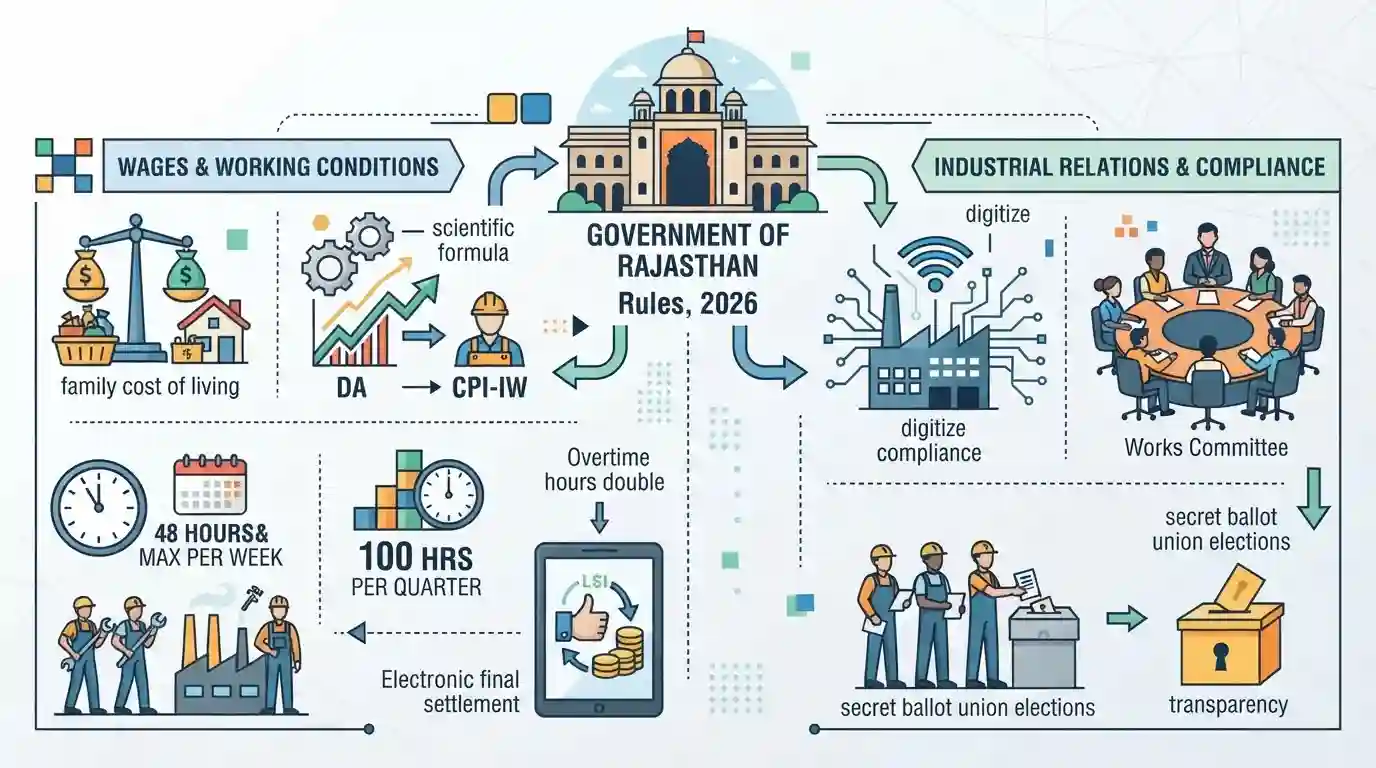
The Government of Rajasthan has implemented the Code on Wages (Rajasthan) Rules, 2026 and the Rajasthan Industrial Relations Rules, 2026 to strengthen labour welfare and streamline industrial relations. The new rules introduce a scientific formula for calculating minimum wages based on the cost of living for a standard working-class family and mandate linking Dearness Allowance (DA) to the Consumer Price Index for Industrial Workers (CPI-IW). The rules also define normal working hours, cap the weekly limit at 48 hours, double the overtime limit to 100 hours per quarter, and ensure swift, electronic final settlement of wages. Concurrently, the Industrial Relations Rules digitize compliance, mandate Works Committees for large establishments, and enforce secret ballots for trade union elections to promote transparency.
Key Points
- The Rajasthan government has enacted new rules under the Code on Wages to standardize minimum wage calculation based on a family of 3.3 consumption units and link Dearness Allowance (DA) to the CPI-IW.
- The daily working limit is capped at 10.5 hours (including rest) with a maximum of 48 hours per week, while the quarterly overtime limit has been increased from 50 to 100 hours.
- Under the newly implemented rules, final wage settlement must be completed electronically within two days of an employee's separation.
- The Rajasthan Industrial Relations Rules, 2026 introduce online portal registrations, digitised dispute resolution, and mandate Works Committees in establishments with 100 or more workers.
- A secret ballot process has been mandated for the election of trade unions to ensure transparency and accountability.
Important Terms
Code on Wages (Rajasthan) Rules, 2026

State-level rules operationalizing the central Code on Wages, 2019. They introduce scientific minimum wage calculation, cap working hours at 48 per week, link DA to the CPI-IW, and mandate transparent digital compliance.
UPSC context
GS Papers 2 & 3. Important for understanding cooperative federalism and the state-level execution of national labour reforms.
Rajasthan Industrial Relations Rules, 2026
State rules designed to streamline industrial dispute resolution and trade union administration. They mandate electronic grievance settlements, establish Works Committees for large enterprises, and enforce secret ballots for union elections.
UPSC context
GS Papers 2 & 3. Crucial for understanding state-level ease of doing business, dispute resolution frameworks, and labour union rights.
Labour Bureau
An attached office under the Ministry of Labour & Employment that compiles national labour statistics. It publishes the Consumer Price Index for Industrial Workers (CPI-IW) to guide wage and Dearness Allowance calculations.
UPSC context
GS Paper 3 (Economy). Highly relevant for Prelims; tests knowledge of inflation metrics, wage frameworks, and government statistical bodies.
Prelims Trap
The Union government directly and exclusively notifies the operational rules for the four Labour Codes across India.
Labour is a Concurrent List subject. While Parliament enacted the broad Labour Codes, State governments must formulate and notify their own rules to operationalize them locally.
Static Concepts Connected
How is 'Labour' distributed in the Constitution's Seventh Schedule?
- Concurrent List: Trade unions, industrial and labour disputes, and welfare of labour fall under the Concurrent List (List III).
- Legislative Power: Both Parliament and States can enact laws, but Central laws prevail in case of a conflict, subject to Presidential assent for State laws (Article 254).
- DPSP Link: Article 43 directs the State to secure a living wage, decent working conditions, and social opportunities for all workers.
What is the Consumer Price Index for Industrial Workers (CPI-IW)?
- Compiler: It is compiled and released monthly by the Labour Bureau under the Ministry of Labour & Employment.
- Primary Utility: It is primarily used to calculate Dearness Allowance (DA) for central government employees and to revise minimum wages in scheduled employments.
- Base Year: The current base year for CPI-IW is 2016, which was updated from the previous base year of 2001 to reflect newer consumption patterns.
Cross-Topic Patterns
Labour Codes + Cooperative Federalism
Parliament enacted the four Labour Codes in 2019-20, but nationwide implementation remains stalled until all states notify respective rules, highlighting the friction and dependency inherent in Concurrent List subjects.
CPI-IW + Inflation Targeting
Linking the minimum wage explicitly to CPI-IW bridges industrial welfare with macroeconomic dynamics, providing an automatic stabilizer that protects industrial workers' real wages against urban inflation shocks.

Expect a 2026 prelims question combining CPI-IW base year facts, the Labour Bureau's role, and Concurrent List rule-making mechanics.
Linked PYQs · 2
Linked PYQs · 2
- 2024RPSC_PRELIMSGS1
Worker to Population Ratio (WPR) is –
- 2016RPSC_PRELIMSGS1
India's unemployment and poverty estimates are based on
