Socioeconomic precarity and urban youth digital activism in India
Source:Indian Express ↗
Why It Matters
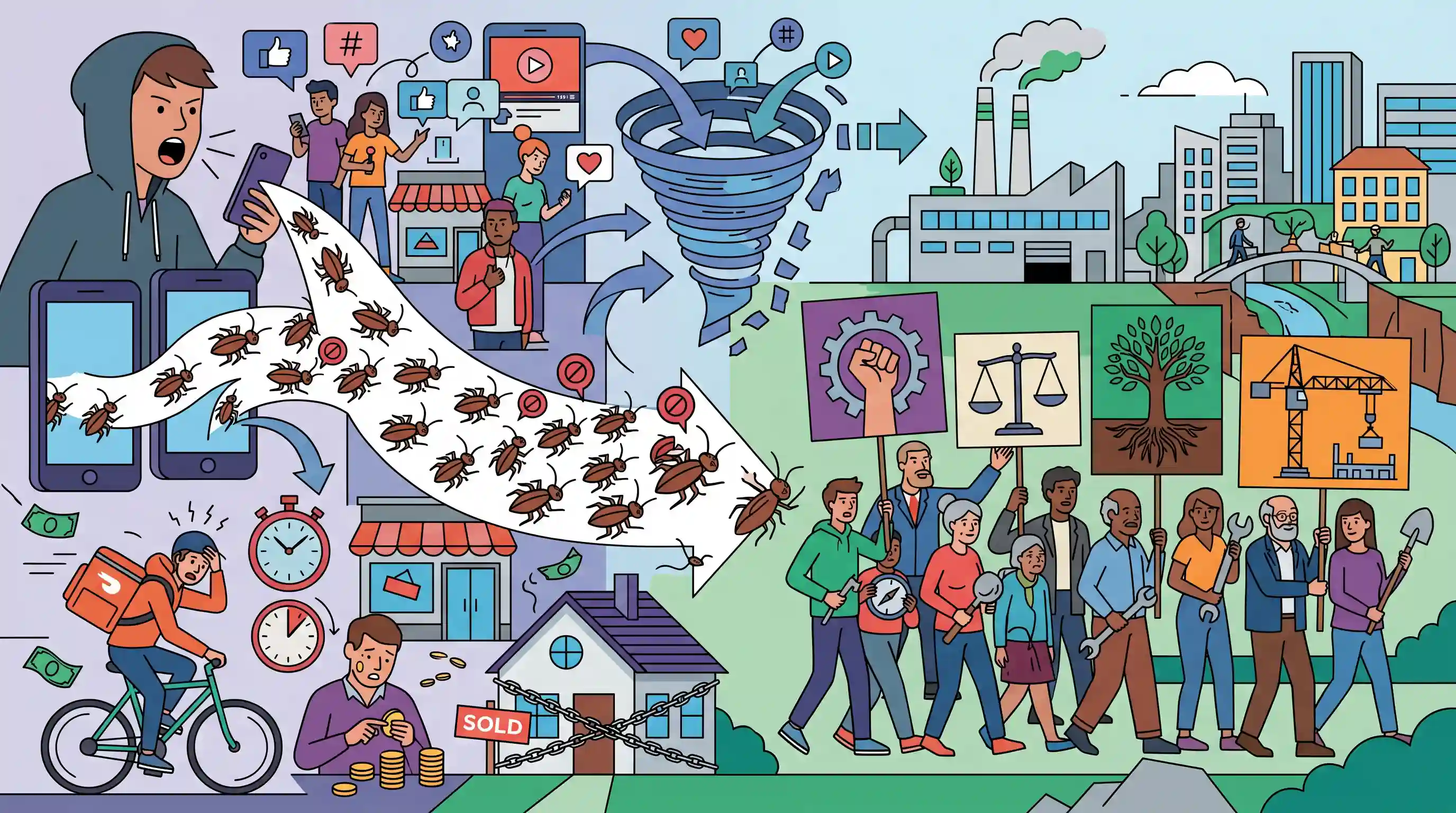
Highlights the shifting nature of youth political participation in the digital age, illustrating how socio-economic precarity (like gig work and unemployment) shapes urban middle-class activism, and warns of the limitations of performative social media dissent.
Summary
The article critiques the 'Cockroach Janta Party' phenomenon—a social media rebellion by urban Gen Z in response to CJI Surya Kant's alleged 'cockroaches' remark. It argues that this digital activism is a cultural performance driven by middle-class anxieties over unemployment, the gig economy, and vanishing privileges, rather than genuine solidarity with marginalized groups. The author emphasizes that this 'Instagramisation of politics' reduces activism to aesthetic branding and online identity, warning that without transitioning into organized democratic structures focused on labour rights and social justice, this digital alienation remains trapped in algorithms and will fail to achieve transformative change.
Key Points
- The 'Cockroach Janta Party' emerged as an online rebellion by urban youth reacting to CJI Surya Kant's alleged 'cockroach' remarks.
- The movement reveals the 'Instagramisation of politics,' where resistance is consumed visually, and online posting substitutes real, collective democratic organization.
- This political awakening is rooted in 'class panic' due to rising middle-class insecurity, such as unemployment and the instability of the gig economy, rather than class solidarity with structurally oppressed groups.
- Social media algorithms reward emotional intensity and outrage without ideological clarity, reducing activism to mere identity curation.
- To be effective, this scattered digital alienation must evolve into grounded political consciousness centered on labour rights, public education, and democratic accountability.
Important Terms
Cockroach Janta Party (CJP)

A satirical youth-led digital movement in India founded in 2026. It weaponizes humor and meme culture to protest high graduate unemployment and institutional apathy.
UPSC context
GS II (Governance/Social Justice) and GS III (Economy). Tests understanding of new-age political mobilization and demographic challenges.
Instagramisation of Politics
The shift of political discourse toward aesthetic, short-form digital content. It prioritizes viral branding and personal identity over sustained grassroots mobilization or ideological depth.
UPSC context
GS II (Role of Social Media) and GS IV (Ethics). Explores the impact of digital algorithms on democratic participation.
Gig Economy
A labor market characterized by temporary, flexible jobs and independent contractors. In India, it symbolizes the precariousness of modern employment for urban youth.
UPSC context
GS III (Employment/Growth). Crucial for discussing labor reforms and the "precaritization" of the Indian workforce.
Middle-Class Insecurity
Economic anxiety among urban professionals whose educational degrees no longer guarantee social mobility. It often drives defensive, identity-based digital activism.
UPSC context
GS I (Society) and GS III. Explains shifting social structures and political behavior of the Indian middle class.
Democratic Organization
Formalized collective action (e.g., trade unions, parties) with structured hierarchies and long-term goals, contrasted with fleeting, unorganized digital "flash" movements.
UPSC context
GS II (Pressure Groups/Civil Society). Tests the ability to distinguish between performative activism and structural reform.
Prelims Trap
Gig and platform workers are classified as 'employees' under the new Labour Codes, entitling them to fixed minimum wages.
The Code on Social Security 2020 recognizes gig workers but keeps them outside the traditional employer-employee definition, meaning standard minimum wage laws do not apply.
Static Concepts Connected
How does the Code on Social Security (2020) address gig workers?
- Definition: Recognizes them as workers earning outside traditional employer-employee relationships.
- Funding: Mandates a Social Security Fund for gig workers financed by aggregator contributions (1-2% of turnover).
- Exclusions: Does not grant traditional statutory benefits like fixed minimum wages, overtime, or formal collective bargaining.
What are the core metrics of the Periodic Labour Force Survey (PLFS)?
- Nodal Agency: Conducted by the National Statistical Office (NSO) under the Ministry of Statistics and Programme Implementation (MoSPI).
- Frequency: Provides quarterly unemployment data for urban areas and annual estimates for both rural and urban sectors.
- Key Indicators: Tracks Labour Force Participation Rate (LFPR), Worker Population Ratio (WPR), and the Unemployment Rate (UR).
Cross-Topic Patterns
Gig Economy + Demographic Dividend
High urban youth unemployment drives educated graduates into the informal gig sector, risking India's demographic dividend and triggering structural 'class panic'.
Attention Economy + Social Fabric
The algorithmic amplification of outrage links GS-3 (Tech) to GS-1 (Society), showing how digital 'slacktivism' replaces actual grassroots democratic movements and deepens urban alienation.

Gig economy social security gaps (Code on Social Security 2020) and PLFS urban youth unemployment data are prime targets for GS-3 in 2026.
Linked PYQs · 4
Linked PYQs · 4
- 2021MainsGS1
Examine the role of 'Gig Economy' in the process of empowerment of women in India.
- 2025MainsGS2
Civil Society Organizations are often perceived as being anti-State actors than non-State actors. Do you agree? Justify.
- 2023MainsGS1
Child cuddling is now being replaced by mobile phones. Discuss its impact on the socialization of children.
- 2024MainsGS3
Social media and encrypting messaging services pose a serious security challenge. What measures have been adopted at various levels to address the security implications of social media? Also suggest any other remedies to address the problem.
