Protests Continue Over Public Examination Irregularities in India
Source:The Hindu ↗
Why It Matters
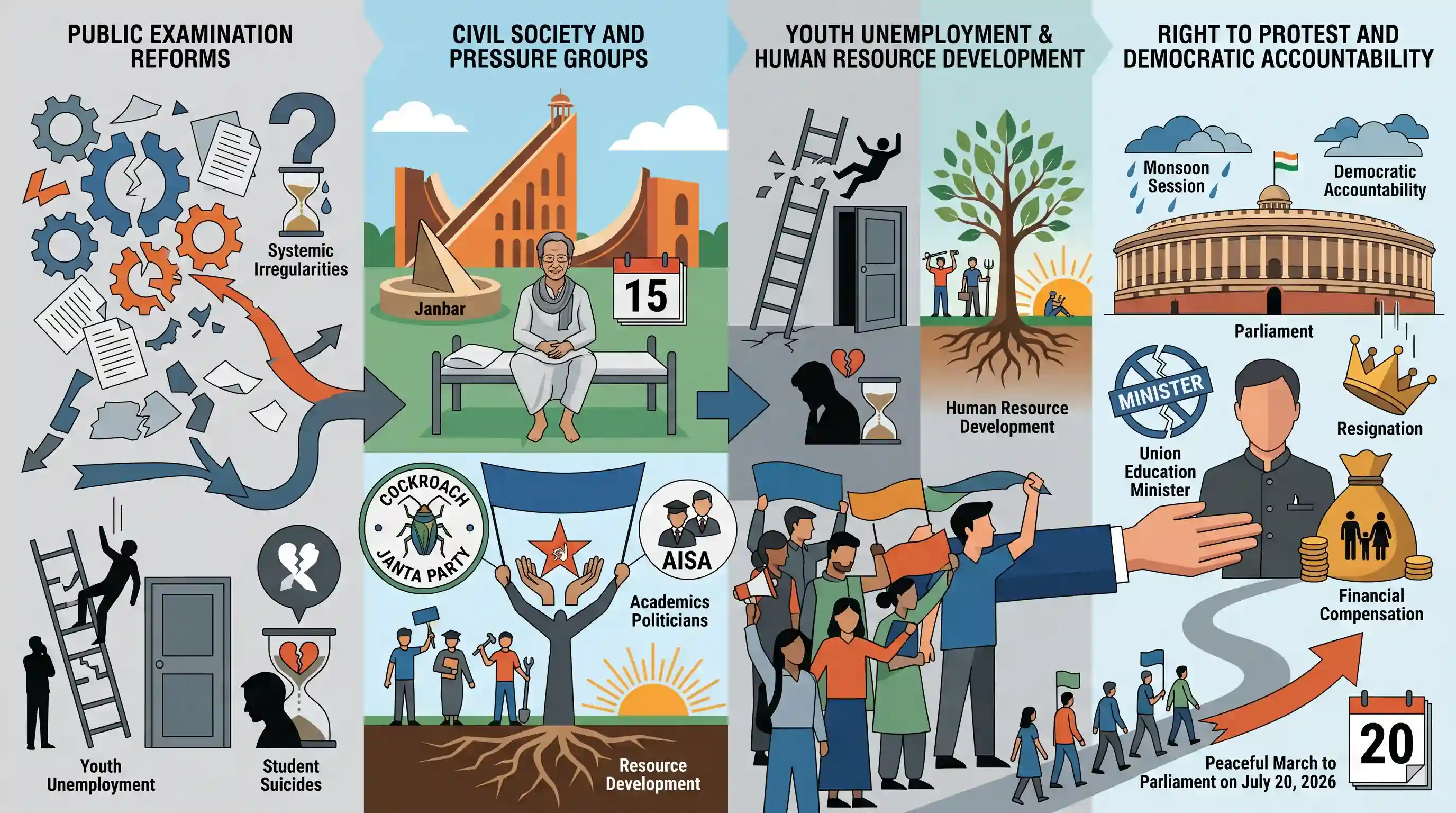
This issue highlights the critical governance challenges surrounding public examinations and national regulatory bodies like the NTA. It links directly to the socio-economic distress of youth unemployment, mental health issues among students, and the role of informal pressure groups/civil society activists in holding the administration accountable through peaceful democratic tools like hunger strikes and marches.
Summary
On July 12, 2026, climate activist and educator Sonam Wangchuk's health deteriorated further on the 15th day of his indefinite hunger strike at Jantar Mantar, New Delhi [1.1]. He is protesting alongside the Cockroach Janta Party (CJP) against systemic irregularities in national public examinations [1.1]. The movement, which has garnered support from politicians, student groups like AISA, and academics, demands the resignation of Union Education Minister Dharmendra Pradhan and financial compensation for families of student suicide victims [1.1]. The group is planning a peaceful march to Parliament on July 20, 2026, the first day of the Monsoon Session [1.1].
Key Points
- Sonam Wangchuk's health deteriorated significantly (blood pressure dropping to 104/66 mm Hg and losing 7.8 kg) on the 15th day of his indefinite hunger strike in solidarity with the student protest.
- The protest, led by the Cockroach Janta Party (CJP) at Jantar Mantar, reached its 23rd day, drawing support from regional political leaders, student bodies like AISA, and public intellectuals.
- The agitators are protesting systemic irregularities in national-level examinations (such as NEET/UGC-NET), demanding the resignation of Union Education Minister Dharmendra Pradhan, and seeking Rs 1 crore compensation for families of students who died by suicide.
- Protesters have scheduled a peaceful march to the Parliament on July 20, 2026, coinciding with the opening day of the Monsoon Session, to urge legislators to address examination integrity.
- Economist Jayati Ghosh delivered a lecture titled 'The Economics of Unemployment' at the protest site, highlighting the direct linkage between competitive examination failures and India's structural youth employment crisis.
Important Terms
National Testing Agency

An autonomous, self-sustained premier testing organization under the Ministry of Education established in 2017 to conduct standardized, transparent entrance examinations (e.g., JEE, NEET, UGC-NET) for higher educational institutions in India.
UPSC context
GS Paper II (Polity & Governance) and GS Paper III (Education/HRD); tests knowledge of statutory/autonomous bodies, public administration, and educational reform.
Public Examinations (Prevention of Unfair Means) Act, 2024
A central legislation enacted to curb cheating, paper leaks, and organized malpractices in public examinations. It provides stringent, non-bailable penalties including heavy fines and multi-year imprisonment for offenders and institutional accomplices.
UPSC context
GS Paper II (Governance) and GS Paper IV (Ethics); tests understanding of legal mechanisms, administrative transparency, and ethical accountability in public systems.
Cockroach Janta Party
A satirical, youth-led Indian political movement founded in May 2026 to protest graduate unemployment, examination leaks, and societal neglect. It was sparked by a controversial courtroom remark comparing activist youth to cockroaches.
UPSC context
GS Paper II (Civil Society & Pressure Groups); tests analytical understanding of citizen-led digital movements, youth dissent, and unconventional public advocacy techniques.
Communist Party of India (Marxist-Leninist) Liberation
A communist political party in India born out of the 1967 Naxalbari uprising. Unlike militant factions, it operates as a recognized state party participating in mainstream electoral democracy and legislative processes.
UPSC context
GS Paper II (Political Parties) and GS Paper III (Internal Security); tests knowledge of party systems, ideologies, and historical left-wing political movements.
All India Students' Association
A left-wing student organization in India affiliated with the CPI(ML) Liberation, advocating for student rights, campus democracy, and resistance against educational commercialization and political fascism across major national universities.
UPSC context
GS Paper II (Pressure Groups and Student Movements); tests knowledge of informal youth political mobilization and interest group dynamics in Indian campuses.
Samajwadi Party
A prominent Indian state political party based primarily in Uttar Pradesh, founded in 1992 by Mulayam Singh Yadav, adhering to social-democratic principles and advocating for marginalized castes and secularism.
UPSC context
GS Paper II (Electoral Politics & Regional Parties); tests comprehension of regional political forces, coalition dynamics, and caste-based political mobilization in India.
Prelims Trap
The Sixth Schedule can be extended to a new territory like Ladakh solely through a Presidential notification.
Extending the Sixth Schedule to a new territory outside the existing four states requires a constitutional amendment passed by Parliament.
Static Concepts Connected
What are the key provisions of the Public Examinations (Prevention of Unfair Means) Act, 2024?
- Targeted entities: Applies to central exam conducting authorities including NTA, UPSC, SSC, and RRBs to prevent unfair practices.
- Nature of offenses: All offenses under the Act are categorized as cognizable, non-bailable, and non-compoundable.
- Stringent punishments: Prescribes up to 10 years imprisonment and a minimum fine of ₹1 crore for organized paper leaks.
Which states are covered under the Sixth Schedule and what powers do Autonomous District Councils (ADCs) hold?
- Geographic coverage: Applies exclusively to tribal areas in Assam, Meghalaya, Tripura, and Mizoram under Articles 244(2) and 275(1).
- Legislative powers: ADCs can make laws on land, forests, water channels, village administration, and inheritance with Governor's assent.
- Judicial authority: Empowered to constitute village councils or courts to try trials/suits between Scheduled Tribe members.
Cross-Topic Patterns
Pressure groups and administrative reforms
Civil society movements bridging environmental and education issues demonstrate how informal pressure groups shape state accountability and legislative reforms under GS2.
Demographic dividend and educational integrity
Systemic leaks in competitive examinations directly undermine India’s human resource development, turning a potential demographic dividend into structural youth unemployment and crisis.

Expect a 2026 GS2 question on how civil society pressure groups catalyze policy reforms in public sector examination systems and employment.
Linked PYQs · 5
Linked PYQs · 5
- 2017MainsGS2
How do pressure groups influence Indian political process? Do you agree with this view that informal pressure groups have emerged as more powerful than formal pressure groups in recent years?
- 2025MainsGS2
Civil Society Organizations are often perceived as being anti-State actors than non-State actors. Do you agree? Justify.
- 2014MainsGS3
While we flaunt India's demographic dividend, we ignore the dropping rates of employability. What are we missing while doing so? Where will the jobs that India desperately needs come from? Explain.
- 2023MainsGS3
Most of the unemployment in India is structural in nature. Examine the methodology adopted to compute unemployment in the country and suggest improvements.
- 2023MainsGS2
Skill development programmes have succeeded in increasing human resources supply to various sectors. In the context of the statement analyse the linkages between education, skill and employment.
