Coalition politics dynamics in Tamil Nadu
Source:Indian Express ↗
Why It Matters
Understanding coalition dynamics is crucial for UPSC GS Paper 2, as it directly relates to the functioning of Indian democracy, the interplay between national and regional political parties, and its broader impact on federalism and state autonomy.
Summary
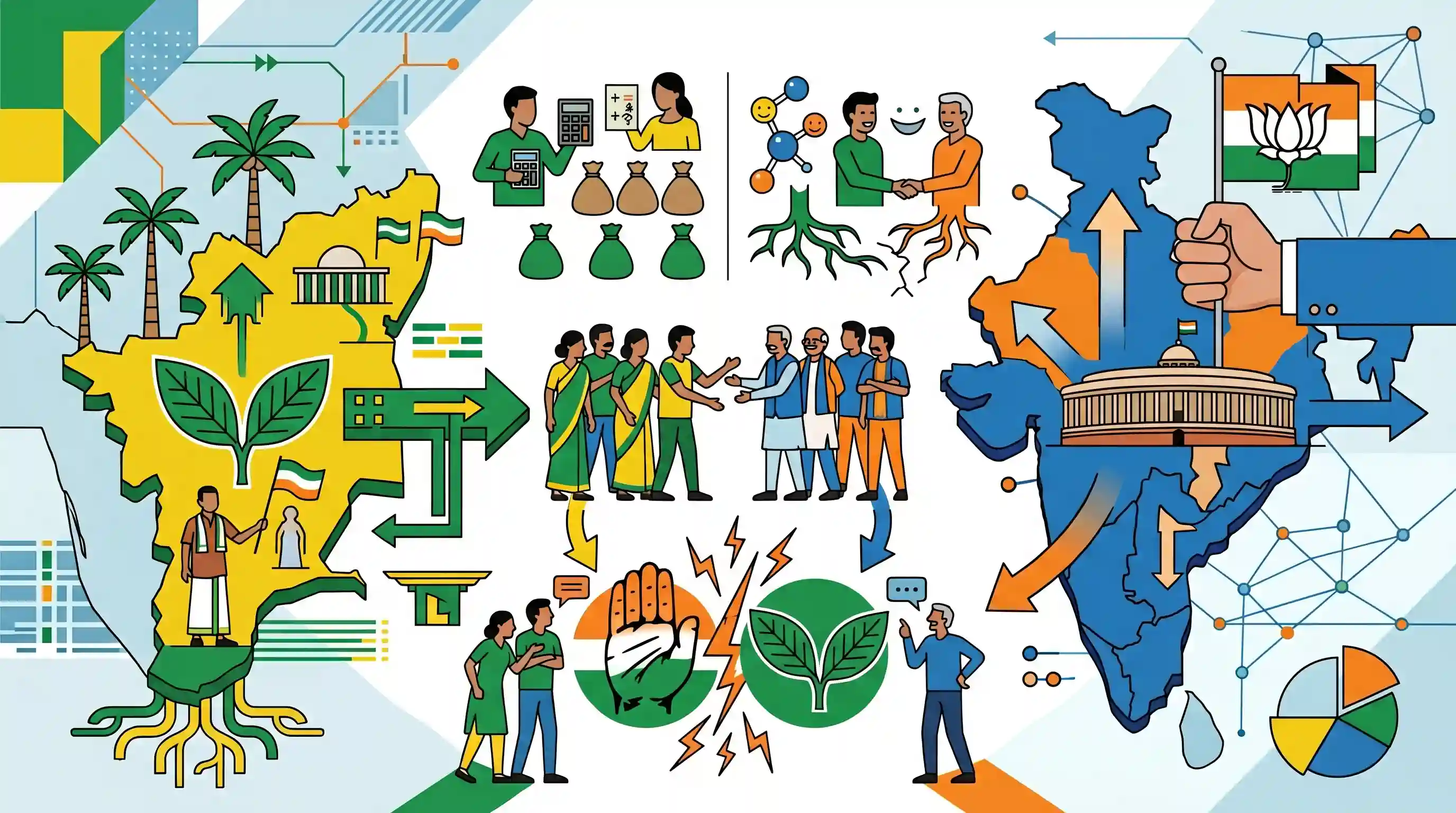
The article discusses the complexities of coalition politics in India, using the strained alliance between the BJP and AIADMK in Tamil Nadu as a case study. It emphasizes that successful alliances require not just electoral 'arithmetic' (combining vote shares) but also 'chemistry' (ideological and grassroots synergy). The breakdown of this relationship reflects the ongoing tension between national parties aiming for centralization and regional expansion, and regional parties striving to maintain their dominance and state autonomy. This friction highlights a transitional phase in the Indian party system, impacting federal dynamics and regional representation.
Key Points
- The article analyzes the intricacies of coalition politics in India, focusing on the friction between national parties seeking expansion and regional parties protecting their turf.
- It highlights the specific dynamics of the BJP-AIADMK alliance in Tamil Nadu, illustrating the breakdown of coalition 'chemistry' despite potential mathematical advantages in 'arithmetic'.
- The narrative reflects broader themes of centralisation vs. state autonomy, demonstrating how regional powers resist assimilation or dominance by national forces.
- Such political alignments have profound implications on federal relations and the multi-party democratic structure of India.
Important Terms
Coalition Government

A governance arrangement where multiple political parties cooperate to form a majority, typically based on a Common Minimum Programme rather than a single ideology.
UPSC context
Relevant for GS Paper II (Polity); tests understanding of power-sharing, multi-party systems, and federal stability.
Regional Parties
Political entities that operate within specific states, prioritizing regional identity, linguistic autonomy, and local developmental needs over national-level agendas.
UPSC context
Key for GS Paper II; examines their role as counterweights to centralization and their impact on federalism.
Federalism
The constitutional division of powers between the Union and the States, characterized in India by a 'quasi-federal' structure with a strong central bias.
UPSC context
Core topic for GS Paper II; tests knowledge of the Seventh Schedule and the tension between centralization and autonomy.
Bharatiya Janata Party (BJP)
India's dominant national party, rooted in the Bharatiya Jana Sangh (1951); it advocates for 'Integral Humanism' and often emphasizes national integration and centralized governance.
UPSC context
GS Paper II; illustrates the role of national parties in shaping centralizing policies and national political trends.
AIADMK
A major Dravidian regional party in Tamil Nadu founded in 1972; it emphasizes social justice, regional autonomy, and welfare-driven populism ('Annaism').
UPSC context
GS Paper II; serves as a case study for regional party dynamics and their bargaining power in national coalitions.
Centre-State Relations
The administrative, legislative, and financial interactions between the Union and States, often influenced by the shifting alliances between national and regional political players.
UPSC context
GS Paper II; focuses on the constitutional framework and practical friction points in India's governance.
Prelims Trap
The Constitution of India explicitly defines the criteria for recognizing National and State political parties.
The Constitution does not define party recognition. The Election Commission sets these criteria under the Election Symbols (Reservation and Allotment) Order, 1968.
Static Concepts Connected
What are the core conditions for ECI recognition as a State Party?
- Vote + Seat rule: Secure 6% of valid votes in State Assembly elections plus 2 MLAs, OR 6% in Lok Sabha elections from the state plus 1 MP.
- Assembly seat rule: Win at least 3% of the total number of seats in the State Assembly or 3 seats, whichever is more.
- Vote-only rule: Secure 8% of total valid votes polled in the state during Lok Sabha or Assembly elections, irrespective of winning any seats.
How do coalition governments structurally impact India's Centre-State relations?
- Policy decentralization: Regional coalition partners compel the Union government to accommodate state-specific socio-economic demands into national policy frameworks.
- Article 356 restraint: Reliance on regional allies for parliamentary majority historically reduces the arbitrary imposition of President's Rule on opposition-ruled states.
- Institutional reliance: Coalition eras often elevate the importance of constitutional bodies like the Inter-State Council and Finance Commission in resolving disputes.
Cross-Topic Patterns
Coalition splits & Tenth Schedule
Breakdown of alliances often triggers MLA shifts. Link regional party friction to recent Supreme Court rulings on the Speaker's role in the Anti-Defection Law (e.g., Maharashtra political crisis).
Regional identity vs National assimilation
The friction between centralized national parties and regional powers parallels broader GS2 debates on asymmetric federalism, fiscal centralization, and state autonomy demands in South India.

Expect a GS2 Mains question linking the rise/fall of regional party coalitions to the evolution of cooperative federalism since the 1990s.
Linked PYQs · 2
Linked PYQs · 2
- 2022MainsGS2
“While the national political parties in India favour centralisation, the regional parties are in favour of State autonomy.” Comment.
- 2016MainsGS2
The Indian party system is passing through a phase of transition which looks to be full of contradictions and paradoxes." Discuss.
