Thermal Plant Inflexibility hinders India Clean Energy Transition
Source:Indian Express ↗
Why It Matters
Understanding the grid-level challenges of the clean energy transition is essential for UPSC GS-3 (Infrastructure and Environment), as it highlights the practical barriers to achieving India's ambitious climate targets and the necessity of policy interventions to support legacy energy infrastructure.
Summary
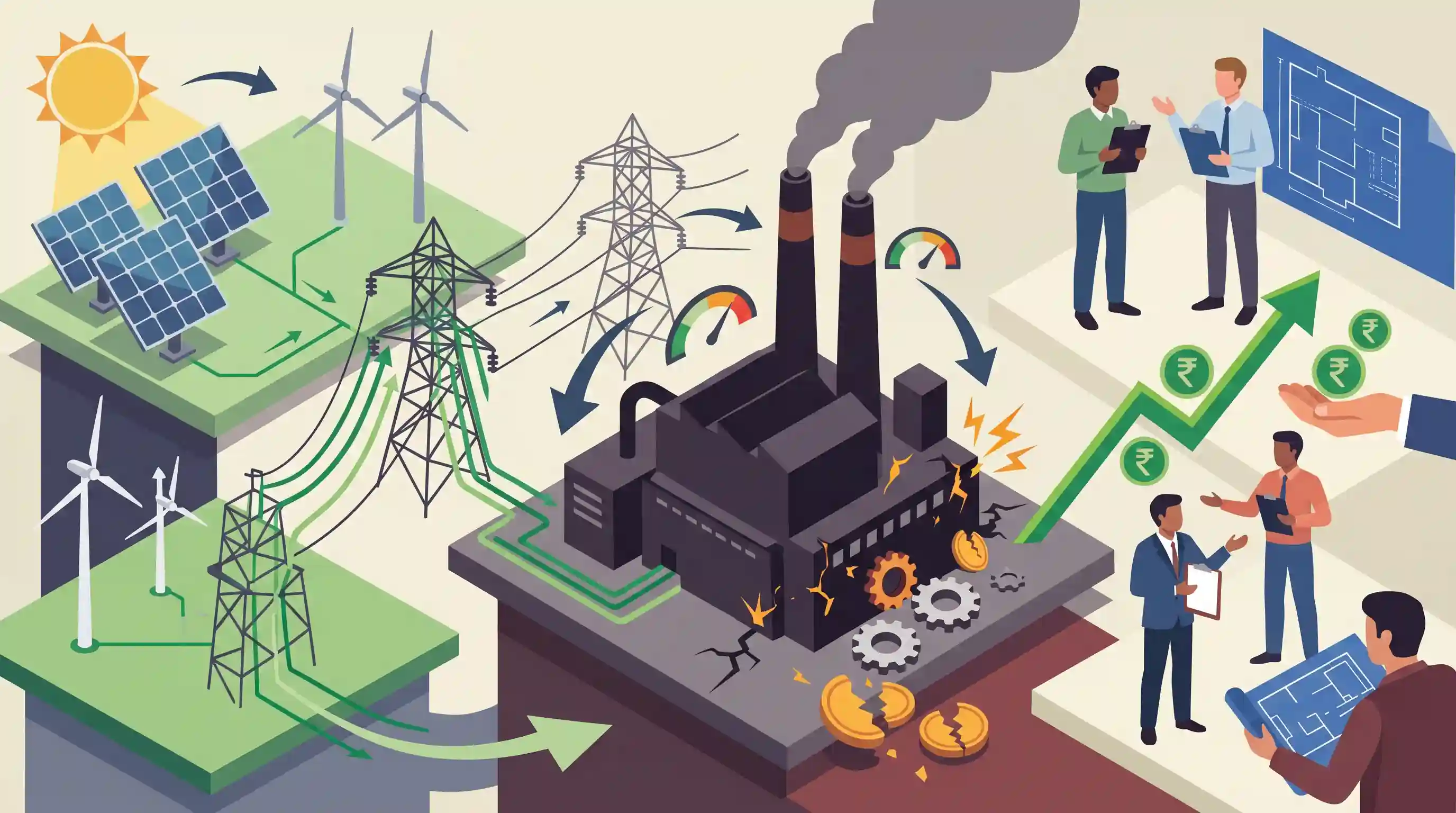
India's aggressive push towards clean energy highlights a critical grid integration challenge: the technical inflexibility of legacy coal-fired power plants. As intermittent renewable energy like solar and wind surges, thermal plants must increasingly operate flexibly to balance the grid, especially during peak demand times when solar generation drops. This flexible operation causes higher wear and tear, reduced efficiency, and financial strain on generators. To ensure grid stability without compromising energy security, regulators are considering an incentive mechanism to adequately compensate thermal power plants for the technical and financial costs associated with flexible generation and retrofitting.
Key Points
- India's clean energy goals (like 500 GW non-fossil capacity by 2030) are heavily reliant on integrating intermittent renewable energy (solar and wind) into the national grid.
- To balance the grid during renewable generation fluctuations (e.g., solar dropping in the evening), legacy coal-fired thermal power plants must operate flexibly by rapidly ramping their output up and down.
- Flexible operation imposes technical and financial burdens on coal plants, including increased wear and tear, lower thermal efficiency, and decreased Plant Load Factor (PLF).
- To ensure energy security and grid stability, policymakers are considering incentive schemes to financially compensate power generators for the costs of running coal plants flexibly and retrofitting them for lower minimum technical limits.
Important Terms
Panchamrit Targets

Five climate commitments announced at COP26 (2021) including 500 GW non-fossil capacity by 2030, 50% renewable energy share, carbon intensity reduction, and Net Zero emissions by 2070.
UPSC context
GS Paper III (Environment/Climate Change); critical for understanding India's international climate pledges and domestic energy transition roadmap.
National Electricity Plan (NEP)
A statutory roadmap formulated by the Central Electricity Authority (CEA) every five years to plan India's generation and transmission capacity additions and resource optimization.
UPSC context
GS Paper III (Infrastructure: Energy); tests knowledge of long-term power sector planning and the integration of renewable energy.
Central Electricity Regulatory Commission (CERC)
A statutory body with quasi-judicial status established under the Electricity Act, 2003, responsible for regulating interstate transmission tariffs and promoting competition in the bulk power market.
UPSC context
GS Paper II (Regulatory Bodies); tests understanding of the institutional framework governing the Indian power sector.
Flexibilization (Thermal Power)
The ability of thermal power plants to adjust output levels (ramping up or down) to balance the intermittent generation of renewable sources like solar and wind.
UPSC context
GS Paper III (Energy/Environment); relevant to challenges of grid stability and transitioning from baseload to variable power systems.
Minimum Technical Load (MTL)
The lowest power output level at which a thermal plant can operate safely and stably without shutting down; a key constraint in integrating intermittent renewables.
UPSC context
GS Paper III (Infrastructure); tests technical understanding of constraints in phasing out or repurposing legacy coal infrastructure.
Central Electricity Authority (CEA)
A statutory organization that advises the government on technical and planning matters in the power sector, including the formulation of the National Electricity Plan.
UPSC context
GS Paper II & III (Statutory Bodies/Energy); focuses on the technical planning arm of India's power governance.
Grid Integration
The process of connecting renewable energy sources to the existing power grid while maintaining stability, frequency, and reliability despite their variable and intermittent nature.
UPSC context
GS Paper III (Science & Technology/Infrastructure); central to discussions on achieving massive renewable energy expansion without system failure.
Prelims Trap
Higher renewable energy generation improves the Plant Load Factor (PLF) of existing thermal power plants.
Surging renewables actually reduce thermal PLF. Coal plants are forced to back down during peak solar hours, lowering their overall utilization, thermal efficiency, and profitability.
Static Concepts Connected
What is the 'Duck Curve' in electricity generation?
- Definition: A graph showing the timing imbalance between peak renewable energy production and peak electricity demand.
- Visual shape: Characterized by a "belly" during midday (high solar supply, low net demand) and a steep "neck" in the evening (solar drops, demand spikes).
- Significance: It highlights the need for battery energy storage (BESS) and rapid ramping capabilities in conventional thermal power plants.
What is Plant Load Factor (PLF) in the power sector?
- Meaning: The ratio of actual electricity generated by a power plant to its maximum possible generation capacity over a given period.
- Indicator: It acts as a primary metric for the capacity utilization and operational efficiency of thermal and nuclear power plants.
- Impact of RE: When coal plants operate flexibly to balance renewable intermittency, their PLF drops, increasing wear-and-tear and per-unit generation costs.
Cross-Topic Patterns
Pumped Hydro Storage & Topography
Balancing intermittent renewables heavily relies on pumped hydro storage. UPSC frequently links energy transition targets to the geographic and ecological feasibility of hydro projects in peninsular versus Himalayan India.
Grid Stability via Carbon Markets
CERC's push to financially incentivize flexible coal plants overlaps with the Energy Conservation (Amendment) Act, linking grid stabilization costs with India's emerging domestic Carbon Credit Trading Scheme (CCTS).

The 'Duck Curve' phenomenon and the impact of solar intermittency on thermal PLF are prime candidates for a conceptual 2026 Prelims MCQ.
Linked PYQs · 4
Linked PYQs · 4
- 2023PrelimsGS1
With reference to coal-based thermal power plants in India, consider the following statements: 1. None of them uses seawater. 2. None of them is set up in water-stressed district. 3. None of them is privately owned. How many of the above statements are correct?
- 2018MainsGS3
“Access to affordable, reliable, sustainable and modern energy is the sine qua non to achieve Sustainable Development Goals (SDGs).” Comment on the progress made in India in this regard.
- 2016MainsGS3
Give an account of the current status and the targets to be achieved pertaining to renewable energy sources in the country. Discuss in brief the importance of National Programme on Light Emitting Diodes (LEDs).
- 2024PrelimsGS1
Consider the following: 1. Battery storage 2. Biomass generators 3. Fuel cells 4. Rooftop solar photovoltaic units How many of the above are considered "Distributed Energy Resources"?
