CIL and UPRVUNL sign joint venture pact for renewable energy in UP
Source:uniindia ↗
Why It Matters
This partnership demonstrates the collaborative efforts between a Maharatna PSU (Coal India) and a State PSU (UPRVUNL) to accelerate the green energy transition, highlighting sub-national clean energy strategies and the diversification of coal-dependent sectors in UP, which is highly relevant for GS-3 infrastructure, economy, and environment sections.
Summary
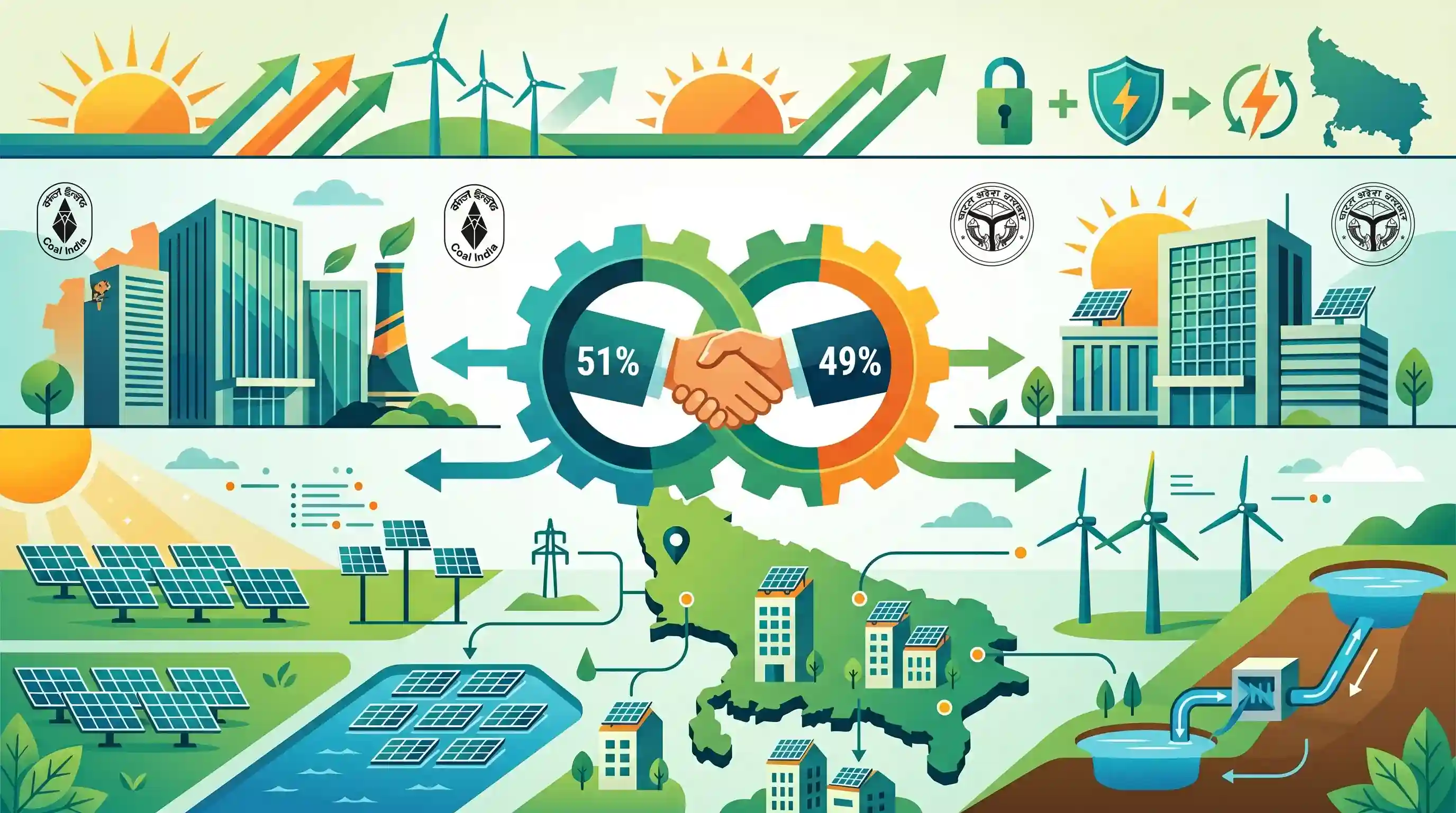
Coal India Limited (CIL) and Uttar Pradesh Rajya Vidyut Utpadan Nigam Limited (UPRVUNL) have signed a Joint Venture Agreement to develop multiple renewable energy projects in Uttar Pradesh. Under the pact, a joint venture entity will be created with CIL holding a 51% stake and UPRVUNL holding a 49% stake to build, operate, and maintain ground-mounted solar, floating solar, rooftop solar, wind, and pumped storage projects across the state.
Key Points
- Coal India Limited (CIL) and Uttar Pradesh Rajya Vidyut Utpadan Nigam Limited (UPRVUNL) signed a Joint Venture Agreement (JVA) to set up a new renewable energy joint venture company.
- The joint venture company will have a shareholding structure of 51% for Coal India and 49% for UPRVUNL.
- The partnership is tasked with developing, financing, constructing, operating, and maintaining various renewable projects in Uttar Pradesh, including ground-mounted solar, floating solar, rooftop solar, wind energy, and pumped storage.
- This initiative aligns with Coal India's transition roadmap to transform into an integrated energy conglomerate, diversifying away from coal-only operations.
- The venture will leverage CIL's financial capabilities and UPRVUNL's domain experience in power generation within Uttar Pradesh to strengthen the state's long-term energy security and lower carbon footprints.
Important Terms
Coal India Limited

A Maharatna public sector undertaking under the Ministry of Coal, it is India's largest coal-producing company and is currently diversifying into renewable energy to align with national green transition goals.
UPSC context
GS Paper III: Infrastructure & Energy. Tests awareness of PSU diversification strategies and national transition towards renewable energy.
Uttar Pradesh Rajya Vidyut Utpadan Nigam Limited
A wholly owned state public sector undertaking of the Government of Uttar Pradesh, responsible for thermal power generation and now expanding into renewable energy development.
UPSC context
GS Paper III: Energy Sector. Tests understanding of state public enterprises and sub-national contributions to India's green targets.
Invest UP
The investment promotion and facilitation agency of the Government of Uttar Pradesh tasked with attracting investments, easing the business environment, and driving industrial development across the state.
UPSC context
GS Paper III: Investment Models. Tests knowledge of state-led investment promotion agencies and ease of doing business initiatives.
Pumped Storage Projects
Hydroelectric energy storage systems that act as giant water batteries, pumping water to an upper reservoir during low-demand periods and releasing it downhill to generate power during peak demand.
UPSC context
GS Paper III: Infrastructure and Science & Tech. Tests concepts of energy storage systems essential for grid stability.
Floating Solar Photovoltaic
Solar energy systems where photovoltaic panels are mounted on floating structures deployed on water bodies, conserving land, reducing evaporation, and utilizing water's cooling effect to enhance performance.
UPSC context
GS Paper III: Environment & Infrastructure. Tests knowledge of land-saving clean energy innovations and their ecological benefits.
Prelims Trap
Coal India Limited, as a Maharatna PSU expanding into solar and wind power, operates under the administrative control of the Ministry of Power.
Despite its heavy diversification into green energy and joint ventures with state power utilities, CIL remains a PSU under the Ministry of Coal.
Static Concepts Connected
What are the criteria for a PSU to achieve Maharatna status in India?
- Navratna prerequisite: Must already be a Navratna company listed on Indian stock exchanges with minimum prescribed public shareholding.
- Financial thresholds: Three-year average annual net profit > ₹5,000 crore, net worth > ₹15,000 crore, and turnover > ₹25,000 crore.
- Global footprint: Must have a significant global presence or international operations to qualify.
How does Pumped Storage Hydropower (PSH) function as grid-scale energy storage?
- Working mechanism: Uses two reservoirs at different elevations; excess grid power pumps water uphill, and gravity releases it downhill through turbines during peak demand.
- Grid stabilization: Acts as a 'water battery' to balance the intermittency of solar and wind energy sources.
- Efficiency and lifespan: Offers high cycle life and round-trip efficiency of 70% to 80% with low operational costs.
Cross-Topic Patterns
Brown to Green PSU Transition
Fossil-fuel giants like CIL leveraging coal revenues to fund solar projects represents a strategic internal cross-subsidization model for India's green transition.
Floatovoltaics and Water-Energy Nexus
Floating solar projects bypass land-acquisition hurdles while conserving reservoir water by reducing evaporation, showcasing a vital climate-adaptation synergy.

PSU energy diversification models and the operational mechanics of pumped hydro storage are highly likely to feature in UPSC 2026.
Linked PYQs · 2
Linked PYQs · 2
- 2022UPPSC_PRELIMSGS1
Solar energy is converted into electric energy through
- 2024UPPSC_PRELIMSGS1
Match List-I with List-II and select the correct answer from the codes given below. List-I (Coal Resources): (A) Hutar (B) Ib River (C) Tatapani - Ramkola (D) Umaria List-II (States): 1. Madhya Pradesh 2. Chhattisgarh 3. Odisha 4. Jharkhand
