Coal India commissions 200 MW solar capacity in Khavda Gujarat
Source:renewable-watch ↗
આ શા માટે મહત્વનું છે
Demonstrates the critical shift of India's fossil fuel-based PSUs toward green energy generation. This diversification is essential for meeting India's Intended Nationally Determined Contributions (INDCs), increasing non-fossil fuel electricity capacity, and ensuring a just energy transition while maintaining energy security.
સારાંશ
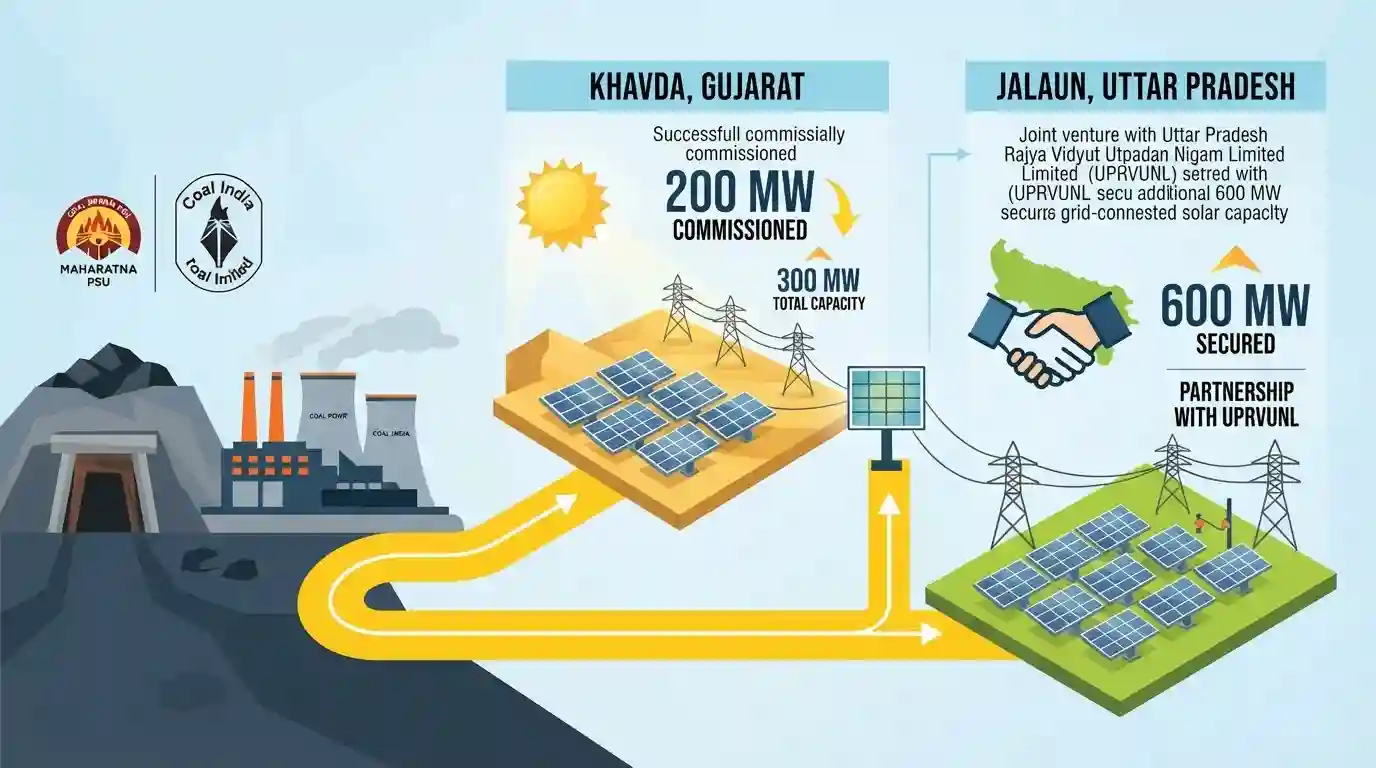
Coal India Limited (CIL) is actively diversifying its energy portfolio by expanding into renewable energy generation. The Maharatna PSU has successfully commissioned 200 MW of solar power capacity as part of a larger 300 MW project located in Khavda, Gujarat. In addition to this milestone, CIL has partnered with Uttar Pradesh Rajya Vidyut Utpadan Nigam Limited (UPRVUNL) through a joint venture to develop further green energy projects. Through this collaboration, CIL has secured an additional 600 MW of grid-connected solar capacity at the Jalaun Solar Park in Uttar Pradesh, reflecting the broader transition of India's fossil fuel giants toward supporting national non-fossil energy targets.
મુખ્ય મુદ્દા
- Coal India Limited (CIL) has commissioned 200 MW of solar power capacity out of a planned 300 MW project at Khavda, Gujarat.
- This initiative highlights the strategic diversification of India's largest coal-producing Maharatna PSU into the renewable energy sector.
- CIL has formed a joint venture with Uttar Pradesh Rajya Vidyut Utpadan Nigam Limited (UPRVUNL) to develop green energy infrastructure.
- The joint venture recently secured an additional 600 MW of grid-connected solar power capacity at the Jalaun Solar Park in Uttar Pradesh.
મહત્વપૂર્ણ શબ્દો
Coal India Limited (CIL)

A state-owned coal mining corporate and Maharatna PSU under India's Ministry of Coal, which is transitioning from traditional fossil fuel extraction to major renewable energy generation.
UPSC context
GS Paper III (Economic Development, Energy Sector); tests knowledge of key PSUs and energy transition strategies.
Uttar Pradesh Rajya Vidyut Utpadan Nigam Limited (UPRVUNL)
A wholly-owned state thermal power utility in Uttar Pradesh, actively collaborating with central PSUs to develop utility-scale solar and other renewable energy capacities.
UPSC context
GS Paper III (Infrastructure & Energy); tests understanding of state-level public sector undertakings driving the green energy transition.
Maharatna Status
A status granted to top-performing Central Public Sector Enterprises (CPSEs) in India, offering them exceptional financial and operational autonomy, including investing up to 15% of net worth in a project.
UPSC context
GS Paper III (Indian Economy & PSUs); tests criteria, benefits, and investment powers of key public enterprises.
Khavda Renewable Energy Park
Located in Gujarat's Kutch region, this is the world's largest hybrid renewable energy park under development, with a planned capacity of over 30 GW to generate clean wind and solar power.
UPSC context
GS Paper III (Environment, Infrastructure); tests major renewable energy projects and regional geography in India.
Jalaun Solar Park
A major clean energy initiative in Uttar Pradesh’s Bundelkhand region, acting as a utility-scale solar hub designed to supply clean electricity directly to the state power grid.
UPSC context
GS Paper III (Infrastructure & Energy); tests knowledge of key regional solar parks and national grid integration.
Panchamrit
India's five-point climate action targets announced at COP26, which include achieving 500 GW of non-fossil fuel capacity by 2030 and reaching net-zero emissions by 2070.
UPSC context
GS Paper III (Environment and Ecology); tests India's climate commitments and policies under global environmental summits.
પ્રિલિમ્સ ટ્રેપ
India's updated NDC commits to achieving 50% of its electricity generation from renewable energy sources by 2030.
The actual target is 50% of cumulative electric power *installed capacity* from non-fossil sources, which is vastly different from actual generation or total energy consumption.
સંલગ્ન સ્થિર ખ્યાલો
What are the criteria for granting Maharatna status to a Central Public Sector Enterprise (CPSE)?
- Pre-requisite Status: Must already hold Navaratna status and be listed on the Indian stock exchange with prescribed public shareholding.
- Turnover Threshold: Average annual turnover of more than ₹25,000 crore during the last three years.
- Profit and Worth: Average annual net worth over ₹15,000 crore and average annual net profit after tax over ₹5,000 crore during the last three years.
What are the core pillars of a 'Just Transition' framework in the energy sector?
- Socio-economic Equity: Ensures the shift to a green economy does not disproportionately harm workers and communities historically dependent on fossil-fuel industries.
- Economic Diversification: Focuses on retraining workforces, restructuring local economies of coal belts, and funding community-led sustainable developmental projects.
આંતર-વિષય પેટર્ન
PSU JVs & Cooperative Federalism
Central PSUs partnering with state entities (like CIL-UPRVUNL) pool land and capital, demonstrating fiscal and operational cooperative federalism to meet India's climate commitments.
Regional disparities in greening
Redirecting coal profits (traditionally serving eastern India) to solar projects in western/northern states could widen regional developmental imbalances, posing a challenge for Just Transition policies.

UPSC may link Maharatna financial autonomy, updated NDC installed capacity targets, and Just Transition challenges in GS Paper 3.
સંલગ્ન PYQ · 3
સંલગ્ન PYQ · 3
- 2026GPSC_PRELIMSGS1
Which of the following statement/s is/are correct regarding Renewable Energy Installed Capacity in India? 1. Wind energy is second only to solar energy in the Indian renewable sector. 2. Biomass power capacity accounts for around 30% of India's total renewable energy. 3. India ranks among the top three countries in the world in Hydropower Installed Capacity. Choose the correct option from the following.
- 2025GPSC_PRELIMSGS1
Which of the following is/are not a part of the India's Intended Nationally Determined Contribution towards climate action? (i) Reducing emission intensity of GDP (ii) Increasing the share of non-fossil fuel-based electricity
- 2021GPSC_PRELIMSGS1
Statement : Should India immediately stop digging coal from its mines? Arguments : I. Yes. The present stock of coal will not last long if we continue mining at the present rate. II. No. We do not have alternate energy source of sufficient quantity. III. No. This will put millions of people at a disadvantage and their lives will get adversely affected and also the industry.
