Coal India and UPRVUNL Clean Energy Partnership Agreement
Source:powerline ↗
Why It Matters
This joint venture represents a significant development in Uttar Pradesh's power sector, reflecting state-level targets for renewable capacity expansion, solar infrastructure, and corporate transition of public energy behemoths like Coal India. Such state-specific infrastructural and energy initiatives are highly relevant to the UPPSC PCS Prelims.
Summary
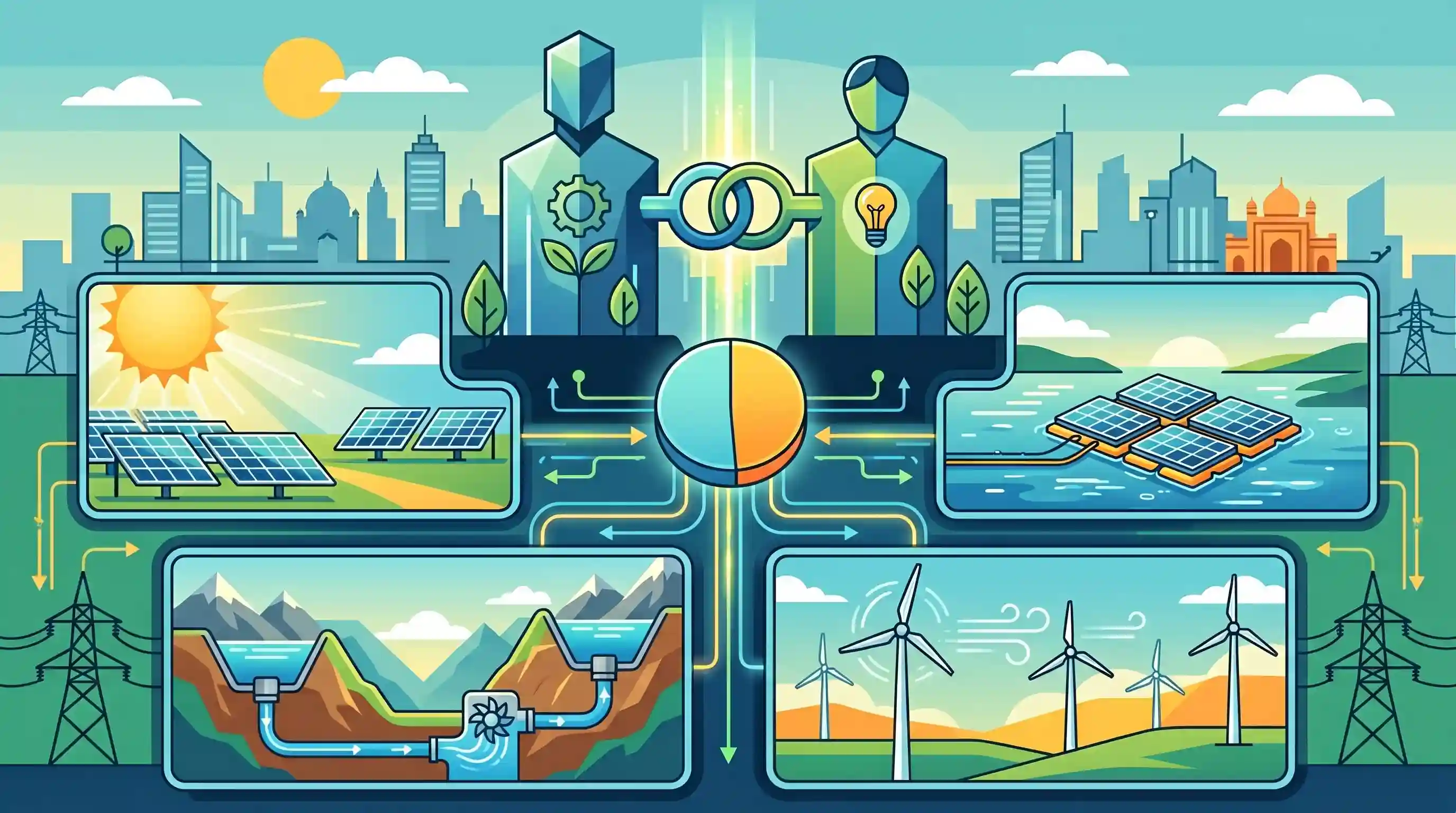
Coal India Limited (CIL) and Uttar Pradesh Rajya Vidyut Utpadan Nigam Limited (UPRVUNL) have entered into a Joint Venture (JV) agreement to execute renewable energy projects throughout Uttar Pradesh. CIL will hold a majority stake of 51% in the private limited entity, with UPRVUNL holding 49%. The joint venture is designed to establish diverse green initiatives including ground-mounted solar, floating solar, pumped storage, and wind projects.
Key Points
- Coal India Limited (CIL) and Uttar Pradesh Rajya Vidyut Utpadan Nigam Limited (UPRVUNL) signed a Joint Venture (JV) agreement to set up renewable energy projects in Uttar Pradesh.
- The equity shareholding pattern in the JV company is 51% held by CIL and 49% held by UPRVUNL.
- The scope of the JV includes developing ground-mounted and floating solar, pumped storage plants (PSPs), wind energy, and other renewable installations.
- The venture will be incorporated as a private limited company with an initial paid-up capital of Rs 1 million (Rs 10 lakh) and an authorised share capital of Rs 100 million (Rs 10 crore).
- The JV is also authorized to engage in power trading and other closely aligned business activities.
Important Terms
Coal India and UPRVUNL JV Agreement

A 2026 joint venture agreement between Coal India Limited (51%) and UPRVUNL (49%) to develop, operate, and maintain renewable energy projects, including solar, wind, and pumped storage, across Uttar Pradesh.
UPSC context
GS Paper III (Infrastructure & Energy); tests understanding of joint ventures, state-level clean energy transitions, and diversification of state-owned entities.
Coal India Limited (CIL)
A Maharatna central public sector enterprise under the Ministry of Coal, established in 1975, headquartered in Kolkata; it is the largest coal-producing company in the world and key to India's energy security.
UPSC context
GS Paper III (Energy/Infrastructure); tests knowledge of CPSE statuses, energy transition challenges, and fossil-fuel-dependent economic sectors.
Uttar Pradesh Rajya Vidyut Utpadan Nigam Limited (UPRVUNL)
A wholly state-owned thermal power utility company of the Government of Uttar Pradesh, established in 1980, tasked with constructing, operating, and maintaining coal-fired power plants across the state.
UPSC context
GS Paper III (Infrastructure/Energy); tests understanding of state power utilities, thermal generation capacity, and regional electricity reforms.
Pumped Storage Projects (PSP)
Hydroelectric energy systems designed to store excess grid power by pumping water from a lower reservoir to an upper one, releasing it through turbines during peak demand periods.
UPSC context
GS Paper III (Renewable Energy/Infrastructure); tests knowledge of energy storage systems, grid stability, and long-duration storage technologies.
Prelims Trap
Floating solar installations are restricted to natural lakes to avoid disrupting active hydroelectric reservoirs.
India's largest floating solar projects are strategically built on artificial reservoirs of active dams (like Rihand) to leverage existing grid-transmission infrastructure.
Static Concepts Connected
How do Pumped Storage Hydropower (PSH) plants act as grid-balancing systems?
- Dual-Reservoir Mechanism: Uses an upper and lower reservoir to act as a giant gravity-based water battery storing electricity.
- Peak Load Shifting: Pumps water uphill during off-peak hours (using cheap solar/wind) and releases it downhill to generate power during peak demand.
- High Efficiency: Achieves an efficient round-trip energy recovery rate of 75-80% with rapid ramp-up times.
What are the eligibility criteria and financial powers of a Maharatna CPSE?
- Eligibility Benchmarks: Must hold Navratna status, be listed on the Indian stock exchange, and have >Rs 5,000 crore average net profit over 3 years.
- Investment Autonomy: Can invest up to Rs 5,000 crore or 15% of their net worth in a single project without prior government approval.
- JV & M&A Freedom: Empowered to enter into technology joint ventures, strategic alliances, and set up financial subsidiaries domestically or globally.
Cross-Topic Patterns
Extractive PSUs & Green Transitions
Legacy fossil-fuel extraction PSUs like Coal India are restructuring into green energy developers to align with India's 2030 NDC goals.
Floating Solar + Water Resource Management
Floating solar arrays on reservoirs serve a dual purpose: generating clean power while reducing critical evaporative water loss in arid zones.

Mains 2026 may evaluate Pumped Storage Projects (PSPs) as the key to grid-stability amidst India's aggressive non-fossil capacity targets.
Linked PYQs · 1
Linked PYQs · 1
- 2020UPPSC_PRELIMSGS1
In which of the following districts of U.P. a major solar power plant was established in collaboration with France in 2018 ?
