Coal India and UPRVUNL Renewable Energy Joint Venture
Source:renewablewatch ↗
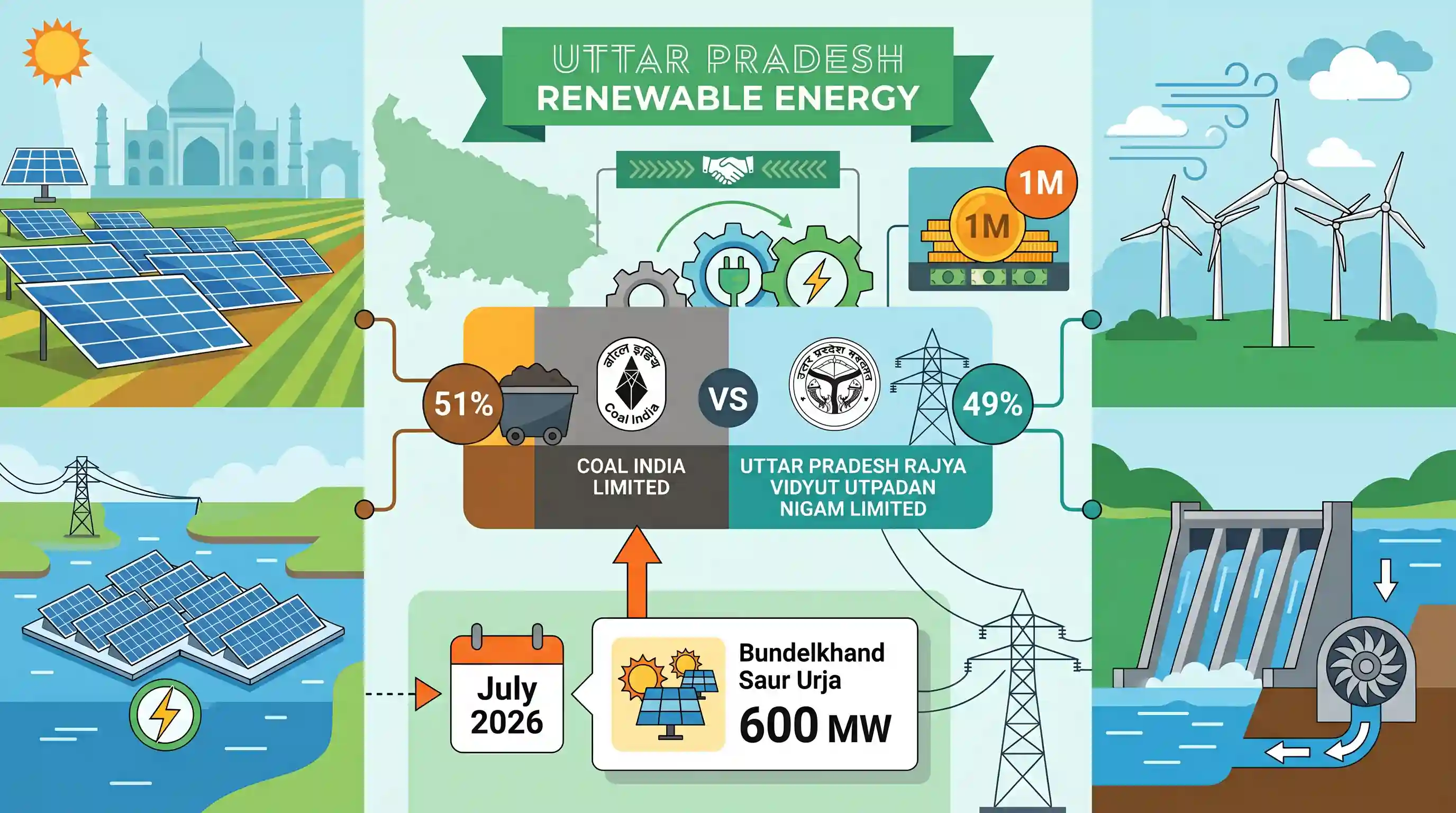
Why It Matters
Energy transition, especially solar and pumped storage projects in UP, is a frequent theme in UPPSC Prelims and Mains (UP Special GK). Knowing specific joint ventures (like Bundelkhand Saur Urja and UPRVUNL-CIL) and equity structures is highly useful for regional state service questions.
Summary
Coal India Limited (CIL) and Uttar Pradesh Rajya Vidyut Utpadan Nigam Limited (UPRVUNL) have formed a joint venture (CIL holding 51%, UPRVUNL holding 49%) to develop diverse renewable energy projects in Uttar Pradesh. The JV is structured with Rs 1 million paid-up capital and will focus on ground-mounted solar, floating solar, wind, and pumped storage projects. This follows CIL's July 2026 acquisition of 600 MW capacity from Bundelkhand Saur Urja Limited.
Key Points
- Coal India Limited (CIL) and Uttar Pradesh Rajya Vidyut Utpadan Nigam Limited (UPRVUNL) signed a Joint Venture (JV) agreement to establish renewable energy projects in Uttar Pradesh.
- The JV will develop ground-mounted solar, floating solar, pumped storage, wind, and other clean energy projects, alongside power sales.
- Under the agreement, CIL will hold a 51% controlling stake in the JV, while UPRVUNL will hold the remaining 49% stake.
- The new private limited company will have an initial paid-up capital of Rs 1 million and an authorised share capital of Rs 100 million, with a 5-year restriction on share transfers to maintain the shareholding structure.
- Additionally, Coal India secured 600 MW capacity from the NHPC’s 1,200 MW grid-connected solar project via Bundelkhand Saur Urja Limited (a joint venture of NHPC and UPNEDA).
Important Terms
Coal India Limited

A Maharatna public sector undertaking under the Ministry of Coal, CIL is the world's largest coal producer and is increasingly diversifying into solar and other renewable energy projects to meet clean energy goals.
UPSC context
GS Paper III: Infrastructure/Energy. Tests knowledge of public sector undertakings, fossil fuel transition, and national renewable energy targets.
Uttar Pradesh Rajya Vidyut Utpadan Nigam Limited (UPRVUNL)
A wholly-owned state government undertaking responsible for thermal power generation in Uttar Pradesh, actively expanding its energy mix by venturing into green energy, solar, and pumped storage projects.
UPSC context
GS Paper III: Energy Security. Tests awareness of state-level power generation utilities and their transition strategies toward renewable energy.
Uttar Pradesh New and Renewable Energy Development Agency (UPNEDA)
The designated state nodal agency under UP’s Department of Additional Sources of Energy that administers solar subsidies, off-grid electrification, and green energy projects across Uttar Pradesh.
UPSC context
GS Paper III: Government Policies & Energy. Tests knowledge of institutional frameworks for decentralized solarization and state renewable energy policies.
NHPC Limited
A prominent Navratna Central Public Sector Enterprise under the Ministry of Power, originally focused on hydroelectric power but now diversified into solar, wind, and overall renewable energy infrastructure.
UPSC context
GS Paper III: Energy & Infrastructure. Tests understanding of major CPSEs, public sector classifications, and hydropower resources.
Bundelkhand Saur Urja Limited
A joint venture between NHPC Limited and UPNEDA established to build solar infrastructure, key to developing major solar parks, such as the 1,200 MW Jalaun Ultra Mega Solar Park.
UPSC context
GS Paper III: Energy Infrastructure. Tests understanding of strategic joint ventures in regional green energy expansion and solar park development.
Prelims Trap
The target of installing 14.4 GW of renewable energy by coal PSUs is mandated and monitored by the Ministry of New and Renewable Energy.
The green transition target for coal PSUs is administratively set and monitored directly by the Ministry of Coal, not the MNRE.
Static Concepts Connected
What is Pumped Storage Hydropower (PSH) and how does it support grid stability?
- Dual-reservoir mechanism: Uses two water reservoirs at different elevations to generate electricity during peak demand and pump water back up during surplus solar/wind generation.
- Grid storage role: Acts as a giant gravitational energy storage system, offering rapid-response dispatchability and frequency regulation to balance intermittent renewable energy grids.
- High efficiency: Maintains a high round-trip energy efficiency of 70% to 80%, outperforming many chemical battery storage solutions at utility scale.
What financial autonomy do Maharatna PSUs have regarding joint ventures?
- Investment ceiling: Can invest up to ₹5,000 crore or 15% of their net worth in a single joint venture/subsidiary project without prior government approval.
- Mergers and alliances: Authorized to structure mergers, acquisitions, and technology partnerships domestically and globally within the prescribed financial limits.
Cross-Topic Patterns
Brown to Green: PSU Just Transition
Fossil-fuel monopolies like Coal India leveraging their capital surpluses to fund green infrastructure exemplifies how state-backed entities manage the socio-economic transition away from coal.
Cooperative Federalism in Clean Infrastructure
Joint ventures between Central Maharatnas and State power utilities serve as a vital fiscal model, resolving land-acquisition bottlenecks while accelerating state-level renewable targets.

PSU green diversification mandates under non-energy ministries (like Coal) and Pumped Storage tech will likely feature in 2026.
Linked PYQs · 2
Linked PYQs · 2
- 2022UPPSC_PRELIMSGS1
Solar energy is converted into electric energy through
- 2021UPPSC_PRELIMSGS1
A non-renewable source of energy is
