India Coal Power Generation Sees Historic First Decline
Source:Indian Express ↗
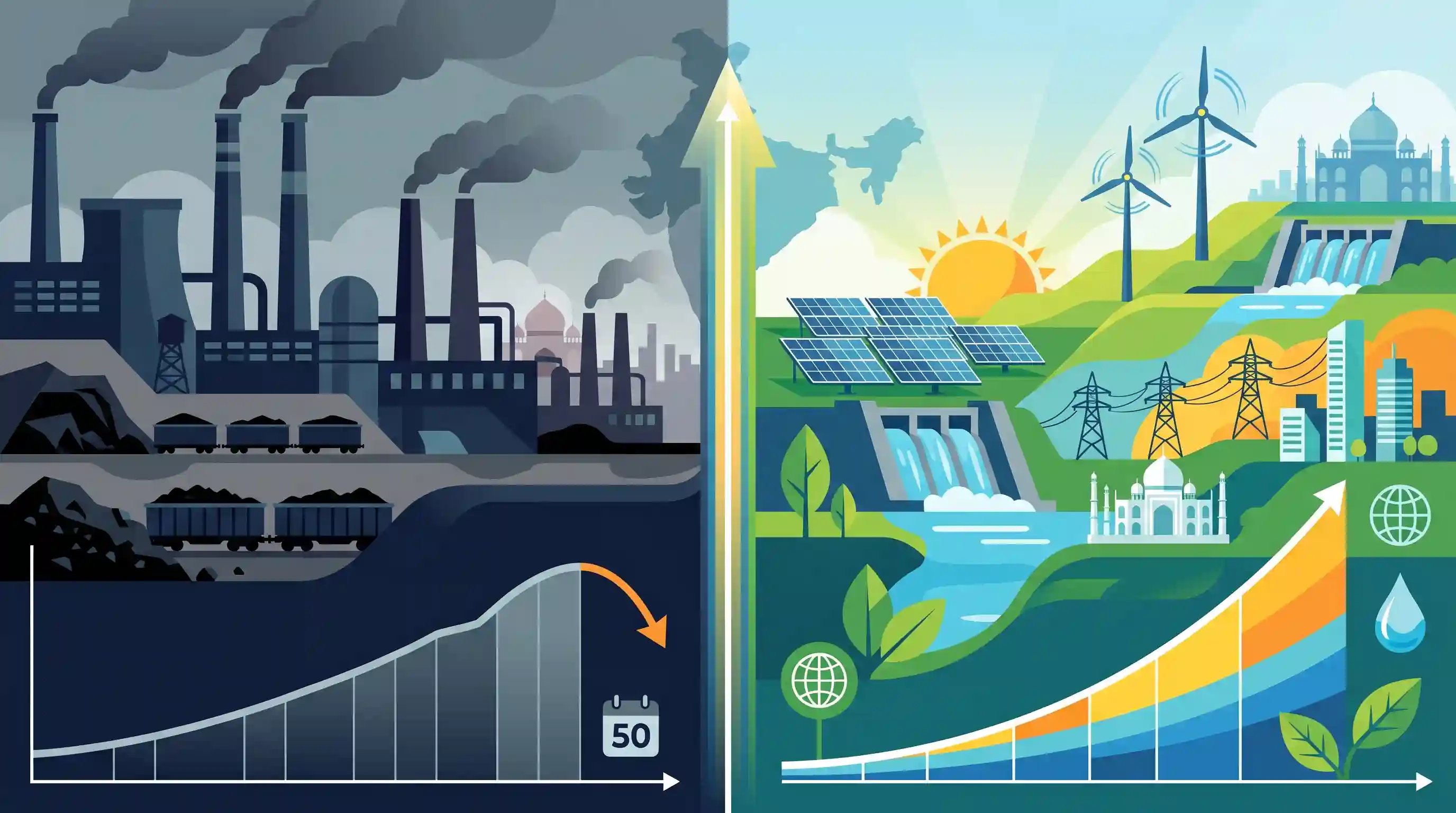
Why It Matters
This is a historic inflection point for India's power sector, directly answering recurring UPSC questions about whether India can realistically achieve its ambitious 2030 renewable energy targets and phase down coal. It provides concrete evidence for Mains answers on climate commitments, NDCs, and the energy mix.
Summary
For the first time in 50 years, India's coal-fired power generation has witnessed a year-on-year decline. This landmark shift reflects the rapid and sustained expansion of renewable energy capacity—particularly solar and wind—which is finally beginning to outpace the overall growth in electricity demand. The milestone underscores India's structural progress in its energy transition and global climate commitments, signaling a potential long-term peak in absolute coal reliance as non-fossil alternatives steadily dominate the country's electricity generation mix.
Key Points
- For the first time in half a century, India's coal-fired power generation recorded a year-on-year decline.
- The drop indicates that the rapid expansion of renewable energy capacity (such as solar and wind) is successfully absorbing incremental electricity demand.
- The milestone is a significant step forward in India's energy transition and aligns with its updated NDC target to achieve 50% cumulative electric power installed capacity from non-fossil fuel resources by 2030.
- Although generation numbers dropped, coal continues to serve as the critical baseload for grid stability in the near term.
Important Terms
Paris Agreement

A 2015 legally binding international treaty aiming to limit global warming to well below 2°C. It provides the framework for global climate action and India's transition to renewable energy.
UPSC context
GS Paper 3: Environment/Climate Change. Tests knowledge of international treaties and India’s global climate leadership.
Nationally Determined Contributions (NDCs)
National climate action plans submitted under the Paris Agreement. India’s targets include reducing GDP emissions intensity by 45% and achieving 50% non-fossil fuel power capacity by 2030.
UPSC context
GS Paper 3: Environment. Tests understanding of specific national commitments and progress toward Net Zero 2070.
Central Electricity Authority (CEA)
A statutory body under the Electricity Act, 2003, that advises the government on policy and formulates the National Electricity Plan. It manages technical standards and power sector data.
UPSC context
GS Paper 3: Infrastructure/Energy. Tests knowledge of regulatory bodies and technical planning in India's power sector.
UNFCCC
The 1992 primary international treaty established to stabilize greenhouse gas concentrations. It serves as the parent treaty for both the Kyoto Protocol and the Paris Agreement.
UPSC context
GS Paper 3: Environment/International Agreements. Tests foundational knowledge of global climate governance and the COP process.
Ministry of Power
The Union Ministry responsible for policy formulation and regulation of the power sector. It oversees electricity production, transmission, and the implementation of energy-related legislation.
UPSC context
GS Paper 3: Infrastructure/Energy. Tests understanding of the executive's role in national energy security and transition.
Energy Transition
The long-term structural shift of energy systems from fossil-fuel-based generation (like coal) to low-carbon renewable sources (like solar and wind) to mitigate climate change.
UPSC context
GS Paper 3: Environment/Economy. Tests conceptual clarity on sustainable development and the challenges of diversifying energy mixes.
Prelims Trap
"Non-fossil fuels now account for over 50% of India's total electricity generation."
Aspirants often conflate 'installed capacity' with actual 'generation'. India achieved 50% non-fossil installed capacity, but coal still heavily dominates actual electricity generation due to lower renewable Plant Load Factors.
Static Concepts Connected
What are India's updated Nationally Determined Contributions (NDCs) under the Paris Agreement?
- Electric Capacity: Achieve about 50% cumulative electric power installed capacity from non-fossil fuel-based energy resources by 2030.
- Emission Intensity: Reduce the emissions intensity of its GDP by 45% by 2030, from 2005 levels.
- Carbon Sink: Create an additional carbon sink of 2.5 to 3 billion tonnes of CO2 equivalent through additional forest and tree cover by 2030.
Why does coal remain India's critical 'baseload' power source despite renewable growth?
- Continuous Supply: Baseload power requires uninterrupted, 24/7 generation to meet the minimum continuous grid demand, which thermal coal readily provides.
- RE Intermittency: Solar and wind are weather-dependent. Without widespread and affordable Battery Energy Storage Systems (BESS), they cannot independently maintain grid frequency.
- High PLF: Coal plants maintain a significantly higher Plant Load Factor (PLF) compared to renewables, ensuring consistent and predictable electrical output.
Cross-Topic Patterns
RE intermittency + Critical Minerals dependency
Phasing down coal baseload requires massive Battery Energy Storage Systems (BESS), directly linking grid stability to India's import dependency for Lithium and Cobalt and Quad supply chain initiatives.
Fly ash utilization + Circular economy mandates
A structural decline in coal generation alters fly ash availability, a toxic byproduct currently heavily mandated by the MoEFCC for use in domestic cement manufacturing and highway construction.

Expect a tricky 2026 Prelims statement differentiating India's non-fossil 'installed capacity' milestones from actual 'generation' shares.
Linked PYQs · 5
Linked PYQs · 5
- 2022MainsGS3
Do you think India will meet 50 percent of its energy needs from renewable energy by 2030 ? Justify your answer. How will the shift of subsidies from fossil fuels to renewables help achieve the above objective ? Explain.
- 2021MainsGS3
Describe the major outcomes of the 26th session of the Conference of the Parties (COP) to the United Nations Framework Convention on Climate Change (UNFCCC). What are the commitments made by India in this conference?
- 2025MainsGS3
Write a review on India's climate commitments under the Paris Agreement (2015) and mention how these have been further strengthened in COP26 (2021). In this direction, how has the first Nationally Determined Contribution intended by India been updated in 2022?
- 2023PrelimsGS1
Consider the following statements: Statement-I: India, despite having uranium deposits, depends on coal for most of its electricity production. Statement-II: Uranium, enriched to the extent of at least 60%, is required for the production of electricity. Which one of the following is correct in respect of the above statements?
- 2025PrelimsGS1
Consider the following statements : I. Carbon dioxide (CO2) emissions in India are less than 0.5 t CO2/ capita. II. In terms of CO2 emissions from fuel combustion, India ranks second in Asia-Pacific region. III. Electricity and heat producers are the largest sources of CO2 emissions in India. Which of the statements given above is/are correct?
