Coal Buffer Depletion and Thermal Power Plant Security
Source:Indian Express ↗
આ શા માટે મહત્વનું છે
Coal remains the primary backbone of India's electricity generation. A sharp decline in buffer stocks exposes the vulnerability of power infrastructure to supply shocks, logistical bottlenecks, and extreme weather spikes, posing direct risks to industrial output and grid reliability.
સારાંશ
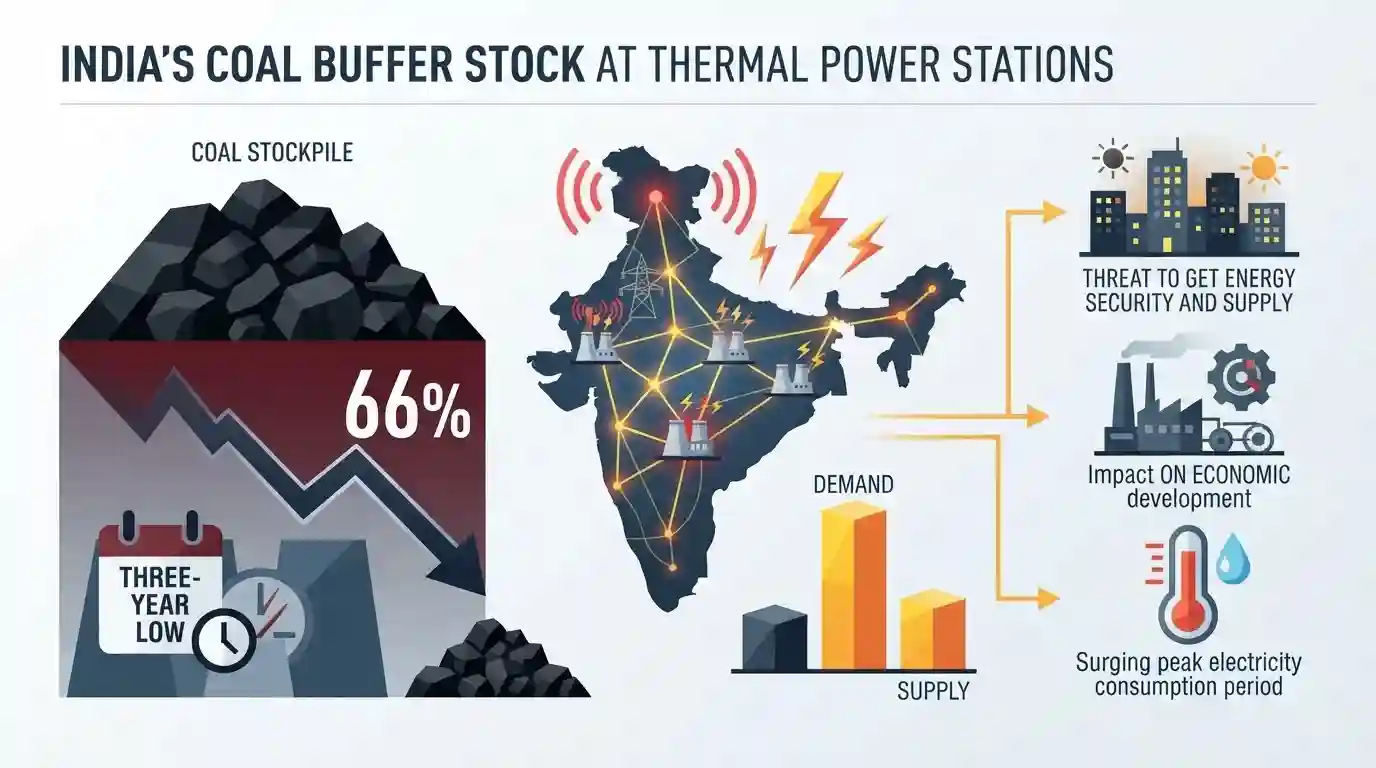
India's coal buffer stock at thermal power stations has dropped significantly by 66% to a three-year low, sparking concerns over energy security, grid stability, and the ability to meet surging electricity demand during peak consumption periods.
મુખ્ય મુદ્દા
- India's coal buffer stock at thermal power plants experienced a steep 66% plunge, reaching a three-year low.
- The depletion raises concerns over energy security and peak power demand management during high-consumption cycles.
- Rapid economic growth and industrial activity have driven up electricity demand, placing immense pressure on coal inventories.
- Ensuring adequate fuel supply logistics and railway rake availability remains critical for replenishing power plant reserves.
મહત્વપૂર્ણ શબ્દો
Ministry of Coal

A cabinet-level ministry in the Government of India responsible for the exploration, production, distribution, and overall policy formulation regarding coal and lignite reserves across the nation.
UPSC context
GS Paper III (Infrastructure: Energy, Coal and Minerals); tests understanding of institutional frameworks managing core mineral sectors.
Central Electricity Authority (CEA)
A statutory body under the Ministry of Power established to advise the government on national electricity policy, formulate power sector plans, and set technical grid standards.
UPSC context
GS Paper III (Infrastructure: Power and Energy); tests knowledge of regulatory bodies monitoring power grid stability and energy security.
પ્રિલિમ્સ ટ્રેપ
Domestic coal production surplus guarantees uninterrupted thermal power generation without logistical constraints.
Aspirants often assume that high domestic coal production automatically ensures adequate fuel availability at power plants, ignoring severe logistical bottlenecks like railway rake shortages.
સંલગ્ન સ્થિર ખ્યાલો
What are the key institutional mechanisms and bodies monitoring India's power and coal sector?
- CEA Mandate: Central Electricity Authority (CEA) statutory body under the Electricity Act 2003 advises the government on national power policy and monitors plant-level coal stocks.
- Linkage Committee: Standing Linkage Committee (SLC) coordinates long-term coal supply linkages between coal companies and power utilities.
- SHAKTI Scheme: SHAKTI Scheme (Scheme for Harnessing and Allocating Koyala Transparently in India) introduced transparent coal allocation for power plants.
આંતર-વિષય પેટર્ન
Coal logistics and railway freight dynamics
Coal logistics bottlenecks highlight the crucial integration between energy security, Ministry of Railways rake allocation, and industrial electricity demand management under GS Paper III.
Energy transition vs baseload coal security
Surging power demand driven by rapid industrialization tests India's net-zero transition pathways and baseload coal reliance simultaneously.

Coal buffer depletion + logistics bottlenecks (railway rakes) is a high-yield pairing for Prelims and GS-3 Energy Security questions.
સંલગ્ન PYQ · 3
સંલગ્ન PYQ · 3
- 2024MainsGS3
Elucidate the importance of buffer stocks for stabilizing agricultural prices in India. What are the challenges associated with the storage of buffer stock? Discuss.
- 2023PrelimsGS1
With reference to coal-based thermal power plants in India, consider the following statements: 1. None of them uses seawater. 2. None of them is set up in water-stressed district. 3. None of them is privately owned. How many of the above statements are correct?
- 2025PrelimsGS1
Consider the following statements : I. Carbon dioxide (CO2) emissions in India are less than 0.5 t CO2/ capita. II. In terms of CO2 emissions from fuel combustion, India ranks second in Asia-Pacific region. III. Electricity and heat producers are the largest sources of CO2 emissions in India. Which of the statements given above is/are correct?
