Copyright Infringement and Generative AI Legal Disputes
Source:The Hindu ↗
Why It Matters
This development is highly relevant for the GS3 syllabus topic 'issues relating to intellectual property rights' and 'awareness in the fields of IT'. It highlights the emerging friction between traditional copyright frameworks and the rapid advancement of generative AI technologies, raising critical questions about data scraping, fair use, and the compensation of original creators in the digital economy.
Summary
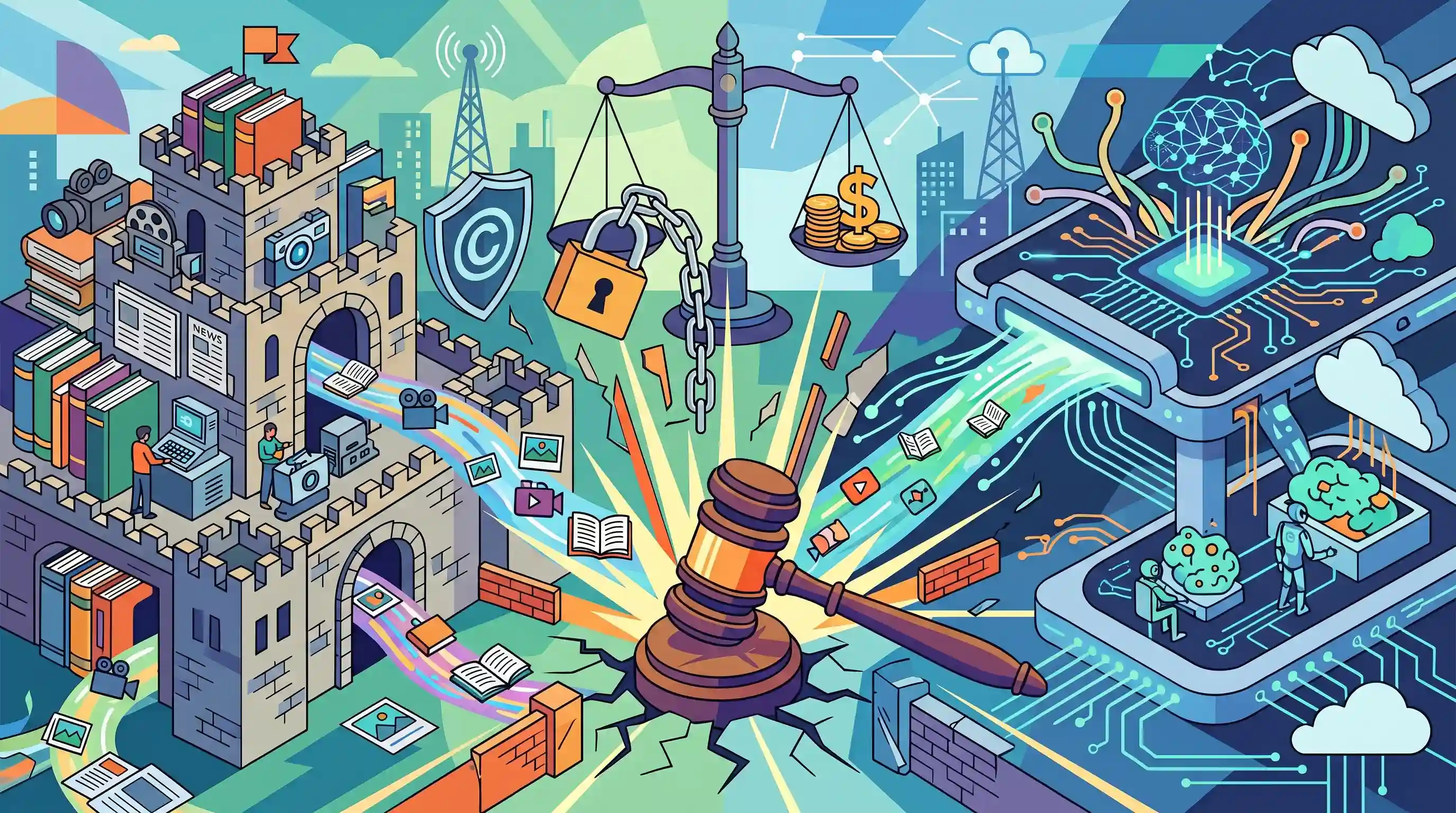
CNN has filed a federal lawsuit against the AI search engine company Perplexity, accusing it of massive copyright infringement for scraping its news stories, videos, and images. The dispute underscores the growing legal tensions between major news publishers and AI developers over the unauthorized use of proprietary content to train generative AI models. While tech companies argue that they are simply utilizing non-copyrightable facts, publishers are increasingly demanding injunctions and fair compensation to protect their intellectual property rights.
Key Points
- CNN has filed a lawsuit in a New York federal court against AI search engine Perplexity for unlawful distribution of copyrighted content.
- The lawsuit alleges that Perplexity copied thousands of CNN stories, videos, and images without permission to train and operate its AI models.
- Perplexity defends its actions by arguing that facts themselves cannot be copyrighted, highlighting a common legal grey area in generative AI training.
- The case is part of a broader trend of news publishers, including the New York Times and Dow Jones, fighting to protect their intellectual property from being repurposed by AI chatbots without compensation.
Important Terms
Intellectual Property Rights (IPR)

Legal rights granting creators exclusive control over original inventions, literary works, and artistic designs to encourage innovation and ensure financial returns.
UPSC context
GS Paper 3 (Science & Tech/Economy); analyzes India's innovation ecosystem and TRIPS compliance.
Copyright Law
Legal protection for original literary, artistic, and musical works (expression, not ideas), governed in India by the Copyright Act, 1957.
UPSC context
GS Paper 3; relevant to understanding "Fair Dealing" and AI training-data liability.
Perplexity
An AI-powered search engine that synthesizes answers by scraping real-time web content and providing cited summaries to user queries.
UPSC context
GS Paper 3 (IT & AI); demonstrates emerging regulatory challenges in the digital economy and search engine liability.
Anthropic
An AI safety and research startup (developer of Claude) that established a landmark $1.5 billion copyright settlement in 2025.
UPSC context
GS Paper 3; illustrates global legal precedents regarding "Transformative Use" in AI development.
CNN
A major global news broadcaster currently challenging AI firms for "live scraping for inference" without licensing or authorization.
UPSC context
GS Paper 3; serves as a case study for "publisher vs. platform" legal conflicts in the AI era.
Prelims Trap
Content generated exclusively by AI can be copyrighted by the software's creator under the Indian Copyright Act.
False. Under Indian law, authorship strictly requires a natural person (human). AI-generated works lacking significant human creative input are currently ineligible for copyright protection.
Static Concepts Connected
How does the Indian Copyright Act handle facts, expressions, and exemptions?
- Idea-Expression Dichotomy: Copyright protects only the original expression of ideas (e.g., article text), not the underlying facts, news, or data. AI companies use this to justify scraping facts.
- Doctrine of Fair Dealing: Allows limited unauthorized use of copyrighted works for research or private study. Whether commercial AI mass-scraping qualifies as "research" remains legally ambiguous.
- Human Authorship Rule: Authorship is legally restricted to natural persons, meaning purely AI-generated content without human creative input cannot receive copyright protection in India.
Cross-Topic Patterns
AI scraping vs. DPDP Act 2023
Unauthorized mass web scraping for AI risks capturing personally identifiable information, shifting the dispute from pure IPR to severe privacy violations under India's DPDP Act 2023.
EU AI Act sets global benchmark
The EU's 2024 legislation explicitly mandates that AI developers publish transparent summaries of copyrighted datasets, serving as a template for future Indian AI-IPR frameworks.

Expect a 2026 multi-statement Prelims question testing the intersection of AI training data, the DPDP Act, and India's Fair Dealing doctrine.
Linked PYQs · 2
Linked PYQs · 2
- 2014MainsGS3
In a globalized world, Intellectual Property Rights assume significance and are a source of litigation. Broadly distinguish between the terms-Copyrights, Patents and Trade Secrets.
- 2023MainsGS3
Introduce the concept of Artificial Intelligence (AI). How does Al help clinical diagnosis? Do you perceive any threat to privacy of the individual in the use of Al in healthcare?
