UP Investor Policies and Land Bank for Industrial Growth
Source:outlook-business ↗
Why It Matters
Uttar Pradesh's industrial distribution, registered MSME statistics, and major investment projects in the National Capital Region (NCR) like Noida and Greater Noida are recurring themes in UPPSC Prelims. Specific data regarding mobile manufacturing shares and regional industrial policy initiatives are highly examinable.
Summary
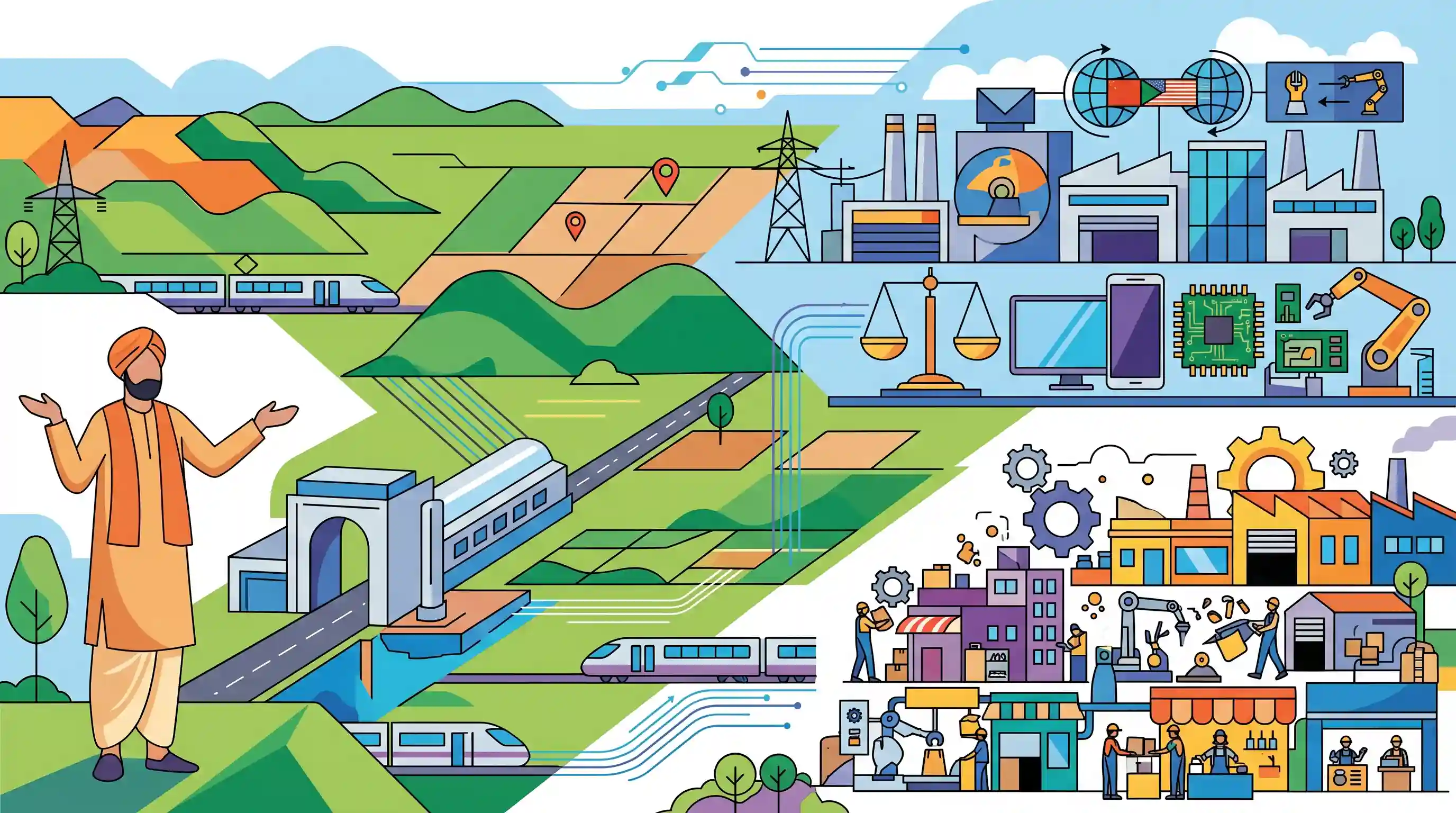
Uttar Pradesh Chief Minister Yogi Adityanath invited domestic and global investors to the state, highlighting its massive 75,000-acre land bank, sector-specific policies for 36 different sectors, and a robust single-window clearance system. Speaking at the foundation stone-laying ceremony for a Rs 6,045 crore Indo-Korean joint venture electronics manufacturing plant (Amber Group and Ascent-K Circuits) in Jewar, Gautam Buddh Nagar, the CM noted that UP has become India's mobile phone hub (producing 55% of mobile phones and 55-60% of electronic components in the Noida-Greater Noida region) and its premier MSME powerhouse with over 96 lakh registered units.
Key Points
- Uttar Pradesh has established a massive 75,000-acre land bank to attract domestic and global investors, backed by sector-specific industrial policies formulated for 36 different sectors.
- The state has emerged as India's mobile phone manufacturing hub, with the Noida-Greater Noida region alone accounting for approximately 55% of India's mobile phones and 55% to 60% of national electronic components production.
- Uttar Pradesh is now the country's leading MSME hub, with more than 96 lakh registered micro, small, and medium enterprises.
- A major private Indo-Korean joint venture electronics manufacturing plant by Amber Group and South Korea's Ascent-K Circuits is being established in the Jewar area of Gautam Buddh Nagar with an investment of over Rs 6,045 crore.
- The state emphasizes ease of doing business through timely incentives and a streamlined digital single-window clearance mechanism to eliminate red tape and minimize human intervention in project setups.
Important Terms
Single-Window Clearance System

A unified digital platform allowing investors to obtain all required regulatory approvals, licenses, and clearances from a single point without interacting with multiple government agencies.
UPSC context
GS Paper 2 (Governance & E-governance), GS Paper 3 (Ease of Doing Business, Industrial Growth).
Nivesh Mitra
The dedicated digital single-window portal launched by Uttar Pradesh to streamline, simplify, and expedite statutory clearances, NOCs, and incentives for setting up and operating businesses.
UPSC context
GS Paper 2 (E-governance) and GS Paper 3 (Ease of Doing Business, regional economic development).
UP Industrial Investment and Employment Promotion Policy 2022
Uttar Pradesh's core economic policy aimed at attracting massive investments, generating jobs, and driving the state toward a $1 trillion economy via capital subsidies and SGST/PLI top-ups.
UPSC context
GS Paper 3 (Industrial policy, economic growth, employment generation, investment models).
India Industrial Land Bank (IILB)
A dynamic GIS-enabled centralized platform by DPIIT mapped with industrial parks, infrastructure details, and vacant plot-level spatial data to help remotely scout and secure industrial land.
UPSC context
GS Paper 3 (Infrastructure, industrial corridor development, land acquisition reforms).
Ministry of Electronics and Information Technology (MeitY)
The central government ministry responsible for policy-making, digital public infrastructure, cybersecurity, indigenization, and promoting IT and electronics manufacturing ecosystems under Digital India.
UPSC context
GS Paper 3 (Indigenization of technology, digital economy, and GS Paper 2 (E-governance)).
Micro, Small, and Medium Enterprises (MSMEs)
Highly dynamic business entities classified by investment and turnover limits under the MSMED Act, serving as the backbone of economic growth and large-scale employment generation in India.
UPSC context
GS Paper 3 (Indian Economy, MSME challenges, inclusive development, and employment models).
Prelims Trap
State semiconductor policies are legally barred from offering capital subsidies that stack on top of the Central India Semiconductor Mission (ISM) incentives.
This is false. States like Uttar Pradesh and Gujarat specifically offer 'top-up' capital subsidies (e.g., UP's 50% additional subsidy) that stack directly on top of the Central Government's 50% fiscal support under the India Semiconductor Mission.
Static Concepts Connected
What is the India Semiconductor Mission (ISM) fiscal support structure?
- Nodal Agency: Launched in 2021 under the Ministry of Electronics and IT (MeitY) to build a semiconductor and display ecosystem.
- Central Fiscal Support: Provides uniform 50% fiscal support of the project cost on a pari-passu basis for setting up semiconductor/display fabs.
- Subnational Stacking: Allows states to offer complementary top-up incentives (e.g., land rebates, power subsidies, or additional capital support) without central deduction.
What are the current composite criteria for MSME classification in India?
- Unified Classification: Both manufacturing and service enterprises are governed by the same unified composite investment and turnover thresholds.
- Micro Enterprises: Investment in Plant/Machinery up to Rs 1 crore AND annual turnover up to Rs 5 crore.
- Small Enterprises: Investment up to Rs 10 crore AND annual turnover up to Rs 50 crore.
- Medium Enterprises: Investment up to Rs 50 crore AND annual turnover up to Rs 250 crore.
Cross-Topic Patterns
State Subsidy Wars & Competitive Federalism
The race between states (e.g., UP, Gujarat, Tamil Nadu) to offer top-up subsidies for high-tech manufacturing highlights how competitive federalism drives India's global supply chain integration.
Electronics Chains & Bilateral FTAs
Joint ventures like Amber-Ascent-K leverage tariff concessions under the India-Korea CEPA, illustrating how bilateral trade frameworks translate into subnational industrial projects.

Mains 2026 may analyze how subnational industrial policies stack with central schemes (like ISM/PLI) to overcome regional economic disparities.
Linked PYQs · 2
Linked PYQs · 2
- 2006UPPSC_PRELIMSGS1
Special Economic Zones are being set up in U.P. at
- 2016UPPSC_PRELIMSGS1
Largest concentration of software and business process outsourcing industry in U.P. is at
