Uttar Pradesh Government Stance on Temple Donation Fraud Probe
Source:indiatvnews ↗
Why It Matters
The governance of religious trusts, administrative probe mechanisms (SIT), and the architectural and geographical background of the Ayodhya Ram Temple are highly recurring themes in the UPPSC PCS Prelims General Studies syllabus.
Summary
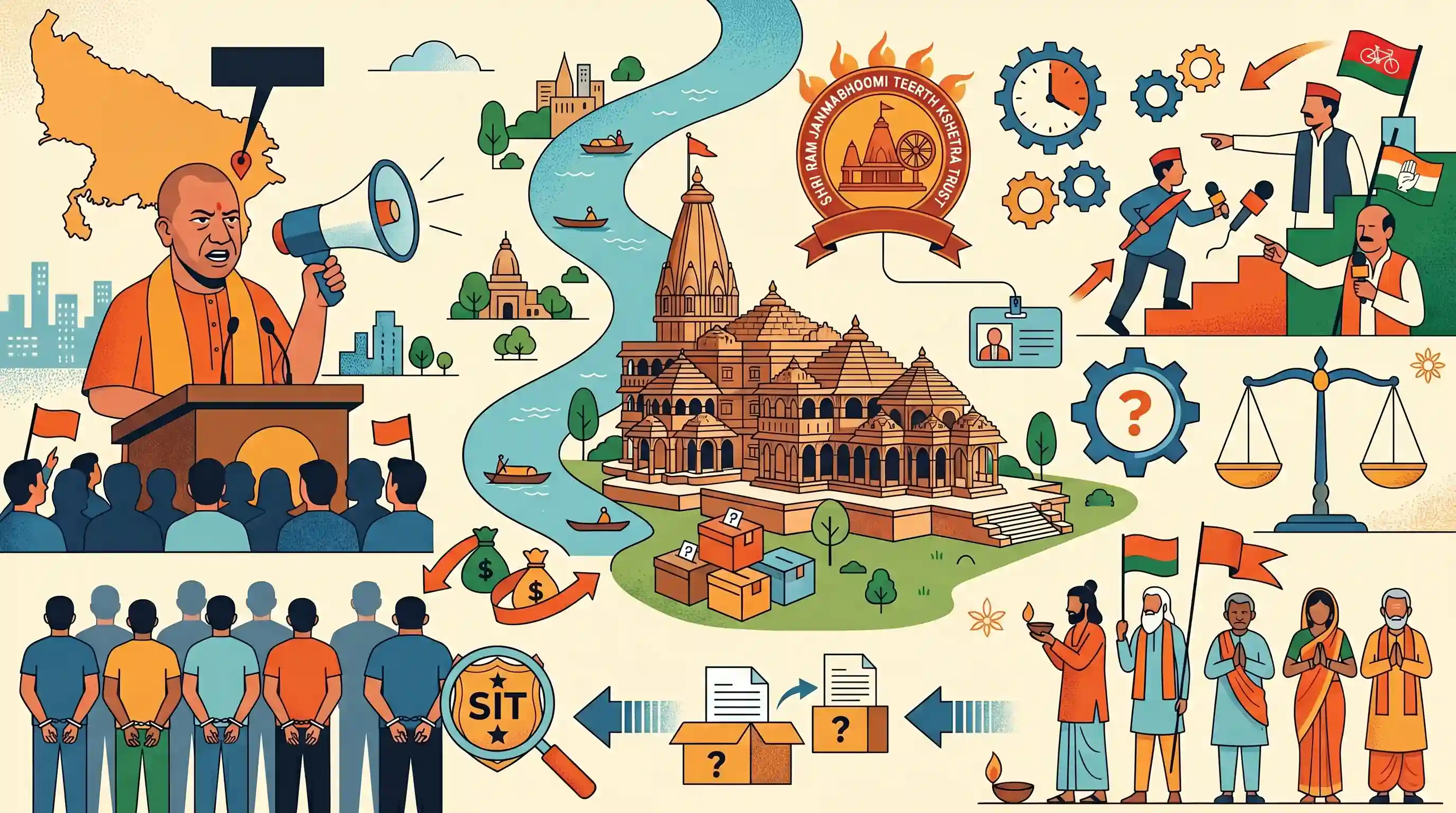
In June 2026, Uttar Pradesh Chief Minister Yogi Adityanath addressed a gathering in Deoria, warning of zero tolerance in the alleged Ram Temple donation theft case in Ayodhya. He stated that a Special Investigation Team (SIT) had already arrested eight individuals, including Ramashankar Yadav (a close aide of Shri Ram Janmabhoomi Teerth Kshetra Trust's general secretary, Champat Rai). Chief Minister Adityanath criticized opposition parties like the Samajwadi Party and Congress for using the issue to gain political mileage ahead of the upcoming UP assembly elections, urging them to submit any evidence to the SIT rather than testing the patience of Ram devotees.
Key Points
- During an event in Deoria, UP Chief Minister Yogi Adityanath warned against politicizing the alleged Ram Temple donation theft case and promised zero tolerance, stating 'Ram bhakton ki agnipariksha mat lo'.
- A Special Investigation Team (SIT) has been constituted by the UP government to investigate the donation theft, leading to the arrest of eight individuals so far.
- Among the arrested is Ramashankar Yadav (alias Tinnu Yadav), a key aide to Champat Rai, who is the General Secretary of the Shri Ram Janmabhoomi Teerth Kshetra Trust.
- Yogi Adityanath slammed opposition parties (Samajwadi Party and Congress) for raising the issue with political motives ahead of the UP assembly elections, pointing out their past opposition to the temple's construction.
- The state government assured the public that anyone hurting the religious sentiments of 'Sanatana' or misusing temple funds would face the harshest punishment based on the SIT findings.
Important Terms
Shri Ram Janmabhoomi Teerth Kshetra Trust

A trust established by the Government of India in 2020 to manage and oversee the construction of the Ram Mandir in Ayodhya following the Supreme Court's landmark verdict.
UPSC context
GS Paper II (Governance); tests understanding of trust administration, executive notifications, and the implementation of judicial mandates.
Special Investigation Team (SIT)
An ad hoc, specialized investigative body formed in India by courts or governments to probe complex, sensitive, or high-profile cases requiring impartial and focused inquiry.
UPSC context
GS Paper II (Polity & Governance); tests knowledge of police reforms, investigative mechanisms, and judicial oversight.
Article 26
A fundamental right in the Indian Constitution that guarantees religious denominations collective freedom to manage their own religious affairs, establish institutions, and administer property.
UPSC context
GS Paper II (Fundamental Rights); tests understanding of freedom of religion, collective vs. individual rights, and reasonable restrictions.
Nagara Style
A prominent style of Hindu temple architecture prevalent in Northern India, characterized by a curvilinear tower (Shikhara) over the sanctum and the absence of elaborate boundary walls.
UPSC context
GS Paper I (Art & Culture); tests knowledge of temple architecture development, regional variations, and iconic structural elements.
Supreme Court of India
The apex judicial body in India, acting as the ultimate court of appeal, the final interpreter of the Constitution, and the guardian of fundamental rights.
UPSC context
GS Paper II (Judiciary); tests understanding of judicial power, original and appellate jurisdictions, and judicial review.
Prelims Trap
All fifteen trustees of the Shri Ram Janmabhoomi Teerth Kshetra Trust hold equal voting rights in its administrative decisions.
Out of the 15 designated trustees, only 11 possess voting rights. Government-appointed officers, the Ayodhya district collector, and the Nirmohi Akhara representative are strictly non-voting members.
Static Concepts Connected
What are the defining features of the Maru-Gurjara (Solanki) sub-style of temple architecture?
- Origin and Era: Developed under the Solanki (Chaulukya) dynasty of Gujarat and Rajasthan between the 11th and 13th centuries as a distinct regional variation of Nagara architecture.
- Decorative Style: Characterized by highly ornate, intricately carved interior pillars, ceilings, and archways (toranas), contrasting with relatively plain external shikhara surfaces.
- Temple Tanks: Often features lavish, stepped temple tanks (kunds) with small shrines built directly into the steps, as famously seen in the Modhera Sun Temple.
How is the right to manage religious properties regulated under the Indian Constitution?
- Article 26(b): Guarantees religious denominations the right to establish and maintain institutions, and to manage their own affairs in matters of religion.
- Article 26(d): Explicitly states that the right to administer property is subject to "law," allowing the State to regulate secular activities associated with religious practices.
- Legislative Competence: Both "Trusts and trustees" (Entry 10) and "Charitable institutions" (Entry 28) fall under the Concurrent List, enabling both Union and State legislation.
Cross-Topic Patterns
Temple Trusts + Article 26 Freedom
Examines the constitutional balance between state administration of public religious trusts and the fundamental rights of denominations under Article 26.
Hydrology + Indo-Nepal Water Diplomacy
Links the Sarayu-Ghaghara-Sharda basin hydrology with Indo-Nepal transboundary water agreements, notably the Mahakali Treaty, under bilateral diplomatic relations.

UPSC may frame a multi-statement question contrasting standard Nagara temple features with the specific Maru-Gurjara (Solanki) sub-style.
Linked PYQs · 2
Linked PYQs · 2
- 1997UPPSC_PRELIMSGS1
The temples of Bhuvaneshwar and Puri were built in:
- 2023UPPSC_PRELIMSGS1
Chandraprabha Wildlife Sanctuary is situated in which district of Uttar Pradesh?
