Lucknow hosts Aam Mahotsav to boost mango exports and production
Source:uniindia ↗
Why It Matters
Uttar Pradesh's dominance in mango production and its export growth are crucial indicators for state economic geography and agricultural infrastructure. Understanding the key producing regions, infrastructure hubs (like those near Jewar Airport and local pack houses), and state subsidies is highly relevant for both UPPSC state-specific questions and GS paper analysis.
Summary
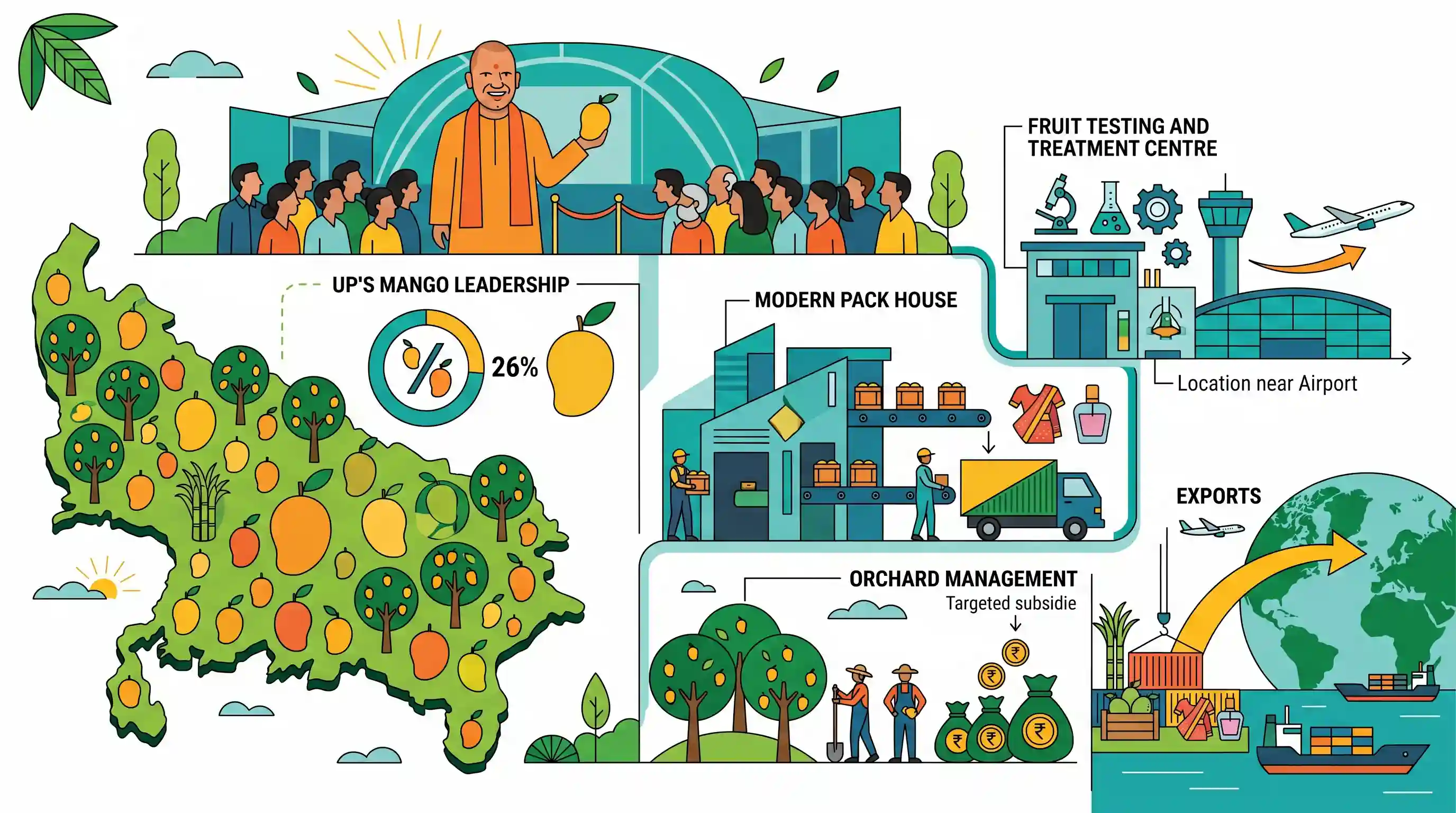
Chief Minister Yogi Adityanath inaugurated the three-day Aam Mahotsav 2026 in Lucknow to promote Uttar Pradesh's prominent mango varieties, agricultural technology, and exports. Uttar Pradesh leads India in mango production, contributing over 26% of the country's total output. The state is scaling up infrastructure with modern pack houses, a dedicated Fruit Testing and Treatment Centre near Jewar Airport, and targeted subsidies for orchard management.
Key Points
- Chief Minister Yogi Adityanath inaugurated the three-day Aam Mahotsav 2026 at Indira Gandhi Pratishthan, Lucknow, which showcases over 800 mango varieties.
- Uttar Pradesh ranks first in India in mango production, with cultivation spread over 3.27 lakh hectares, producing approximately 61.96 lakh metric tonnes (accounting for 26.22% of India's total mango production).
- Prominent mango varieties cultivated in UP include Dussehri, Langra, Chausa, Gaurjeet, Lucknow Safeda, Amrapali, and the GI-tagged Rataul variety.
- The state's mango exports grew significantly from 404 MT (worth ₹2.63 crore) in 2024-25 to 3,563 MT (worth ₹12.67 crore) in 2025-26, targeting markets such as the UK, UAE, Japan, Russia, and Italy.
- To boost exports, UP operates modern Mango Pack Houses in Lucknow, Saharanpur, Varanasi, and Amroha, and is constructing a Fruit Testing and Treatment Centre near Jewar Airport in Greater Noida.
- The state government supports orchardists by providing a 40% subsidy on per-hectare unit cost for canopy management of unproductive/aging orchards and distributing 1.50 crore fruit bags.
- A Mango Buyer-Seller Conference is scheduled at Jan Bhavan, Lucknow, with participation from multiple states including MP, Maharashtra, and Gujarat.
Important Terms
APEDA

A statutory body established in 1986 under India's Ministry of Commerce and Industry to promote the export and development of agricultural and processed food products.
UPSC context
GS Paper III (Agriculture & Economy); crucial for agricultural export policies, trade facilitation, and organic food standard certification.
Atmanirbhar Krishak Samanvit Vikas Yojna
An integrated agricultural development scheme in Uttar Pradesh focused on boosting farmer incomes by setting up Farmer Producer Organisations (FPOs) and utilizing the Agriculture Infrastructure Fund.
UPSC context
GS Paper III (Government Schemes & Agriculture); tests knowledge of state-level interventions to enhance agricultural productivity and farmer welfare.
Geographical Indication (GI) Tag
A sign used on products with a specific geographical origin, possessing qualities or reputation due to that place, registered under India's Geographical Indications of Goods Act, 1999.
UPSC context
GS Paper III (Intellectual Property Rights); evaluates understanding of trade protection, regional heritage promotion, and agricultural product value-addition.
Aam Mahotsav 2026
A three-day state-sponsored mango festival held in Lucknow, Uttar Pradesh, to showcase diverse mango varieties, promote agricultural technologies, and connect local farmers with exporters.
UPSC context
GS Paper III (Horticulture & Agriculture); highlights regional agricultural promotion, post-harvest management, and export-oriented value chain creation.
Prelims Trap
The GI-tagged Rataul mango is native to the Malihabad region of Lucknow.
While Malihabad is legendary for Dussehri mangoes, the Rataul mango is indigenous to and got its GI tag from the Baghpat district in western Uttar Pradesh.
Static Concepts Connected
What is APEDA and its mandate in agricultural exports?
- Statutory Status: Established under the Agricultural and Processed Food Products Export Development Authority Act, 1985, under the Ministry of Commerce and Industry.
- Core Mandate: Responsible for promoting and developing the export of scheduled products, including fruits, vegetables, floriculture, and processed foods.
- Export Standards: Sets quality standards, registers exporters, assists in packing/processing infrastructure, and facilitates financial assistance schemes for market development.
What are Sanitary and Phytosanitary (SPS) measures under the WTO?
- Definition: An agreement under WTO allowing member nations to set food safety and animal/plant health standards to prevent pest or disease entry.
- Non-Discrimination: Requires that regulations must be based on scientific principles and should not be used as disguised restrictions on international trade.
- Impact on Mangoes: Indian mangoes frequently undergo quarantine treatments (e.g., hot water or vapor heat treatment) to comply with importing nations' SPS guidelines.
Cross-Topic Patterns
SPS barriers and agricultural diplomacy
Non-tariff barriers like Vapor Heat Treatment requirements on mangoes show how strict Sanitary and Phytosanitary (SPS) standards under WTO dictate bilateral trade negotiations.
Agro-climatic zoning and climate resilience
Diversifying from water-guzzling crops to high-value, zone-specific horticulture acts as a structural defense against climate-induced monsoon variability.

APEDA's export infrastructure mandates coupled with regional GI tags of commercial crops likely to feature in upcoming Prelims.
Linked PYQs · 2
Linked PYQs · 2
- 2025UPPSC_PRELIMSGS1
With reference to 'Uttar Pradesh', which of the following statements is/are correct ? 1. Uttar Pradesh is the leading producer of potato in the country. 2. Government of India has approved for establishment of South Asia Regional Centre of International Potato Centre at Aligarh. Select the correct answer from the code given below :
- 2014UPPSC_PRELIMSGS1
The number of agro-climate zones in Uttar Pradesh is
