Uttar Pradesh Clean Air Management Project launched by CM Yogi
Source:hindustantimes ↗
Why It Matters
Important for UPPSC aspirants tracking state-level environmental initiatives, pollution control measures, and urban governance policies.
Summary
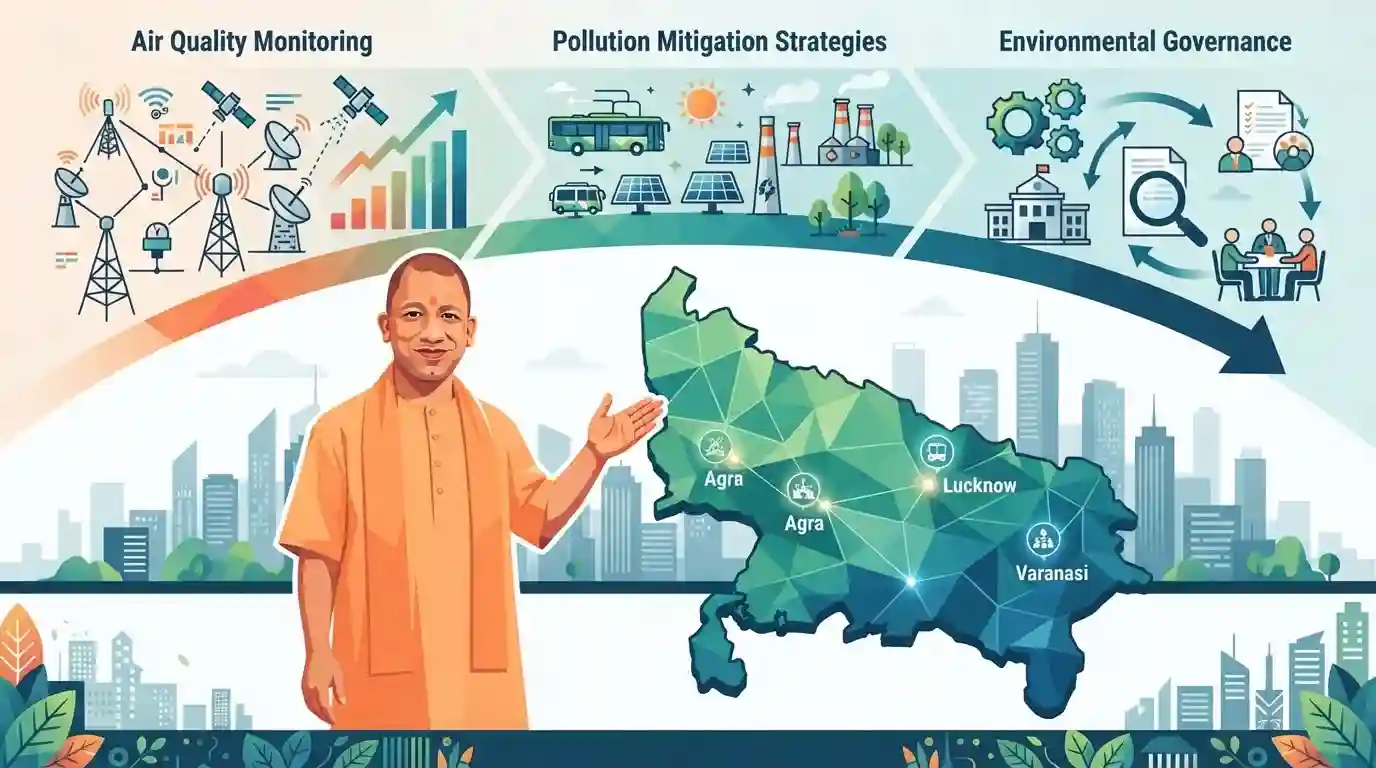
Uttar Pradesh Chief Minister Yogi Adityanath launched the Uttar Pradesh Clean Air Management Project, an initiative aimed at strengthening air quality monitoring, pollution mitigation strategies, and environmental governance across urban centers in the state.
Key Points
- Chief Minister Yogi Adityanath launched the Uttar Pradesh Clean Air Management Project to tackle worsening air pollution in the state.
- The project focuses on scientific mitigation, monitoring, and capacity building to improve urban air quality across key cities in Uttar Pradesh.
- It aligns with broader national efforts like the National Clean Air Programme (NCAP) aimed at reducing particulate matter (PM2.5 and PM10) concentrations.
Important Terms
Uttar Pradesh Clean Air Management Project

India's first airshed-based management project supported by the World Bank to tackle air pollution across the Indo-Gangetic Plains, focusing on cleaner mobility, cooking solutions, and monitoring.
UPSC context
Important for UPPSC GS Paper III (Environment & Pollution Control) and UP-specific current affairs.
National Clean Air Programme
A flagship national initiative launched by the Ministry of Environment, Forest and Climate Change to reduce PM10 and PM2.5 particle pollution levels in non-attainment cities across India.
UPSC context
Core topic under UPPSC GS Paper III (Environmental Governance, Conservation, and Pollution) and national policy interventions.
Prelims Trap
Uttar Pradesh Clean Air Management Project is entirely funded through the state exchequer's climate budget.
Aspirants often confuse UPCAMP as a purely state-funded scheme, whereas it is backed by a World Bank loan of $299.66 million and a $5 million grant.
Static Concepts Connected
What are the primary targets and mechanisms of the National Clean Air Programme (NCAP) in India?
- Reduction Target: NCAP is a national-level strategy by the MoEFCC to reduce PM2.5 and PM10 concentration levels by 40% by 2026 (baseline 2017).
- Coverage: It covers over 130 non-attainment cities that fail to meet national ambient air quality standards (NAAQS).
- Implementation: Funding is linked to performance-based grants for urban local bodies to implement dust mitigation, vehicular emission checks, and industrial pollution control.
What constitutes an Air-shed approach in environmental management and why is it significant for the Indo-Gangetic Plains?
- Definition: An airshed is a geographic area where local topography, meteorology, and climate confine or share common air pollution characteristics.
- IGP Vulnerability: The Indo-Gangetic Plain suffers from trapped pollutants due to the Himalayan barrier, low wind speeds, and regional stubble/biomass burning.
- Management Shift: Airshed management transcends administrative boundaries, requiring coordinated multi-district or multi-state policies rather than isolated municipal measures.
Cross-Topic Patterns
UP Clean Air Project & Climate Finance
The project connects urban environmental governance with World Bank climate financing and public transport electrification under the Faster Adoption and Manufacturing of Electric Vehicles (FAME/PM-eBus) frameworks.
Indo-Gangetic Air-Shed & Regional Geography
Air-shed management in the Indo-Gangetic Plains integrates geographic science (meteorology and topography) with administrative state-level pollution abatement targets.

UPCAMP's World Bank outlay ($304.66M) and Indo-Gangetic air-shed approach will feature in UPPSC Prelims matching/statement questions.
Linked PYQs · 2
Linked PYQs · 2
- 2020UPPSC_PRELIMSGS1
National Clean Air Programme has been launched by the Central Government in the year
- 2021UPPSC_PRELIMSGS1
Which of the following is indicator of air pollution ?
