Uttar Pradesh Vidhan Bhavan Infrastructure and Modernization Projects
Source:thestatesman ↗
Why It Matters
Modernizing legislative infrastructure and adopting new-age outreach tools like podcast studios reflect the UP government's focus on enhancing administrative efficiency, public communication, and institutional prestige while promoting the state's cultural identity.
Summary
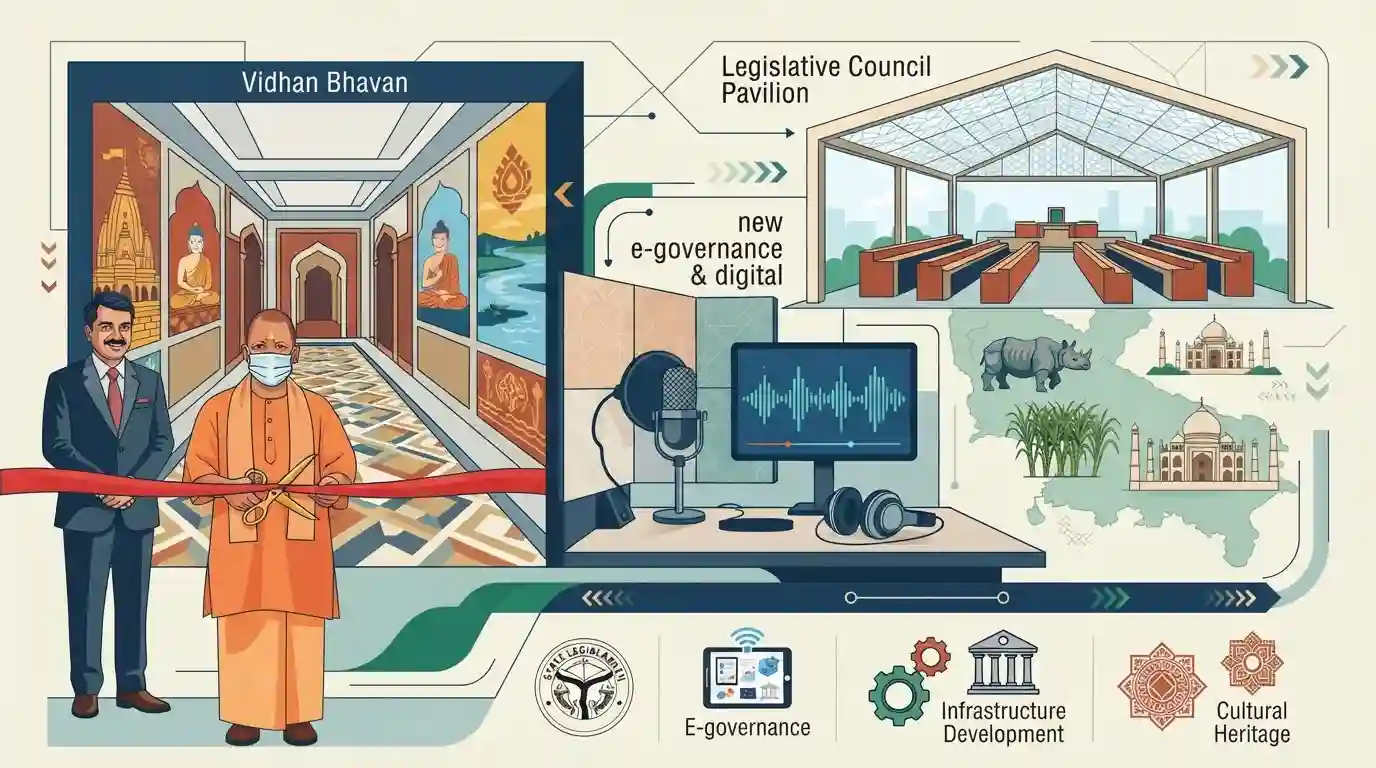
Uttar Pradesh Chief Minister Yogi Adityanath inaugurated several beautification and development projects at the UP Vidhan Bhavan, including a newly constructed podcast studio, a renovated ground-floor corridor, and the Legislative Council pavilion. The improvements showcase the state's rich spiritual heritage and natural beauty through cultural imagery. Assembly Speaker Satish Mahana welcomed the Chief Minister during his visit to review arrangements for the upcoming legislative session, highlighting ongoing efforts to modernize the state's legislative infrastructure while preserving its historical and cultural ethos.
Key Points
- Chief Minister Yogi Adityanath inaugurated multiple beautification and development projects at the UP Vidhan Bhavan.
- Key inaugurations included a newly constructed podcast studio, a renovated ground-floor corridor, and the Legislative Council pavilion.
- The newly renovated spaces feature displays of religious images reflecting Uttar Pradesh's spiritual heritage and natural beauty.
- The event also involved a review of preparations for the upcoming legislative session, with Assembly Speaker Satish Mahana welcoming the Chief Minister.
Important Terms
UP Vidhan Bhavan

The seat of the bicameral state legislature of Uttar Pradesh, housing both the Legislative Assembly and Legislative Council. Its modernization reflects ongoing efforts to integrate digital platforms into the state's legislative and democratic processes.
UPSC context
GS Paper 2 (Polity). Relevant for understanding the modernization of legislative infrastructure, e-governance initiatives, and institutional capacity building.
UP Legislative Assembly
The directly elected lower house of a state's legislature (Vidhan Sabha). As per Article 170, it serves as the primary law-making body at the state level, exercising significant authority over legislation, finance, and the executive.
UPSC context
GS Paper 2 (Polity). Tests the composition, powers, duration, and role of the Vidhan Sabha in passing legislation.
UP Legislative Council
The permanent upper house of a bicameral state legislature (Vidhan Parishad), governed by Article 169. It plays an advisory and reviewing role and cannot be dissolved, with one-third of its members retiring every two years.
UPSC context
GS Paper 2 (Polity). Evaluates knowledge of bicameralism, the creation/abolition process, and structural differences compared to the Assembly.
Prelims Trap
The fields for nomination to the Legislative Council by the Governor are identical to those for the Rajya Sabha by the President.
False. The 'cooperative movement' is an explicit field for nomination to a State Legislative Council under Article 171, but it is not a field for the Rajya Sabha.
Static Concepts Connected
What is the composition structure of a State Legislative Council under Article 171?
- Size constraints: Total members cannot exceed one-third of the State Legislative Assembly's strength, with a strict minimum of 40 members.
- Electoral college: Five-sixths of members are indirectly elected by distinct electorates: local bodies, state MLAs, university graduates, and secondary school teachers.
- Governor nominations: One-sixth of members are nominated from fields of literature, science, art, cooperative movement, and social service.
What are the core components of the National e-Vidhan Application (NeVA) project?
- Digital Parliament: A Digital India Mission Mode Project designed to eliminate paper by equipping legislative desks with touchscreen devices for seamless house proceedings.
- Nodal Ministry: Implemented and steered by the Union Ministry of Parliamentary Affairs, rather than the Ministry of Electronics and Information Technology.
Cross-Topic Patterns
Colonial architecture + Legislative heritage
The UP Vidhan Bhavan's Indo-European design and Chunar sandstone links to UPSC's frequent focus on colonial civic architecture (like Lutyens' Delhi) and indigenous stone usage in state-building.
Polity + E-Governance integration
The adoption of NeVA and digital infrastructure like podcast studios in state assemblies bridges static constitutional functions with the GS2 e-governance mandate, highlighting institutional modernization.

A comparative Prelims question testing the nomination fields of Rajya Sabha vs State Legislative Councils (Art 171) is likely in 2026.
Linked PYQs · 3
Linked PYQs · 3
- 2013UPPSC_PRELIMSGS1
The total number of members of Uttar Pradesh Legislative Council is
- 2024UPPSC_PRELIMSGS1
Which of the following statements are correct with regard to ICT-based e-Governance? 1. e-Governance reduces the transparency of Government. 2. e-Governance reduces the cost of Government. 3. e-Governance increases citizens input into Government. 4. e-Governance increases bureaucratic red tapism. Select the correct answer from the codes given below:
- 2021UPPSC_PRELIMSGS1
The functions of the State Public Service Commission of Uttar Pradesh can be extended by
