UP Government Introduces Electric and Hydrogen Buses in Noida
Source:The Hindu ↗
Why It Matters
This article outlines critical state-specific infrastructure, green energy initiatives, and international funding projects (such as UP CAMP) that are highly relevant to Uttar Pradesh state exams and regional geography/development questions.
Summary
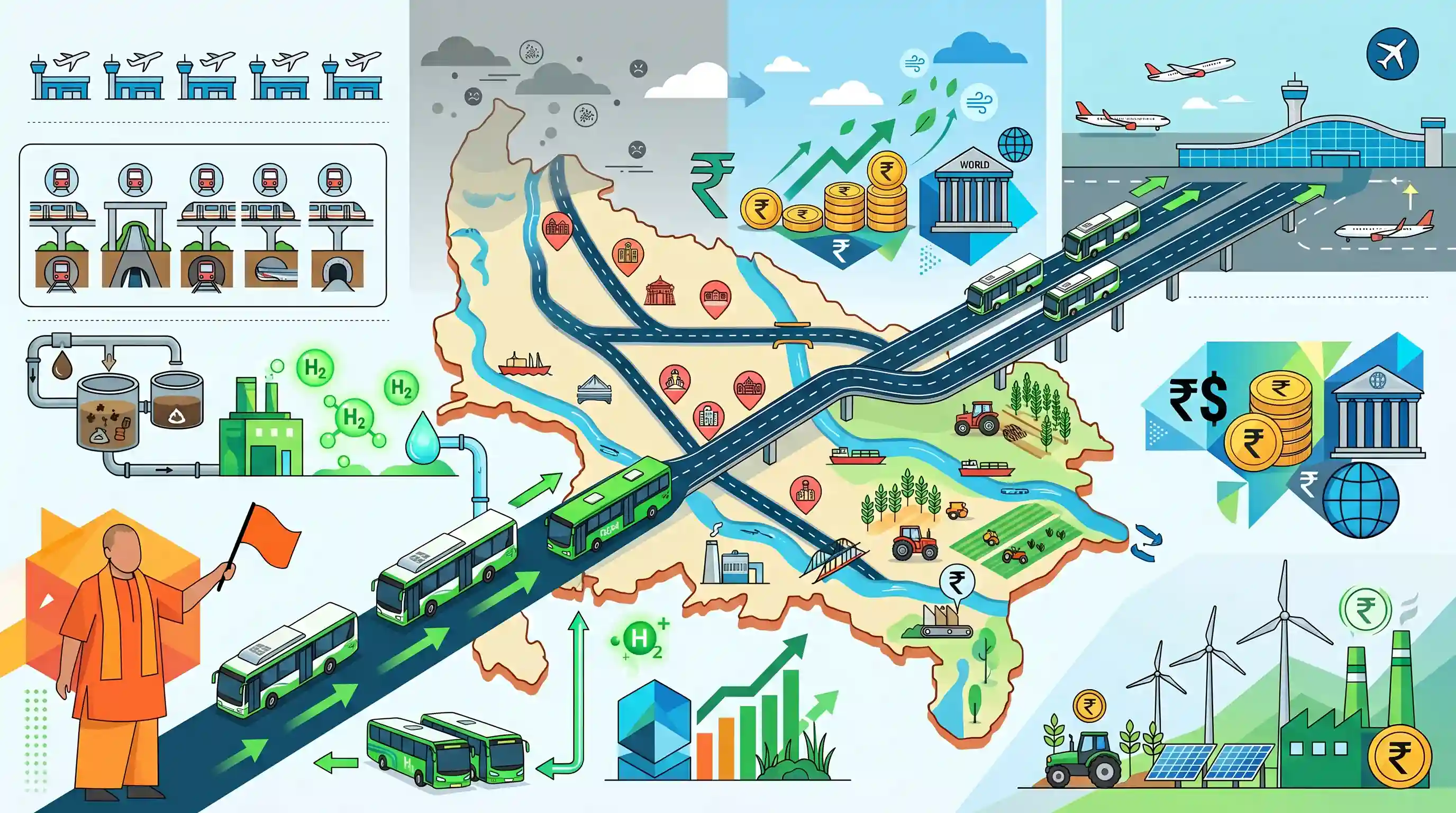
UP Chief Minister Yogi Adityanath flagged off 45 electric buses and 3 hydrogen buses operating to Noida's upcoming Jewar Airport. Key announcements included the introduction of green hydrogen buses fueled by treated sewer water, the Uttar Pradesh Clean Air Management Project (UP CAMP) with ₹2,741 crore World Bank assistance, and state-wide transport infrastructure achievements, including 5 international airports, 7 cities with metro services, and multiple key expressways.
Key Points
- Chief Minister Yogi Adityanath flagged off 45 electric buses and 3 hydrogen buses of UPSRTC to serve the Noida, Greater Noida, and YEIDA regions up to the upcoming Jewar Airport.
- The three innovative hydrogen buses, provided to YEIDA by NTPC, run on hydrogen produced from treated sewer water instead of groundwater or surface water.
- Under the state's clean air initiative, the Uttar Pradesh Clean Air Management Project (UP CAMP) is being implemented with World Bank assistance of ₹2,741 crore.
- UP currently features 5 international airports: Lucknow, Ayodhya (Maharishi Valmiki Airport), Kashi, Kushinagar, and Noida (Jewar). Noida Airport is scheduled to begin operations on June 15.
- Metro systems are functional in 7 cities of UP, and more than 700 electric buses operate across 17 municipal corporations in the state.
- Tata Motors and Ashok Leyland have each set up two electric bus manufacturing plants in Lucknow to support indigenous EV manufacturing.
- To reduce emissions, 15 lakh LED streetlights have been installed in urban areas of UP since 2017, replacing traditional halogen lamps.
Important Terms
Uttar Pradesh Clean Air Management Project (UP CAMP)

A World Bank-backed, airshed-based clean air initiative in Uttar Pradesh designed to reduce PM2.5 levels, promote clean energy and electric mobility, and establish extensive air quality monitoring networks across the Indo-Gangetic Plain.
UPSC context
GS Paper III: Environmental Pollution. Tests state-level environmental governance, airshed management, and multilateral developmental assistance.
Ganga Expressway
A 594-km long, six-lane greenfield expressway in Uttar Pradesh connecting Meerut in the west to Prayagraj in the east, integrating regional markets and functioning as a major economic corridor.
UPSC context
GS Paper III: Infrastructure and Logistics. Tests mega-infrastructure projects, regional connectivity, and transport-led economic development.
Purvanchal Expressway
A 341-km long, six-lane access-controlled expressway linking Lucknow to Ghazipur, designed to improve connectivity and promote industrial, agricultural, and tourist development across eastern Uttar Pradesh.
UPSC context
GS Paper III: Regional Development. Tests transport planning, tackling regional growth disparities, and highway network execution.
Bundelkhand Expressway
A 296-km long, four-lane access-controlled expressway connecting Chitrakoot with Etawah in Uttar Pradesh, linking the underdeveloped Bundelkhand region to major transit networks and supporting the UP Defence Industrial Corridor.
UPSC context
GS Paper III: Regional Planning. Tests connectivity, development of historically backward regions, and military-industrial logistics.
Gorakhpur Link Expressway
A 91.35-km long, four-lane expressway connecting Jaitpur in Gorakhpur to Salarpur in Azamgarh, where it joins the Purvanchal Expressway, significantly reducing travel time in eastern Uttar Pradesh.
UPSC context
GS Paper III: Infrastructure. Tests intra-state transport corridors, feeder routes, and impact on regional economies.
Yamuna Expressway Industrial Development Authority (YEIDA)
A statutory body under the UP Industrial Development Act, 1976, responsible for the systematic and planned industrial development along the Yamuna Expressway corridor, including the Noida International Airport area.
UPSC context
GS Paper III: Urbanization and Industrial Development. Tests statutory planning authorities and infrastructure-led industrialization.
Uttar Pradesh State Road Transport Corporation (UPSRTC)
A public sector passenger transport corporation in Uttar Pradesh that operates one of the largest bus fleets in North India, managing state and interstate routes and driving transition to e-mobility.
UPSC context
GS Paper III: Infrastructure and Public Mobility. Tests public transit management, state road corporations, and green transit schemes.
Prelims Trap
Airshed-based pollution management is confined strictly within state-level political boundaries to prevent transboundary air pollution.
Airsheds are defined by meteorological wind patterns and geographical topography, not political borders. Air pollution naturally crosses district and state lines, making political boundaries ecologically irrelevant.
Static Concepts Connected
What is the 'Airshed' approach to air pollution management?
- Geographical unit: An area where local topography and meteorology limit the dispersion of pollutants, causing them to behave as a uniform volume of air.
- Transboundary shift: Unlike administrative city-specific plans, it addresses transboundary pollution flowing across municipal and state borders.
- Policy integration: NCAP promotes regional, airshed-based strategies recognizing that upwind emissions heavily dictate downwind urban air quality.
What are the feedwater parameters for Green Hydrogen?
- Alternative feedwaters: While standard electrolyzers require highly purified water, emerging technologies allow treated municipal wastewater and seawater feeds to conserve drinking-water sources.
- Zero-emission criteria: The classification depends solely on using renewable energy (solar, wind) for electrolysis, regardless of whether the feedwater is fresh or recycled.
Cross-Topic Patterns
Airshed management & Cooperative Federalism
Indo-Gangetic air pollution requires interstate coordination. Airshed-based funding models like UP-CAMP demonstrate why environmental governance must transcend state and municipal boundaries to be effective.
Wastewater circularity & Green Hydrogen
Using treated sewer water for green hydrogen resolves the ecological conflict of utilizing scarce drinking-grade freshwater for fuel manufacturing, creating a closed-loop urban circular economy.

The shift from city-specific NCAP targets to regional airshed management and wastewater-to-hydrogen circularity will feature in 2026.
Linked PYQs · 5
Linked PYQs · 5
- 2023UPPSC_PRELIMSGS1
Which of the following Scheme/Programme is not the Central Government Programme and it is Uttar Pradesh Government's Programme?
- 2018UPPSC_PRELIMSGS1
'Purvanchal Express Way' in Uttar Pradesh will not pass through which of the following cities?
- 2020UPPSC_PRELIMSGS1
Which of the following Airports in Uttar Pradesh has been granted International Status on 24th June, 2020 by Union Cabinet of India ?
- 2017UPPSC_PRELIMSGS1
Which of the following fuels would produce minimum environmental pollution?
- 2020UPPSC_PRELIMSGS1
National Clean Air Programme has been launched by the Central Government in the year
