Advance Tax Devolution Payment and Cooperative Federalism in UP
Source:uni-india ↗
Why It Matters
Provides a practical example of Centre-State financial relations and cooperative federalism in action, highlighting the constitutional mandate (Article 280) of tax devolution by the Finance Commission.
Summary
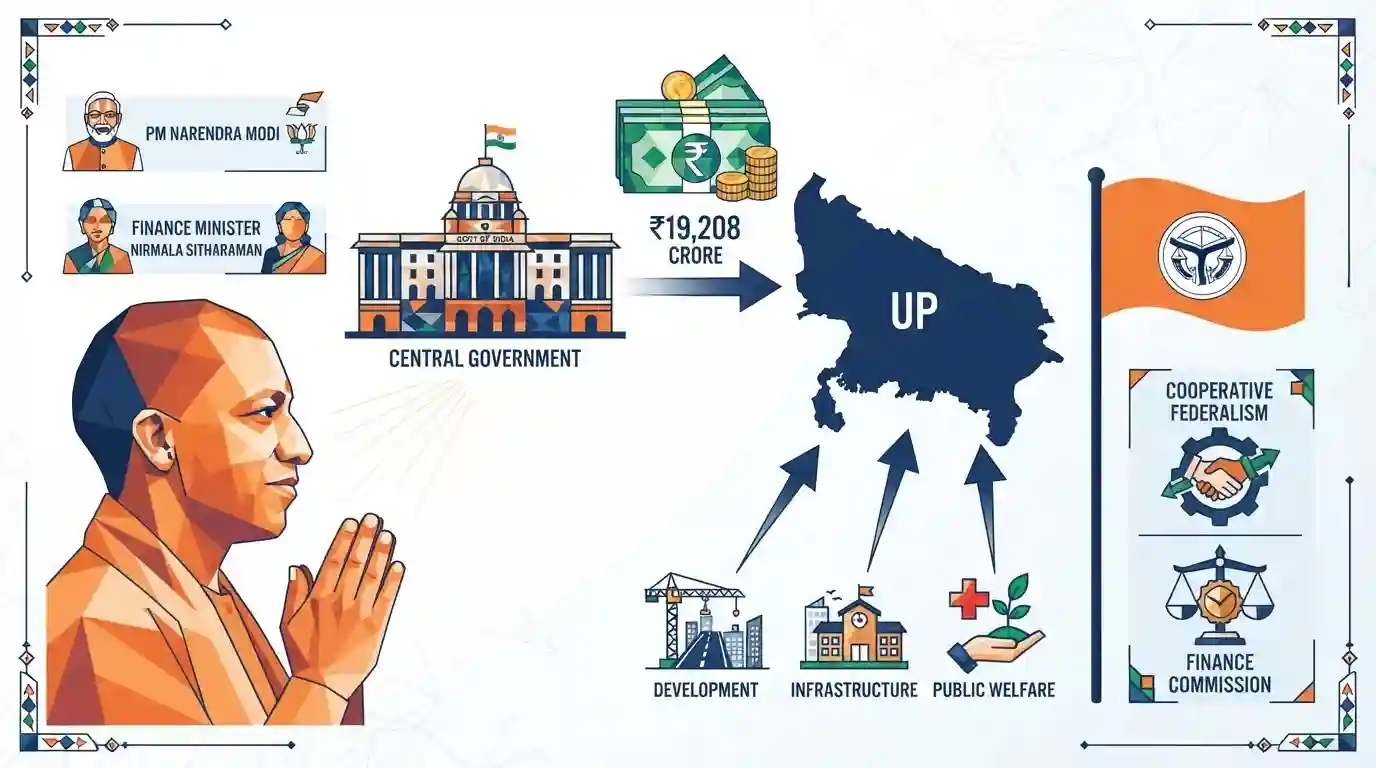
Uttar Pradesh received Rs 19,208 crore as an advance tax devolution installment from the Central Government. CM Yogi Adityanath expressed gratitude to PM Narendra Modi and Finance Minister Nirmala Sitharaman, stating the release embodies "cooperative federalism" and will aid state-level development, infrastructure, and public welfare.
Key Points
- The Central Government released Rs 19,208 crore to Uttar Pradesh as an advance installment of tax devolution.
- Chief Minister Yogi Adityanath highlighted that this financial support reflects the spirit of cooperative federalism.
- The funds are intended to boost the state\'s financial capacity, development works, infrastructure creation, and public welfare initiatives.
Important Terms
Cooperative Federalism

A principle where the central and state governments collaborate as partners to achieve national goals, rather than acting in strict silos or with a top-down approach. It minimizes friction and promotes shared development.
UPSC context
Essential for GS Paper 2 (Indian Polity). Questions frequently test how fiscal policies, councils, or schemes reflect cooperative vs. competitive federalism.
Tax Devolution
The constitutional mechanism (Article 270) of transferring a recommended share of the Union government's net tax proceeds (the divisible pool) to state governments, ensuring untied revenue for states.
UPSC context
Highly relevant for GS Paper 2 (Polity) and GS Paper 3 (Economy), particularly concerning Centre-State financial relations and fiscal federalism.
Finance Commission
A constitutional body formed under Article 280 every five years. It recommends the formula for distributing the divisible pool of central taxes between the Union and the States (vertical and horizontal devolution).
UPSC context
A core topic in GS Paper 2 (Constitutional Bodies) and GS 3. UPSC tests its composition, mandate, and specific recommendations.
Divisible Pool of Taxes
The portion of total tax revenue collected by the Union government that is shared with the States. It includes taxes like income tax and GST, but strictly excludes cesses and surcharges.
UPSC context
Crucial for GS Paper 3 (Indian Economy). UPSC often asks about its composition and issues surrounding the exclusion of cesses.
Central Government
The federal tier of the Indian government, seated in New Delhi. It has exclusive powers over the Union List, shares concurrent powers, and collects the bulk of national tax revenues.
UPSC context
Basic to GS Paper 2 (Polity). Tested regarding its constitutional powers, revenue-raising capacity, and relationship with state governments.
Prelims Trap
"The Finance Commission is the constitutional authority that ascertains and certifies the 'net proceeds' of taxes for devolution."
Under Article 279, it is the Comptroller and Auditor-General (CAG) of India who ascertains and certifies the 'net proceeds', not the Finance Commission.
Static Concepts Connected
What constitutes the Divisible Pool under Article 270?
- Inclusions: It includes the majority of Union taxes and duties levied by the Centre, forming the corpus shared with states.
- Exclusions: It strictly excludes cesses, surcharges, and taxes collected under Articles 268, 269, and 269A (e.g., IGST).
- Net Proceeds: Distribution relies on 'net proceeds' (total revenue minus collection costs), which is legally certified by the CAG.
What are the primary criteria for horizontal tax devolution?
- Income Distance: The highest weightage (45%) given to measure a state's per capita income distance from the highest-income state.
- Population & Demography: A combined 27.5% weight using the 2011 Census (15%) and a reward for demographic performance/population control (12.5%).
- Other Factors: Area (15%), Forest and Ecology (10%), and Tax/Fiscal Efforts (2.5%) balance out the resource distribution matrix.
Cross-Topic Patterns
Financial Devolution + Competitive Federalism
Criteria like 'Tax and Fiscal Efforts' and 'Demographic Performance' in horizontal devolution introduce a competitive element, rewarding states for better population control and revenue generation within a cooperative framework.
Advance Devolution + State Capex
Releasing advance tax installments provides states with front-loaded liquidity, enabling them to execute capital expenditure (Capex) targets early in the fiscal year without resorting to expensive market borrowing.

Expect a multi-statement question on Article 279 (CAG's role in net proceeds) mixed with 16th Finance Commission devolution criteria.
Linked PYQs · 4
Linked PYQs · 4
- 2018UPPSC_PRELIMSGS1
The recommendations of Sarkaria Commission relate to which of the following?
- 2021UPPSC_PRELIMSGS1
The primary duty of the Finance Commission of India is
- 2024UPPSC_PRELIMSGS1
Match List-I: (A) Cooperative Federalism (B) Bargaining Federalism (C) Quasi Federalism (D) Federalism with Centralising Tendency List-II: 1. K.C. Wheare 2. Ivor Jennings 3. Morris-Jones 4. Granville Austin
- 2024UPPSC_PRELIMSGS1
Which one of the following is correctly matched? Constitutional Body — Constitutional Article
