UP Government Directs Officials to Draft New Startup Policy
Source:daily-pioneer ↗
Why It Matters
UPPSC General Studies Paper I frequently tests Uttar Pradesh-specific policies, budget announcements, regional development programs, and achievements in national rankings. Understanding the Startup Policy-2026, U-Hubs, and the Startup Mission is crucial for state-specific economic geography and governance questions.
Summary
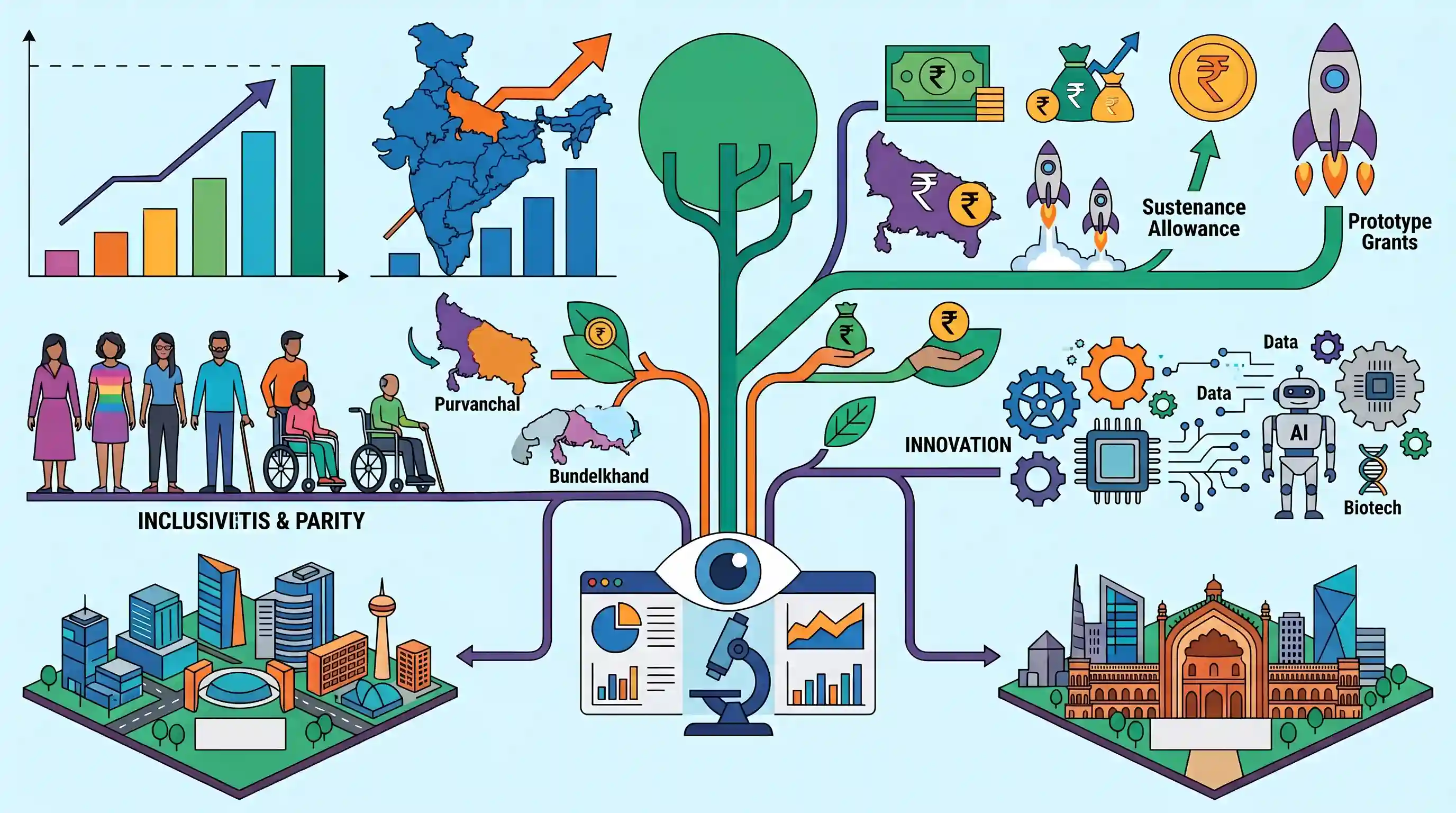
Chief Minister Yogi Adityanath directed officials to formulate the 'Uttar Pradesh Startup Policy-2026' to establish the state as India's leading startup hub. The policy will offer robust support including sustenance allowance, prototype grants, and seed capital, with special focus on inclusive growth (women, transgender individuals, EWS, Divyangjan) and regional parity (Purvanchal and Bundelkhand). It focuses on deep-tech sectors, proposes 'U-Hubs' in Lucknow and Noida, and establishes the 'Uttar Pradesh Startup Mission' to manage and monitor the state's startup initiatives. Notably, UP progressed to the 'Top Performer' category in the Government of India's State Startup Ranking 2025, having started in the 'Aspiring Leader' category in 2018.
Key Points
- Chief Minister Yogi Adityanath has directed the preparation of the new 'Uttar Pradesh Startup Policy-2026' to transform Uttar Pradesh into India's leading startup destination and a hub of innovation-driven growth.
- UP has made significant progress in national rankings, moving from the 'Aspiring Leader' category in 2018 to the 'Top Performer' category in the Government of India's State Startup Ranking 2025.
- The policy will feature targeted incentives for women, economically weaker sections, persons with disabilities (Divyangjan), transgender entrepreneurs, and startups based in the economically lagged Purvanchal and Bundelkhand regions.
- Key policy provisions will include sustenance allowance, prototype grants, seed capital assistance, and special incentives for patents and quality certifications.
- The policy emphasizes deep-tech and emerging sectors such as Artificial Intelligence, Machine Learning, Quantum Technology, Robotics, Semiconductors, Aerospace, Space Technology, and Health-Tech.
- Deep-tech innovation centres called 'U-Hubs' are proposed to be developed in Lucknow and Noida to serve as major hubs for research-based startup support.
- A dedicated institutional mechanism named 'Uttar Pradesh Startup Mission' will be established for the promotion, financial administration, monitoring, and capacity building of the startup ecosystem.
Important Terms
Uttar Pradesh Startup Policy-2026

A state initiative aimed at transforming Uttar Pradesh into India's leading startup hub, focusing on deep-tech sectors, inclusive entrepreneurship (women, transgender, EWS), and regional growth in Purvanchal and Bundelkhand through financial and infrastructure support.
UPSC context
GS-3: Indian Economy and Industrial Policies. Tests understanding of regional developmental parity, technology-led growth, and inclusive state-level entrepreneurship.
States' Startup Ranking Framework
An annual capacity-building exercise by DPIIT evaluating Indian states and UTs on their efforts to build startup-friendly ecosystems. It categorizes them into tiers like 'Best Performers' and 'Top Performers' to foster competitive federalism.
UPSC context
GS-3: Growth, Development, and Investment Models. Tests knowledge of competitive federalism, institutional indices, and central government initiatives driving national entrepreneurship.
Uttar Pradesh Startup Mission
The nodal implementation body under UP's startup policy, established to oversee startup promotion, manage financial disbursements (grants, seed capital), monitor stakeholder performance, and coordinate the state's expanding incubation ecosystem.
UPSC context
GS-2: Governance and Institutional Frameworks. Tests understanding of administrative structures, nodal agencies, and the executive mechanism of state-level welfare policies.
U-Hubs
Specialized deep-tech innovation and incubation centers proposed in Lucknow and Noida to provide early-stage startups with infrastructure, mentoring, investor networks, and advanced research linkages.
UPSC context
GS-3: Science and Technology. Tests familiarity with physical tech-incubation infrastructure, regional R&D clusters, and industry-academia-government integration models.
Department for Promotion of Industry and Internal Trade (DPIIT)
A central government department under the Ministry of Commerce and Industry that formulates industrial policies, facilitates ease of doing business, manages foreign direct investments, and spearheads the national Startup India initiative.
UPSC context
GS-3: Indian Economy and Industrial Growth. Tests awareness of central administrative ministries, key industrial policies, regulatory easing, and ease of doing business.
Prelims Trap
The States' Startup Ranking is evaluated by NITI Aayog, and Uttar Pradesh has achieved the highest 'Best Performer' rank.
The States' Startup Ranking is conducted by DPIIT (Ministry of Commerce & Industry), not NITI Aayog. Also, UP is a 'Top Performer', which is the second-highest category, not 'Best Performer'.
Static Concepts Connected
What is the States' Startup Ranking and how is it structured?
- Nodal Authority: Conducted annually by the Department for Promotion of Industry and Internal Trade (DPIIT) under the Ministry of Commerce and Industry.
- Classification Tiers: Divides states into five tiers: Best Performers, Top Performers, Leaders, Aspiring Leaders, and Emerging Startup Ecosystems to prevent uniform-scale comparison bias.
- Evaluation Pillars: Focuses on key pillars including institutional support, fostering innovation, access to market, incubation support, and funding enablement.
What defines 'Deep-Tech' and its challenges in India?
- Core Definition: Startups founded on tangible scientific discoveries or engineering innovations, distinct from businesses applying standard digital platforms or business model tweaks.
- Key Obstacles: Requires heavy capital, faces long gestation periods (high gestation risk), and demands sophisticated intellectual property protection.
- Policy Redressal: The draft National Deep Tech Startup Policy (NDTSP) proposes long-term funding, infrastructure access, and regulatory sandboxes to ease commercialization.
Cross-Topic Patterns
Regional parity via tech-startup incentives
Targeted top-ups for backward regions like Purvanchal and Bundelkhand show how states utilize technological venture creation to counter historic regional economic imbalances and migration.
Social inclusion through equity ownership
Providing 50% extra incentives for transgender, Divyangjan, and EWS co-founders with >26% equity signals a transition from passive welfare transfers to active wealth-creation policies.

DPIIT State Startup Ranking categories and inclusive equity incentives are highly probable areas for multi-statement GS-3 Prelims questions.
Linked PYQs · 3
Linked PYQs · 3
- 2021UPPSC_PRELIMSGS1
Which of the following Schemes in Uttar Pradesh were introduced in Budget of 2021-22? I. Atmanirbhar Krishak Samanvit Vikas Yojna II. Mukhya Mantri Saksham Suposhan Yojna III. Mukhya Mantri Pravasi Shramik Udyamita Vikas Yojna IV. Yuva Udyamita Vikas Abhiyan Select the correct answer from the codes given below.
- 2023UPPSC_PRELIMSGS1
Which of the following scheme/s is/are related to Uttar Pradesh? (1) Anuthee Uphar Scheme (2) Matra Shakti Udyamita Scheme (3) Kaushalya Matritva Scheme (4) Stree Nidhi Scheme Select the 'correct' answer using the code given below -
- 2024UPPSC_PRELIMSGS1
Match List-I with List-II and select the correct answer from the codes given below. List-I (State): (A) Maharashtra (B) Uttar Pradesh (C) Tamil Nadu (D) Karnataka List-II (Rank according to expenditure on infrastructure 2019 - 23): 1. First 2. Second 3. Third 4. Fourth
