Uttar Pradesh Pitched as GCC Powerhouse at Bengaluru Investor Roadshow
Source:ani ↗
Why It Matters
Understanding regional investment dialogues, infrastructure corridors, and industrial policies is crucial for UPPSC GS Paper 3 (Economy and Infrastructure) and UP State-Specific GK. The transition of UP towards attracting IT-BPO, GCCs, and high-tech investments is a major developmental shift.
Summary
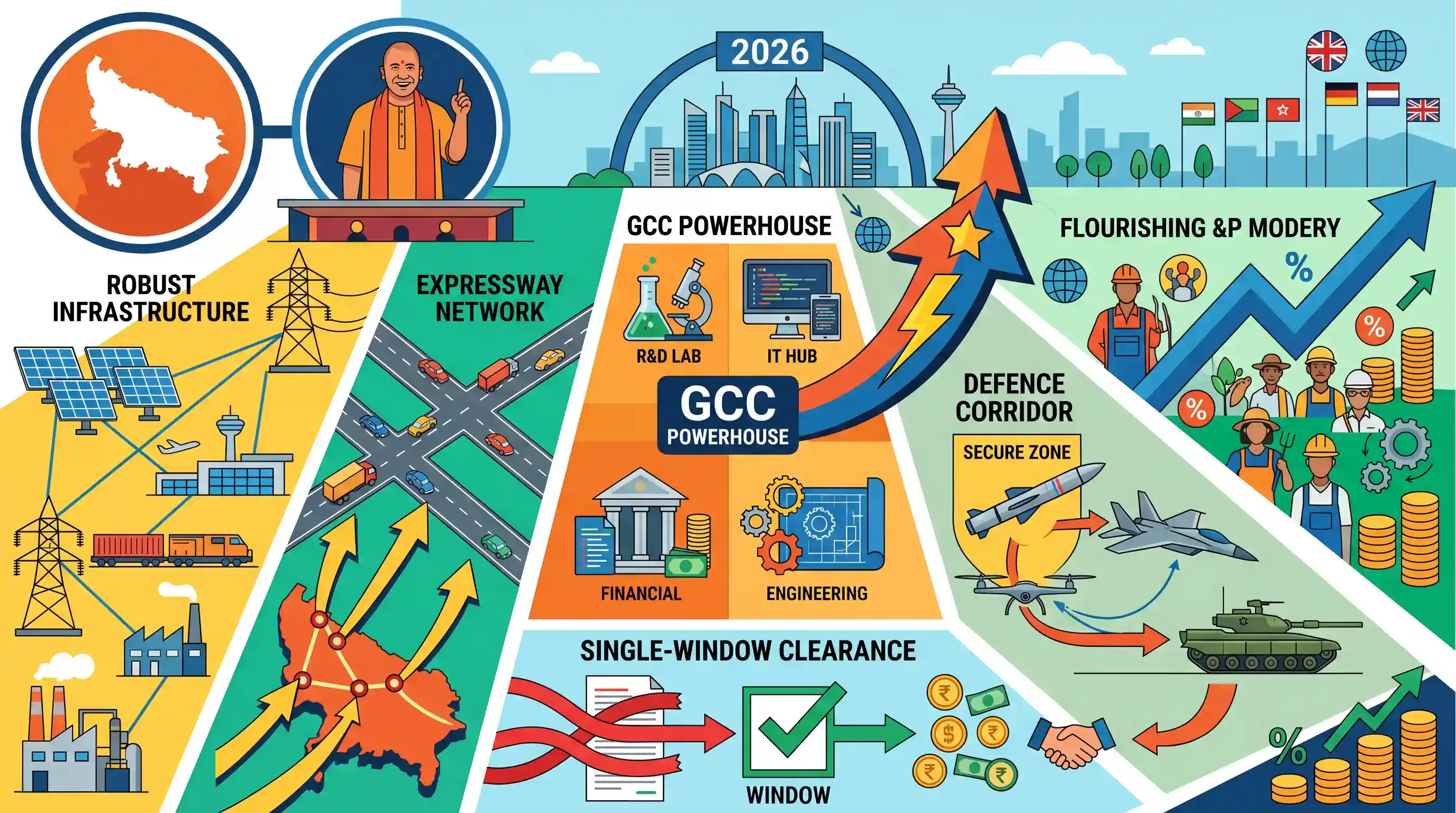
Chief Minister Yogi Adityanath led the Bengaluru Investor Roadshow under the 'Uttar Pradesh Global Growth Dialogue 2026' on June 24, 2026. The event aimed to pitch Uttar Pradesh as a 'GCC Powerhouse' and a preferred destination for Foreign Direct Investment (FDI), leveraging its robust infrastructure, expressway network, Defence Corridor, and single-window clearance system.
Key Points
- Uttar Pradesh Chief Minister Yogi Adityanath led an Investor Roadshow in Bengaluru under the 'Uttar Pradesh Global Growth Dialogue 2026' to position UP as a preferred investment destination.
- The roadshow featured three primary thematic sessions: Infrastructure, IT and IT-enabled Services (IT-ITeS) including Global Capability Centres (GCCs), and Foreign Direct Investment (FDI).
- The state government pitched its industrial ecosystem, highlighting key assets such as its extensive expressway network, the Defence Corridor, Data Centre Parks, the EV ecosystem, and single-window clearance mechanisms.
- The outreach targets technology leaders and industrialists in Bengaluru (India's tech hub) to attract business setups and establish Uttar Pradesh as a 'GCC Powerhouse'.
- Additionally, Chief Minister Adityanath laid foundation stones for several development projects in Hamirpur, emphasizing the state's welfare focus for its 25 crore citizens.
Important Terms
Global Capability Centres (GCC)

Wholly-owned offshore facilities set up by multinational companies to internally handle advanced operations like R&D, product engineering, cybersecurity, and digital transformation.
UPSC context
GS Paper III (Economy/Technology); tests services sector evolution, employment patterns, and India's transition to a high-tech innovation hub.
Uttar Pradesh Global Growth Dialogue 2026
A state government investment outreach initiative designed to attract foreign and domestic investments by positioning Uttar Pradesh as a preferred industrial and technological hub.
UPSC context
GS Paper III (Economic Growth); tests state-level investment policies, industrial infrastructure development, and regional economic planning.
Uttar Pradesh Defence Industrial Corridor
A strategic manufacturing zone comprising six nodes, established to catalyze indigenous defence production, reduce import reliance, and foster private sector and MSME growth.
UPSC context
GS Paper III (Indigenization of Technology); tests strategic manufacturing hubs, defence self-reliance, and public-private partnerships.
Nivesh Mitra
The online single-window clearance portal of the Uttar Pradesh government, facilitating ease of doing business by streamlining investment approvals across diverse departments.
UPSC context
GS Paper III (Ease of Doing Business); tests digital governance, administrative reforms, and state-led facilitation for industrial development.
Foreign Direct Investment (FDI)
An investment made by an individual or entity from one nation into business interests located in another country, establishing lasting interest and control.
UPSC context
GS Paper III (Mobilization of Resources); tests understanding of external capital flows, ease of doing business, and investment policy frameworks.
Prelims Trap
The Uttar Pradesh State Transformation Commission (STC) is a statutory body established under a legislative Act.
Like NITI Aayog, the State Transformation Commission (STC) is established via an executive resolution (cabinet decision) to replace the planning body, not through a legislative Act.
Static Concepts Connected
How do Global Capability Centres (GCCs) differ from traditional Business Process Outsourcing (BPOs)?
- Ownership Structure: Traditional BPOs operate on third-party service provider models, whereas GCCs are 100% captive, wholly owned subsidiaries of the parent multinational corporation.
- Value Chain: BPOs typically manage low-end transactional, operational tasks, while GCCs focus on high-value, IP-heavy, strategic functions like R&D, advanced analytics, and cybersecurity.
What is the structure and objective of the Defence Industrial Corridors in India?
- Dual Corridors: The Ministry of Defence established two corridors: one in Uttar Pradesh (managed by UPEIDA) and one in Tamil Nadu (managed by TIDCO).
- UP Nodes: The UP corridor spans six strategic nodes: Aligarh, Agra, Jhansi, Kanpur, Lucknow, and Chitrakoot, targeting specialized defense manufacturing clusters.
- Primary Objective: To foster domestic defense indigenization, reduce import reliance, and integrate MSMEs into the global defense aerospace supply chain.
Cross-Topic Patterns
Sub-national diplomacy and competitive federalism
State governments directly lobbying domestic tech hubs (like UP in Bengaluru) demonstrates how competitive federalism drives localized FDI policies and decentralized economic diplomacy.
Service sector decentralization to Tier-2/3 cities
The migration of GCCs to Tier-2 and Tier-3 cities reflects a structural shift from traditional IT outsourcing to high-value service-led regional development.

2026 Prelims may test the geographical nodes of India's Defence Corridors and the non-statutory nature of State Transformation Commissions.
Linked PYQs · 2
Linked PYQs · 2
- 2023UPPSC_PRELIMSGS1
Which of the following Scheme/Programme is not the Central Government Programme and it is Uttar Pradesh Government's Programme?
- 2013UPPSC_PRELIMSGS1
The North-South and East West corridors of the National Highway Development Project meet at
