UP launches second phase of School Chalo Abhiyan from Saharanpur
Source:indianmasterminds ↗
Why It Matters
UPPSC Prelims regularly tests students on state-specific welfare and educational schemes (such as School Chalo Abhiyan and Operation Kayakalp), their launch years, core objectives, target demographics (such as differently-abled students), and the specific districts/venues associated with major phase launches.
Summary
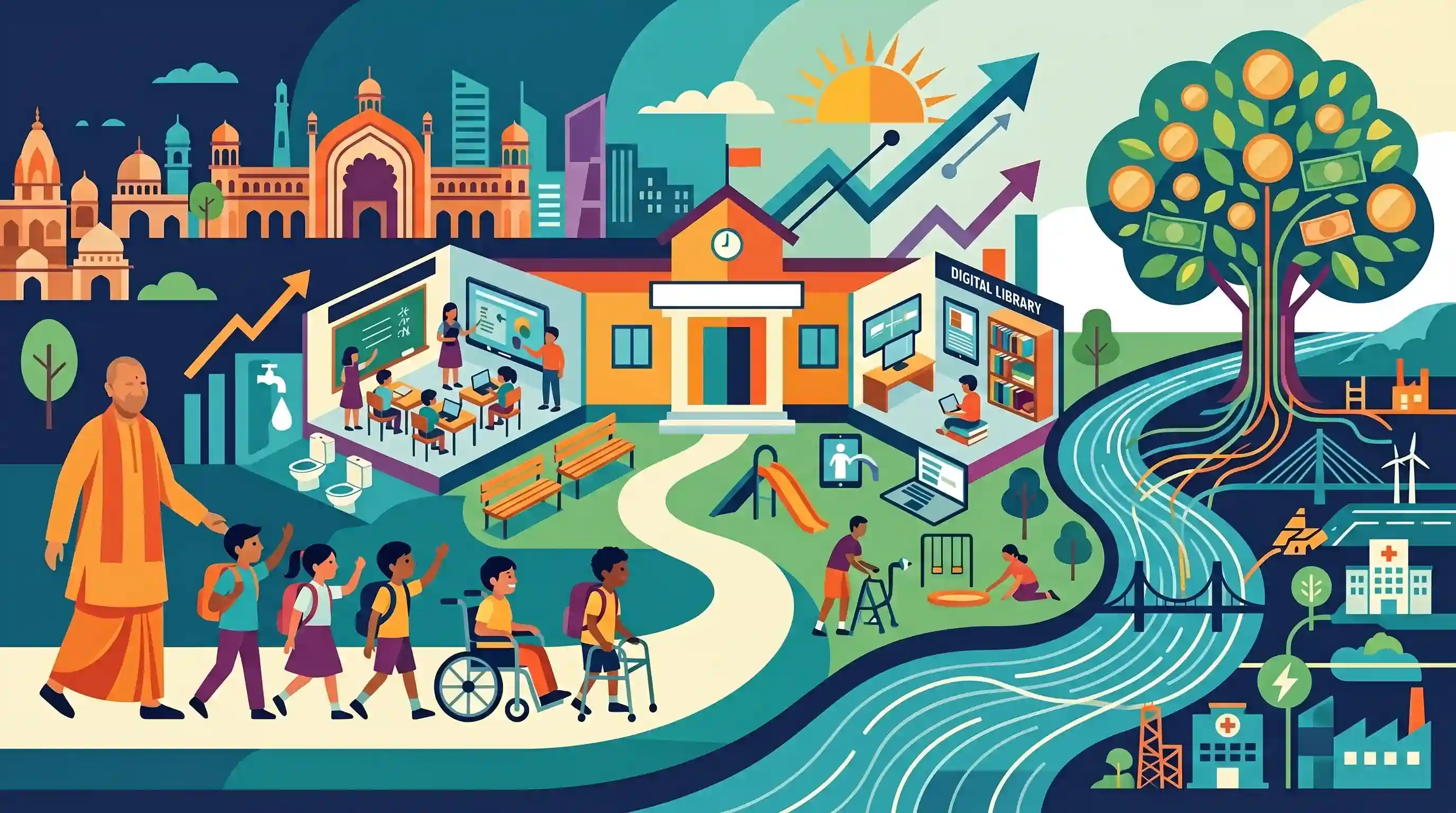
Uttar Pradesh Chief Minister Yogi Adityanath launched Phase-2 of the 'School Chalo Abhiyan 2026' from Saharanpur to boost primary school enrollment and promote universal quality education. The initiative, originally started in 2017, runs alongside 'Operation Kayakalp' to modernize and upgrade government school infrastructure with smart classrooms, digital libraries, and better basic facilities. Additionally, development projects worth ₹613 crore were unveiled during the event.
Key Points
- Chief Minister Yogi Adityanath launched Phase 2 of the statewide 'School Chalo Abhiyan 2026' from the Maharaj Singh Degree College ground in Saharanpur on July 1, 2026.
- The 'School Chalo Abhiyan' is a flagship enrollment campaign in Uttar Pradesh, originally launched in 2017, aiming to ensure universal and non-discriminatory primary education.
- The CM highlighted the role of 'Operation Kayakalp', a scheme initiated to upgrade basic school infrastructure, revealing that only 36% of government schools had basic facilities in 2017 before the scheme's massive infrastructure overhaul.
- Upgrades under 'Operation Kayakalp' include separate toilets, clean drinking water, school furniture, boundary walls, smart classrooms, ICT labs, and digital libraries.
- Under the state's inclusive education push, assistive devices have been provided to more than 1 lakh differently-abled children to help integrate them into mainstream schooling.
- In tandem with the educational campaign, development projects worth over ₹613 crore were inaugurated or had their foundation stones laid in Saharanpur.
Important Terms
School Chalo Abhiyan

A flagship state-wide campaign launched by Uttar Pradesh to achieve 100% school enrollment, target dropouts and out-of-school children, and integrate them into primary and upper primary education.
UPSC context
GS Paper II: Social Sector/Education. Tests knowledge of state-level social welfare schemes and interventions to improve primary enrollment.
Operation Kayakalp
A flagship initiative launched by Uttar Pradesh in 2018 to upgrade physical infrastructure and modernize facilities in state-run primary and upper primary schools using a 19-point standard framework.
UPSC context
GS Paper II: Social Sector/Education. Tests understanding of governance initiatives and infrastructure convergence programs to improve public education quality.
Basic Education Department, Uttar Pradesh
The state government department responsible for administering, regulating, and implementing primary education, teacher recruitment, and welfare initiatives like Nipun Bharat and Operation Kayakalp in Uttar Pradesh.
UPSC context
GS Paper II: Welfare Schemes & Governance. Tests knowledge of state executive bodies executing educational reforms and grassroot policy implementation.
Government of Uttar Pradesh
The sub-national governing body of Uttar Pradesh, India, responsible for implementing regional policy, socio-economic welfare schemes, and infrastructural development across 75 districts.
UPSC context
GS Paper II: Federalism & State Governance. Tests understanding of the role of state-level executives in regional development and public service delivery.
Prelims Trap
Project Alankar is a central government scheme launched to modernize infrastructural facilities in primary schools across India.
Project Alankar is a Uttar Pradesh state scheme (not central) specifically targeting secondary and Sanskrit schools, rather than primary schools.
Static Concepts Connected
What are the key constitutional provisions governing the Right to Education in India?
- Article 21A: Added by the 86th Amendment Act (2002), making free and compulsory education a Fundamental Right for children aged 6 to 14.
- Article 45: Directs the State to provide early childhood care and education until children complete the age of six years.
- Article 51A(k): Mandates parents or guardians to provide educational opportunities to their child or ward between 6 and 14 years of age.
- Seventh Schedule: Education was moved from the State List to the Concurrent List via the 42nd Constitutional Amendment Act of 1976.
What is the ASER survey and how is it conducted?
- Lead Agency: It is a citizen-led, household-based survey facilitated annually by the non-governmental organization Pratham since 2005.
- Target Group: It measures the enrollment status and basic reading and arithmetic abilities of children aged 3 to 16 in rural India.
- Methodology Advantage: Being household-based rather than school-based, it successfully captures children who are out of school or in non-formal systems.
Cross-Topic Patterns
Infrastructure upgrades and local body funds
Linking school infrastructure upgrades under Operation Kayakalp to local panchayat fund convergence shows how decentralized governance drives primary education outcomes.
Digital divide vs. rural schooling
Deploying smart classrooms in rural state schools directly addresses the digital divide, bridging GS-2 educational access with GS-3 technology penetration.

State-led education convergence models like Operation Kayakalp are likely to be evaluated under NEP 2020 federal alignment in GS-2.
Linked PYQs · 3
Linked PYQs · 3
- 2023UPPSC_PRELIMSGS1
Which of the following scheme/s is/are related to Uttar Pradesh? (1) Anuthee Uphar Scheme (2) Matra Shakti Udyamita Scheme (3) Kaushalya Matritva Scheme (4) Stree Nidhi Scheme Select the 'correct' answer using the code given below -
- 2021UPPSC_PRELIMSGS1
Which of the following Schemes in Uttar Pradesh were introduced in Budget of 2021-22? I. Atmanirbhar Krishak Samanvit Vikas Yojna II. Mukhya Mantri Saksham Suposhan Yojna III. Mukhya Mantri Pravasi Shramik Udyamita Vikas Yojna IV. Yuva Udyamita Vikas Abhiyan Select the correct answer from the codes given below.
- 2016UPPSC_PRELIMSGS1
In India inclusive education for the disabled at secondary stage scheme launched in the year 2009-10 is being provided under
