Banda District Infrastructure and Heritage Development Projects
Source:indianmasterminds ↗
Why It Matters
Bundelkhand's regional development, tourism sites (such as Bhuragarh Fort and Kalinjar Fort), local river geography (Ken-Betwa system), and historical figures from the 1857 rebellion (like Rani Avanti Bai Lodhi) are frequently featured in UPPSC GS Paper 1 history and geography questions.
Summary
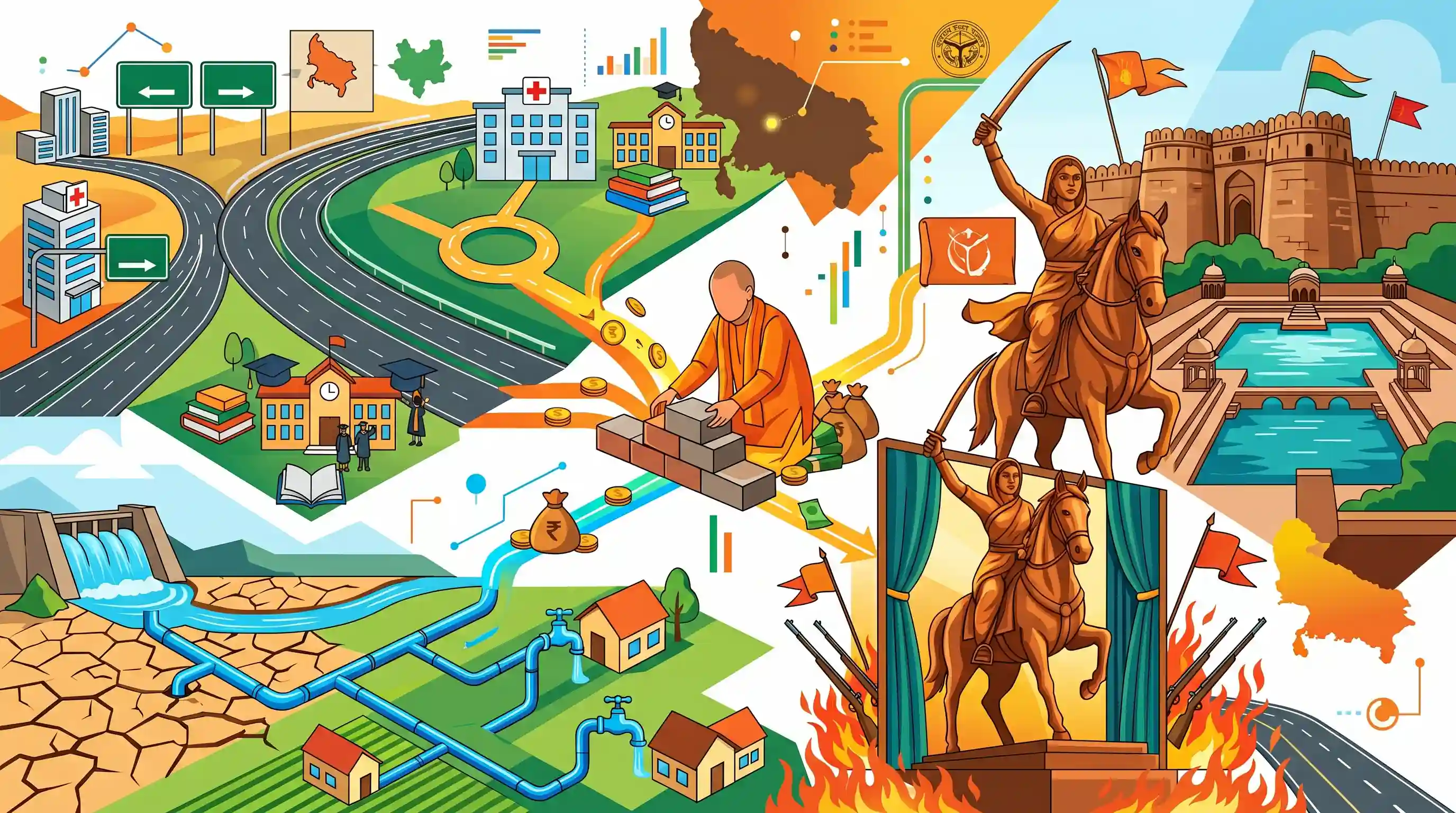
Uttar Pradesh Chief Minister Yogi Adityanath inaugurated and laid the foundation stones for development projects worth ₹710 crore in Banda district, Bundelkhand. Spanning roads, healthcare, education, water resources, and tourism, the 229 projects aim to transform the historically underdeveloped and arid region. Highlights include major road-widening initiatives to link Banda with Chitrakoot and Hamirpur, heritage conservation at Bhuragarh Fort and Nawab Tank, and the unveiling of a statue dedicated to 1857 Revolt heroine Rani Avanti Bai Lodhi. The projects align with broader state and national welfare schemes like the Har Ghar Jal initiative and the Chief Minister Urban Expansion Scheme to address regional challenges.
Key Points
- Uttar Pradesh Chief Minister Yogi Adityanath launched development projects worth ₹710 crore in Banda district, inaugurating 109 completed projects and laying foundation stones for 120 new ones.
- Infrastructure enhancements focus on road connectivity, including the four-laning/widening of the Banda-Kamasin-Rajapur road to link Banda with Chitrakoot, and widening the Banda-Baberu-Tindwari-Sumerpur road toward Hamirpur.
- A statue of Veerangana Rani Avanti Bai Lodhi, a prominent warrior and leader of the 1857 Revolt, was unveiled at the Kalukuan intersection in Banda to honor her struggle against British rule.
- Tourism development initiatives were launched at historic sites including the Bhuragarh Fort (on the Ken River), Shri Dabar Devta Temple, and Nawab Tank, aimed at promoting cultural tourism.
- The development drive emphasizes socio-economic transformation in Bundelkhand, targeting traditional challenges like security issues in the Patha region, drinking water shortages via the Har Ghar Jal scheme, and migration.
Important Terms
Har Ghar Jal initiative

A central government scheme under the Jal Jeevan Mission aiming to provide safe, adequate, and piped drinking water via Functional Household Tap Connections (FHTC) to all rural households in India.
UPSC context
GS Paper II (Government Schemes) and GS III (Water Resources); tests rural development and clean water governance models.
Pradhan Mantri Awas Yojana
A flagship housing scheme of the Government of India designed to provide affordable, all-weather pucca houses with basic amenities like water and sanitation to rural and urban poor families.
UPSC context
GS Paper II (Social Justice & Welfare Schemes); assesses welfare delivery, poverty alleviation, and urban-rural housing initiatives.
Chief Minister Urban Expansion Scheme
An Uttar Pradesh state scheme providing financial support (seed capital) to regional development authorities for land acquisition to establish planned modern townships, new cities, and reduce existing urban congestion.
UPSC context
GS Paper II & III (Urbanization & Regional Planning); tests understanding of decentralized infrastructure and state-level land policies.
Primary Health Centre (PHC), Barokhar
The foundational unit of rural healthcare in India, serving as the first contact point between rural communities and qualified doctors, covering a population of 20,000 to 30,000.
UPSC context
GS Paper II (Social Sector/Health Infrastructure); evaluates rural primary health delivery and National Health Mission targets.
Community Health Centre (CHC), Barokhar
A secondary-level public healthcare referral center in rural India, operating as a 30-bed hospital with specialized medical services for a population of 80,000 to 1,20,000.
UPSC context
GS Paper II (Health Sector & Social Infrastructure); tests understanding of rural referral healthcare systems and public medical administration.
Government Industrial Training Institute (ITI), Banda
A public post-secondary vocational school under India’s skill development ministry, providing trade-specific, industry-oriented technical courses to high school graduates to improve youth employability.
UPSC context
GS Paper III (Employment & Skill Development); assesses human capital development, demographic dividend policies, and vocational training frameworks.
Government Polytechnic Banda
A public technical institution offering multi-year diploma programs in engineering, emphasizing practical, hands-on learning to supply mid-level technicians and supervisors to the industrial workforce.
UPSC context
GS Paper III (Technology & Employment); evaluates the vocational education framework, industrial manpower, and technical skill-building ecosystems.
Prelims Trap
The Ken-Betwa Link Project (KBLP) is designed to divert surplus water from the Betwa river to the water-deficit Ken river.
The project transfers surplus water from the Ken river basin to the water-deficit Betwa river basin, not the other way around. Both are Yamuna tributaries.
Static Concepts Connected
What was the role of Rani Avanti Bai Lodhi in the Revolt of 1857?
- Ramgarh Rebellion: Led the anti-British rebellion in the princely state of Ramgarh (Mandla, MP) after its annexation under the Doctrine of Lapse.
- Battle of Kheri: Defeated British forces under Captain Waddington using highly effective guerrilla tactics.
- Supreme Sacrifice: Chose to end her own life with her sword at Devharigarh hills to prevent capture by the British.
What are the key features and concerns of the Ken-Betwa Link Project?
- First Interlinking Project: India's first river-interlinking project under the National Perspective Plan, transferring water from the Ken to the Betwa.
- Key Infrastructure: Involves constructing the Daudhan Dam and a 221-km canal to irrigate the drought-prone Bundelkhand region.
- Ecological Concern: The project threatens to submerge over 4,000 hectares of the Panna Tiger Reserve, impacting critical tiger and vulture habitats.
Cross-Topic Patterns
River Interlinking vs. Wildlife Conservation
The Ken-Betwa link highlights the core conflict between developmental infrastructure (irrigation for drought-prone Bundelkhand) and environmental conservation (submergence of Panna Tiger Reserve).
Maratha Footprints in Bundelkhand
The Nawab Tank links to Shamsher Bahadur I (Peshwa Baji Rao I's son), illustrating the Maratha expansion into Bundelkhand and their local cultural legacy.

UPSC may combine 1857 regional leaders (like Avanti Bai) with the geographical and ecological trade-offs of the Ken-Betwa Link Project.
Linked PYQs · 3
Linked PYQs · 3
- 2023UPPSC_PRELIMSGS1
Which one of the following (Place of the revolt of 1857 – Start of rebellion) is not correctly matched?
- 2006UPPSC_PRELIMSGS1
In the Uttar Pradesh and Madhya Pradesh States, the joint Rajghat River Valley Project is launched on
- 2022UPPSC_PRELIMSGS1
Which one of the following dams is NOT in Uttar Pradesh ?
