Yogi Adityanath Holds Janata Darshan in Lucknow
Source:indian-masterminds ↗
Why It Matters
Direct citizen-government interfaces like the Janata Darshan are crucial for understanding public grievance redressal mechanisms, a key topic in governance. It also holds relevance for UP-specific current affairs regarding state administrative practices and welfare measures.
Summary
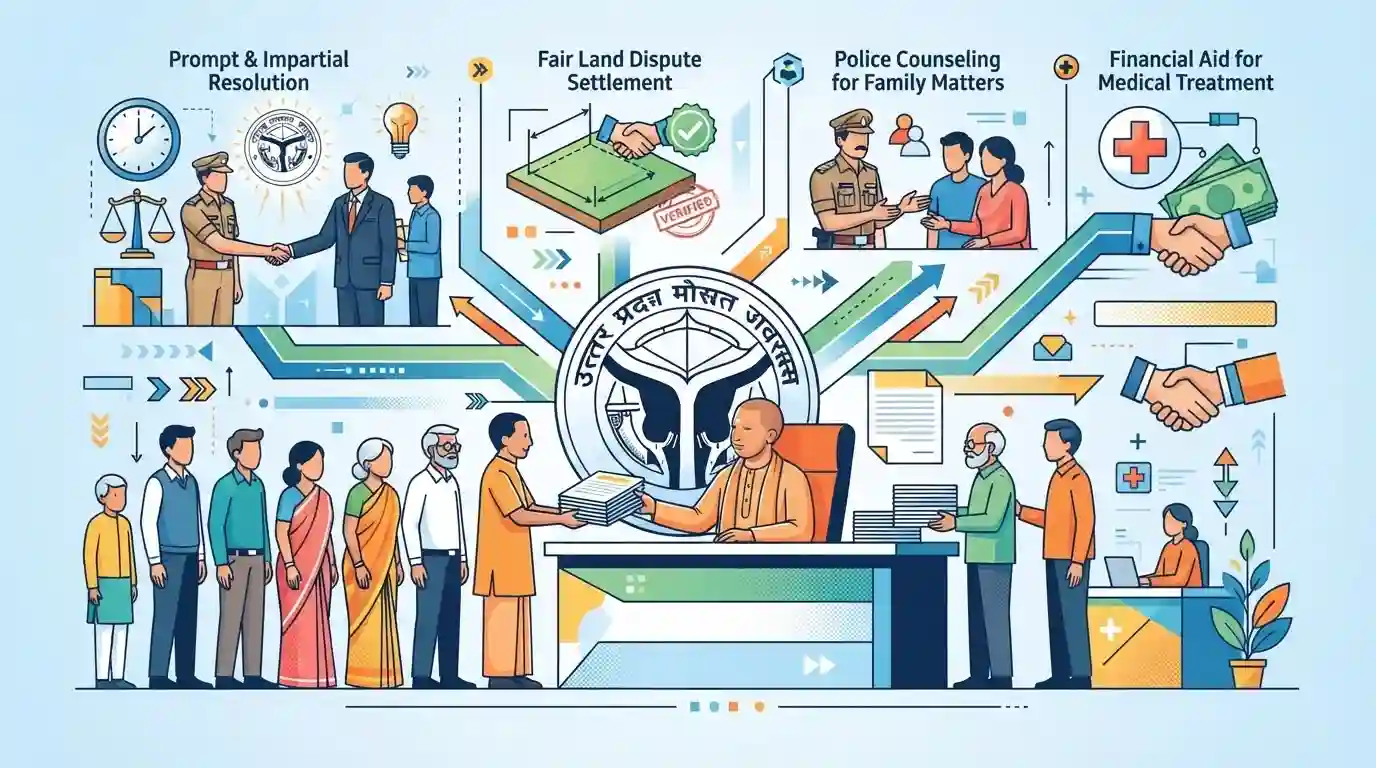
Uttar Pradesh Chief Minister Yogi Adityanath held a 'Janata Darshan' at his official residence in Lucknow, providing a direct platform for citizens to voice their grievances. During the session, he collected applications and directed concerned officials, particularly from the police and revenue departments, to ensure prompt and impartial resolution of issues. He highlighted the need for fair settlement of land disputes and advocated for police counseling to resolve family matters amicably. Furthermore, he assured that the state would provide financial support for medical treatments, reinforcing the government's commitment to responsive administration and effective public service delivery.
Key Points
- Chief Minister Yogi Adityanath organized a 'Janata Darshan' in Lucknow to hear and resolve public grievances directly.
- He directed police and revenue officials to ensure complaints are addressed in a time-bound, transparent, and impartial manner.
- Special emphasis was given to resolving land disputes fairly and using police counseling to mediate and resolve family disputes.
- The CM assured financial assistance for citizens seeking help for medical treatments after proper estimation by officials.
- The Janata Darshan highlights the UP government's focus on direct public outreach, responsive administration, and accessible grievance redressal.
Important Terms
Janata Darshan

A direct public grievance redressal initiative where a Chief Minister interacts directly with citizens to address and resolve their administrative, police, or revenue-related issues.
UPSC context
Relevant for GS Paper 2 (Governance), illustrating informal, direct citizen-centric administration and top-down grievance redressal by state executives.
Public Grievance Redressal Mechanism
Institutional frameworks established by the government to receive, process, and resolve complaints from citizens regarding administrative actions and public service delivery shortcomings.
UPSC context
Core topic in GS Paper 2 (Governance) testing administrative accountability, transparency, and models like CPGRAMS or Sevottam.
Revenue Department
The state-level administrative body responsible for land administration, maintaining property records, taxation, and resolving grassroots land ownership and tenancy disputes.
UPSC context
Important for GS Paper 2 (State Administration) and GS Paper 3 (Land Reforms), focusing on governance and clear land titling.
Time-Bound Resolution
The governance principle of addressing citizen complaints or providing public services within a specifically mandated timeframe to prevent bureaucratic delays.
UPSC context
Connects to GS Paper 2 (Governance), particularly assessing Citizen Charters, right to public services legislation, and mitigating red tape.
Prelims Trap
The 21-day limit for public grievance redressal under CPGRAMS is a statutory right protected under the Right to Information Act.
The 21-day public grievance redressal limit is an executive guideline issued by the DARPG (under CPGRAMS), not a statutory mandate under the Right to Information Act or a central Right to Public Services Act.
Static Concepts Connected
What is the Sewottam Model of Public Service Delivery?
- Origin & Definition: Developed by the Department of Administrative Reforms and Public Grievances (DARPG) to reform citizen-centric public service delivery.
- Three Pillars: Consists of Citizen's Charters, Public Grievance Redress Mechanisms, and Service Delivery Capability.
- Quality Benchmark: Acts as a tool for continuous assessment, enabling organizations to get certified under IS 15700:2018 standards.
How is the grievance redressal framework structured in India?
- CPGRAMS: An online centralized platform under the DARPG for citizens to lodge complaints against central and state government organizations.
- Directorate of Public Grievances: Located in the Cabinet Secretariat to handle grievances for specific sectors that remain unresolved elsewhere.
- State-level Service Guarantees: Enacted by states (like UP's 2011 Act) to legally mandate timeframes for public services, penalizing delays.
Cross-Topic Patterns
Land Records and Rural Crime Prevention
Programs like UP's Varasat and SVAMITVA demonstrate how digital land records and clear succession titles directly reduce rural civil litigation, family disputes, and local law-and-order challenges.
Discretionary Relief and Universal Health Coverage
Financial aid schemes like the CM Relief Fund act as critical safety nets, showing how discretionary executive funds bridge gaps in structured insurance programs like PM-JAY.

DARPG's 21-day timeline reform and 'whole of government' CPGRAMS approach will likely feature in GS2 mains on citizen-centric governance.
Linked PYQs · 3
Linked PYQs · 3
- 2024UPPSC_PRELIMSGS1
Which of the following statements are correct with regard to ICT-based e-Governance? 1. e-Governance reduces the transparency of Government. 2. e-Governance reduces the cost of Government. 3. e-Governance increases citizens input into Government. 4. e-Governance increases bureaucratic red tapism. Select the correct answer from the codes given below:
- 2016UPPSC_PRELIMSGS1
'e-Biz' sefer to
- 2023UPPSC_PRELIMSGS1
Which of the following scheme/s is/are related to Uttar Pradesh? (1) Anuthee Uphar Scheme (2) Matra Shakti Udyamita Scheme (3) Kaushalya Matritva Scheme (4) Stree Nidhi Scheme Select the 'correct' answer using the code given below -
