Uttar Pradesh to honour teachers for improving school education
Source:freepressjournal ↗
Why It Matters
Education policies, educational initiatives, and national schemes (like PM SHRI and NEP 2020) are core elements of social development. Uttar Pradesh, being India's most populous state, serves as a major case study for administrative efforts in basic education quality improvement and teacher incentive structures.
Summary
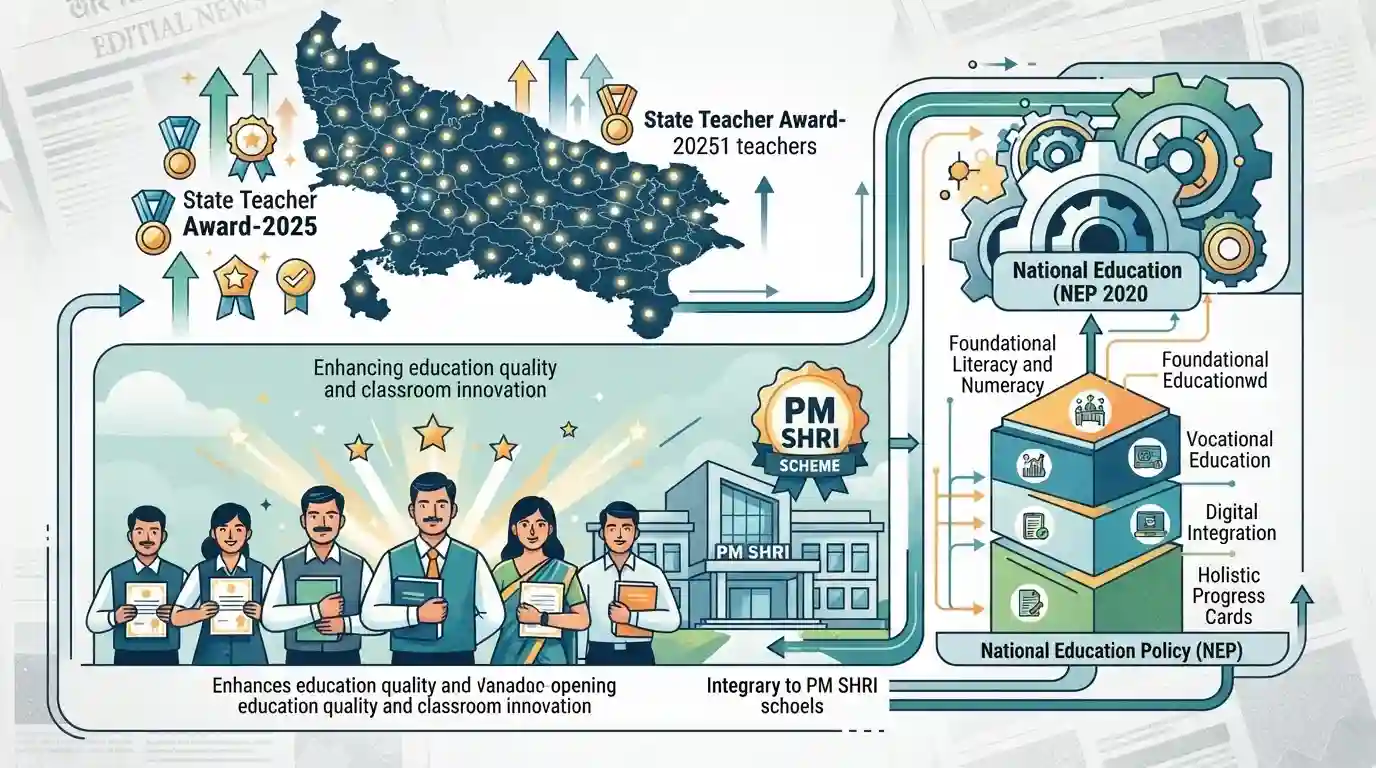
The Yogi Adityanath government in Uttar Pradesh has announced the State Teacher Award-2025 for 61 basic education teachers, recognizing their exemplary work in enhancing school education quality, student learning outcomes, and classroom innovations. The selected teachers, representing various districts, include headmasters and assistant teachers from primary to PM Shri schools. This initiative highlights the state's active push towards aligning its basic education system with the National Education Policy (NEP) 2020 guidelines.
Key Points
- The Uttar Pradesh Basic Education Department selected 61 teachers for the State Teacher Award-2025 for their outstanding work in improving education quality and student learning outcomes in state-run schools.
- The awardees include both headmasters and assistant teachers working in primary, upper primary, composite, pre-secondary, and PM Shri schools.
- UP Minister of State (Independent Charge) for Basic Education, Sandeep Singh, emphasized that the awards aim to foster a culture of quality teaching and classroom innovation.
- This initiative aligns with the overarching objectives of the National Education Policy (NEP) 2020, which is designed to implement holistic reforms in school education across India.
- In UPPSC and UP state exams, educational initiatives, teacher awards, and related national schemes like PM SHRI and NEP 2020 are highly relevant for General Studies and UP-specific sections.
Important Terms
PM SHRI (PM Schools for Rising India) Scheme

A centrally sponsored scheme launched in 2022 to upgrade over 14,500 existing government schools into model institutions that demonstrate the implementation of the National Education Policy (NEP) 2020.
UPSC context
GS Paper II: Social Justice/Education. Tests understanding of primary educational reform initiatives and federal-state cooperative structures.
National Education Policy 2020
India's third national education policy, launched in 2020, aiming to transform Indian education with a new 5+3+3+4 structural pattern, universal access, and multidisciplinary higher studies.
UPSC context
GS Paper II: Education policies. Evaluates knowledge of structural pedagogical changes, foundational literacy targets, and regulatory reforms in India.
Constitution (86th Amendment) Act, 2002
A landmark constitutional amendment that established the Right to Education as a fundamental right under Article 21A, mandating free and compulsory education for all children aged 6 to 14.
UPSC context
GS Paper II: Indian Polity / Fundamental Rights. Assesses familiarity with core social welfare legislation and constitutional provisions for education.
State Teacher Award-2025
An award by the Uttar Pradesh Government recognizing basic education teachers who achieve outstanding school results, student enrollment increases, and pedagogical innovations through a merit-based evaluation.
UPSC context
GS Paper II/UP GK: Uttar Pradesh social sectors. Tests familiarity with state-specific incentives, education schemes, and teacher recognition programs.
Uttar Pradesh Basic Education Department
The state government organ tasked with administering, managing, and regulating primary and elementary schools (Grades 1 to 8) under the legislative mandate of the Uttar Pradesh Basic Education Act of 1972.
UPSC context
GS Paper II/UP GK: Governance and administration. Evaluates awareness of state-level institutional mechanisms executing educational policies.
Prelims Trap
PM SHRI is a 100% centrally funded Central Sector Scheme directly administered by the Union Ministry.
PM SHRI is a Centrally Sponsored Scheme, not a Central Sector Scheme. Costs are shared (60:40 for UP) between the Centre and the State, requiring active state budgetary co-funding.
Static Concepts Connected
What are the key constitutional provisions governing education in India?
- Article 21A: Inserted by the 86th Amendment Act (2002), guaranteeing free and compulsory education to children aged 6 to 14 years.
- Article 45: Directive Principle directing the State to provide early childhood care and education for all children until they complete the age of six.
- Article 51A(k): Fundamental Duty requiring parents or guardians to provide education opportunities to their children between 6 and 14 years.
What is the structural framework of the National Education Policy (NEP) 2020?
- Pedagogical Structure: Replaced the legacy 10+2 system with a 5+3+3+4 model, integrating early childhood education (ages 3–6) into formal schooling.
- GER Target: Targets 100% Gross Enrolment Ratio (GER) in school education from pre-school to secondary level by the year 2030.
- Institutional Rebranding: Formally renamed the Ministry of Human Resource Development (MHRD) to the Ministry of Education.
Cross-Topic Patterns
PM SHRI + Fiscal Federalism
Implementational friction over Centrally Sponsored Schemes like PM SHRI highlights how education (Concurrent List) serves as a testing ground for cooperative fiscal federalism between Centre and States.
Digital Education + Regional Divide
Digital interventions like UP's 'Udgam' portal must navigate the rural-urban digital divide (GS-1/GS-3) to ensure equitable learning outcomes as envisioned under NEP 2020.

UP-specific questions will likely target UP's leading share in PM SHRI schools or the state-led 'Udgam' portal's development agency.
Linked PYQs · 2
Linked PYQs · 2
- 2020UPPSC_PRELIMSGS1
Consider the following statements about New National Education Policy approved by Union Cabinet of India on 29th July, 2020 : 1. It was drafted by a Committee headed by Dr. K Kasturirangan. 2. It will replace the previous Education Policy which has been followed since last 38 years. Select the correct statement(s) from the codes given below.
- 2022UPPSC_PRELIMSGS1
Right to Education has been included into the Fundamental Rights by the
