Ghazipur District Development Projects and Regional Growth in UP
Source:indianmasterminds ↗
Why It Matters
UPPSC Prelims frequently tests knowledge of state-specific initiatives, infrastructure projects (like expressways and regional development), and the historical and cultural significance of various districts (such as the legacy of historical figures and unique facts like Gahmar being the 'village of soldiers').
Summary
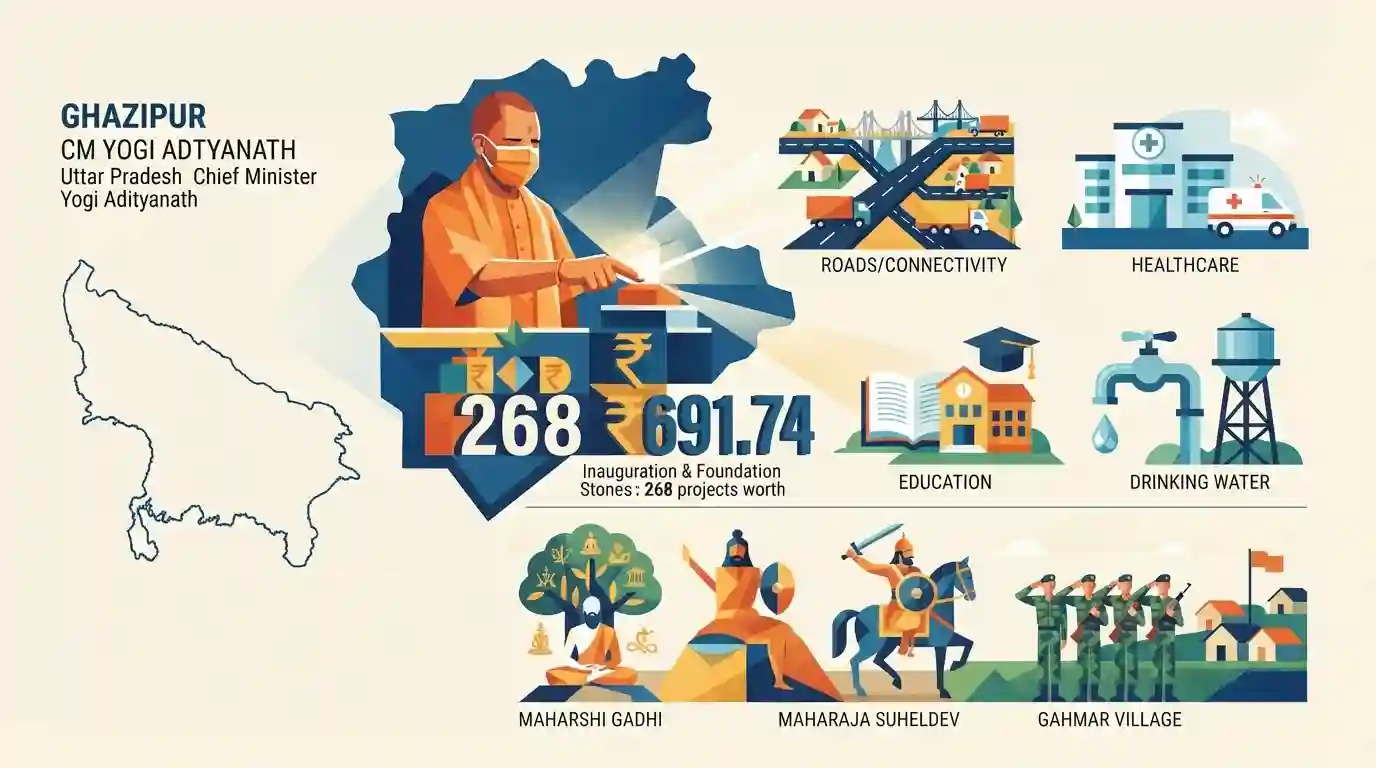
Uttar Pradesh Chief Minister Yogi Adityanath inaugurated and laid the foundation stones for 268 development projects worth ₹691.74 crore in Ghazipur district. These initiatives aim to boost regional infrastructure, encompassing roads, healthcare, education, and drinking water facilities across all seven Assembly constituencies. The Chief Minister also emphasized the rich cultural and historical legacy of the region, specifically honoring Maharshi Gadhi, Maharaja Suheldev, and the village of Gahmar, renowned for its contribution to the armed forces.
Key Points
- Chief Minister Yogi Adityanath launched 268 development projects in Ghazipur, Uttar Pradesh, cumulatively valued at ₹691.74 crore.
- The projects encompass 83 inaugurations and 185 foundation stones, targeting all seven Assembly constituencies in the district.
- Key areas of development include road infrastructure, drinking water, education, and healthcare facilities.
- The Chief Minister highlighted the region's cultural and historical significance, paying tribute to Maharshi Gadhi and the sacred Ganga.
- He also recognized Gahmar, famously known as the village of soldiers, and invoked the historical legacy of Maharaja Suheldev.
Important Terms
Government of Uttar Pradesh

The elected state government governing India's most populous state. It is responsible for regional administration, executing public welfare schemes, and spearheading major infrastructure development projects across the state's districts.
UPSC context
Fits under GS Paper 2 (Governance), highlighting state-level policy execution, regional development, and public welfare administration.
Ghazipur
A district in eastern Uttar Pradesh situated along the Ganga river. It is culturally known for its association with Maharshi Gadhi and encompasses Gahmar, recognized as India's "village of soldiers."
UPSC context
Relevant for UP-specific geography and cultural history in State PCS and UPSC GS Paper 1.
Maharaja Suheldev
An 11th-century ruler of Shravasti in modern-day Uttar Pradesh. He is celebrated in local history and folklore for defeating the Ghaznavid commander Ghazi Salar Masud at the Battle of Bahraich in 1033 AD.
UPSC context
Highly relevant for GS Paper 1 (Medieval History) as a regional figure of resistance against foreign invasions.
Gahmar Village
Located in UP's Ghazipur district, it is widely considered India's most populous village. It is celebrated as the "village of soldiers" because of its immense, multi-generational contribution to the Indian Armed Forces.
UPSC context
Illustrates unique rural demographics and military sociology, relevant for Indian Society topics in GS Paper 1.
Maharshi Gadhi
A revered ancient sage in Hindu tradition, historically associated with the region of Ghazipur in Uttar Pradesh. The area's foundational heritage and cultural identity are closely tied to his legacy.
UPSC context
Important for regional Art & Culture and historical traditions, particularly for UP State PCS examinations.
Prelims Trap
"Lord Cornwallis, known for the Permanent Settlement, died in India and his tomb is located in Kolkata."
While he operated primarily out of Bengal and introduced the Permanent Settlement there, Cornwallis died during his second term in India. His tomb is actually in Ghazipur, UP.
Static Concepts Connected
What is the historical significance of Maharaja Suheldev?
- Battle of Bahraich: An 11th-century ruler of Shravasti credited with defeating the Ghaznavid commander Ghazi Saiyyad Salar Masud in 1033 AD.
- Mirat-i-Masudi: His legend is not found in contemporary 11th-century texts but is primarily documented in this 17th-century Persian hagiography by Abd-ur-Rahman Chishti.
How was Ghazipur linked to British colonial administration?
- Ghazipur Opium Factory: Established by the British East India Company in 1820, it was central to the colonial opium trade and remains India's oldest legal opium processing facility.
- Cornwallis Tomb: It houses the tomb of Lord Cornwallis, the Governor-General who introduced the Permanent Settlement of land revenue, who died there in 1805.
Cross-Topic Patterns
Colonial Economy & Opium Trade
Ghazipur's 1820 opium factory is a physical remnant of the East India Company's triangular trade, linking Indian commercial agriculture directly to Chinese markets and the subsequent Opium Wars.
Subaltern Medieval History
Figures like Suheldev reflect a growing UPSC trend of testing regional medieval rulers and subaltern historical narratives that are currently being integrated into mainstream political and cultural discourse.

Expect a 'Places in News' matching question pairing lesser-known towns (Ghazipur, Bahraich) with colonial or medieval historical markers.
Linked PYQs · 3
Linked PYQs · 3
- 2023UPPSC_PRELIMSGS1
Which of the following Scheme/Programme is not the Central Government Programme and it is Uttar Pradesh Government's Programme?
- 2023UPPSC_PRELIMSGS1
How many railways stations have been identified for modernization under Amrit Bharat Station Scheme in Uttar Pradesh as on February, 2023?
- 2021UPPSC_PRELIMSGS1
Which of the following Schemes in Uttar Pradesh were introduced in Budget of 2021-22? I. Atmanirbhar Krishak Samanvit Vikas Yojna II. Mukhya Mantri Saksham Suposhan Yojna III. Mukhya Mantri Pravasi Shramik Udyamita Vikas Yojna IV. Yuva Udyamita Vikas Abhiyan Select the correct answer from the codes given below.
