Linguistic Discrimination, Student Migration and Police Accountability
Source:The Hindu ↗
Why It Matters
This incident highlights the fault lines of linguistic and cultural discrimination within India's pluralistic society. It acts as a prime case study for UPSC aspirants on the challenges of internal migration, the persistence of regional prejudices, and systemic issues concerning police accountability and human rights violations.
Summary
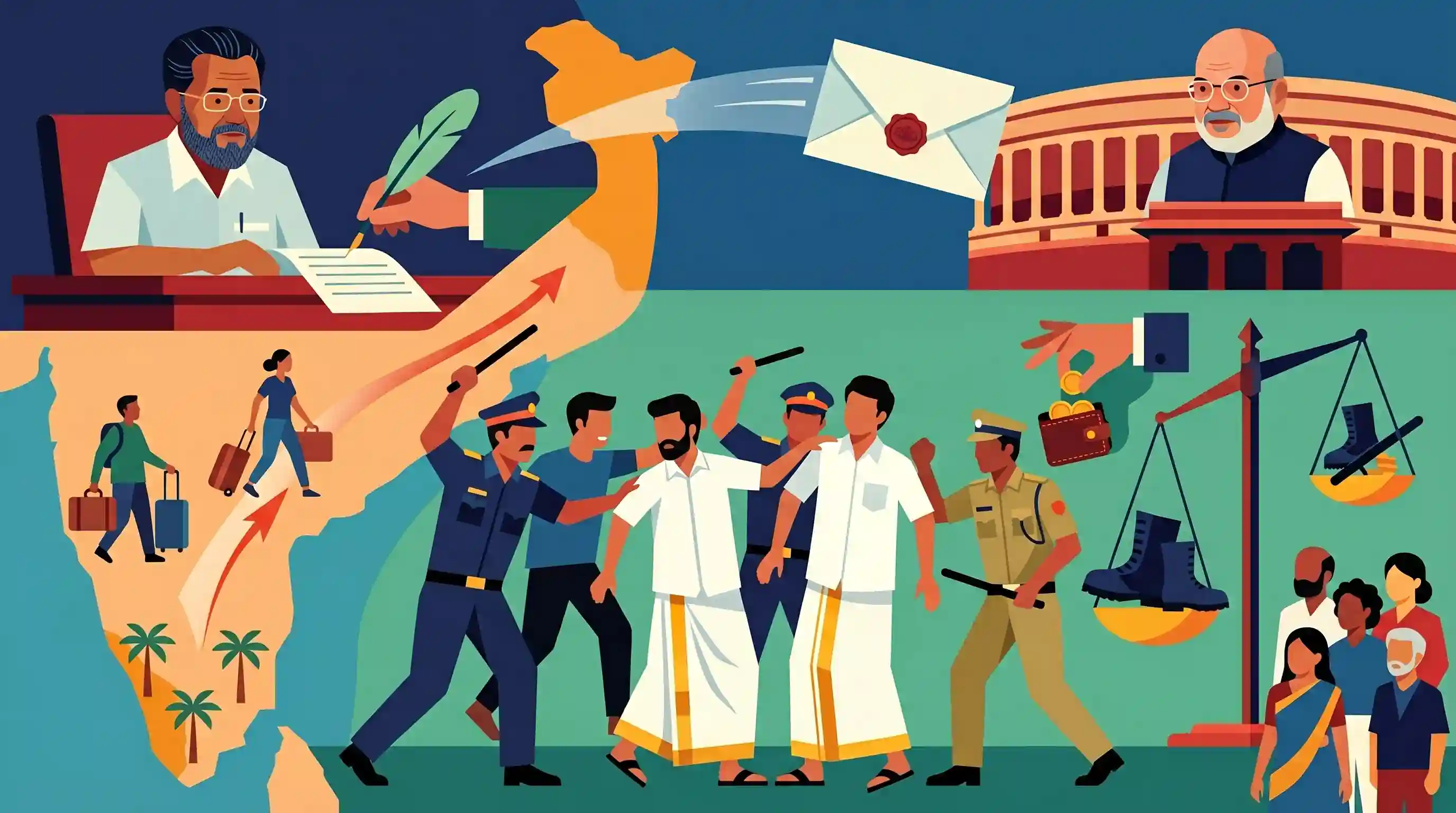
Kerala Chief Minister Pinarayi Vijayan has urged Union Home Minister Amit Shah to intervene and order a comprehensive investigation into the brutal assault of two Malayali students in Delhi by the police and miscreants. The victims were allegedly targeted for wearing traditional attire and being unable to speak Hindi, raising significant concerns about linguistic and cultural discrimination, as well as police extortion and accountability.
Key Points
- Kerala Chief Minister Pinarayi Vijayan has written to Union Home Minister Amit Shah seeking justice for two Kerala students who were assaulted by Delhi Police and miscreants.
- The students were allegedly targeted and brutalised near the Red Fort for wearing traditional Kerala attire (mundu) and failing to speak Hindi fluently.
- Instead of protecting the students, the police allegedly joined the miscreants in the assault and attempted to extort ₹20,000 by threatening to frame them in a false theft case.
- The incident raises serious concerns regarding the safety of student migrants, police accountability, and the persistence of linguistic and cultural discrimination in India.
Important Terms
Delhi_Police

The primary law enforcement agency for the National Capital Territory of Delhi, functioning directly under the Union Ministry of Home Affairs rather than the local state government.
UPSC context
GS Paper 2: Federalism and Center-State relations; specifically the unique administrative and jurisdictional status of Delhi under Article 239AA.
Article 239AA
A constitutional provision granting special status to Delhi, establishing an elected assembly while reserving 'Police,' 'Public Order,' and 'Land' for the Central Government's control through the Lieutenant Governor.
UPSC context
GS Paper 2: Indian Constitution and its features; crucial for understanding governance disputes between the Delhi government and the Union.
Regionalism
An ideology favoring the interests of a specific region over national ones, often fueled by linguistic, cultural, or ethnic identities and the 'son of the soil' sentiment.
UPSC context
GS Paper 1: Social issues and Diversity of India; tests understanding of factors threatening national integration and social harmony.
Police Accountability
The institutional framework ensuring police officers are answerable for their conduct, preventing abuse of power, custodial violence, and ensuring adherence to the rule of law.
UPSC context
GS Paper 2: Governance and Statutory bodies; relates to the Prakash Singh directives and the need for systemic police reforms.
Zakir Husain Delhi College
One of the oldest educational institutions in Delhi and a constituent college of the University of Delhi, historically significant as a center of diverse cultural and academic exchange.
UPSC context
General awareness of historical educational institutions; contextually relevant to the safety and integration of interstate migrant students in education hubs.
Linguistic Discrimination
Mistreatment or prejudice against individuals based on their spoken language, often manifesting as 'linguistic chauvinism' in regions where a dominant language is enforced or expected.
UPSC context
GS Paper 1: Diversity of India; examines the impact of language barriers on internal migration and the social fabric.
Prelims Trap
"Delhi Police is directly accountable to the elected Government of the National Capital Territory of Delhi."
Under Article 239AA, 'Public Order', 'Police', and 'Land' in Delhi are explicitly reserved for the Union Government (MHA), not the Delhi Assembly.
Static Concepts Connected
Who controls the Delhi Police under the Indian Constitution?
- Article 239AA exceptions: Exempts "Public Order, Police, and Land" from the legislative and executive competence of the Delhi Legislative Assembly.
- Union MHA control: Because of this constitutional exception, the force operates under the direct administrative control of the Union Ministry of Home Affairs.
- Role of LG: The Lieutenant Governor administers these three reserved subjects as an administrator acting on the President's behalf, independent of the Delhi Cabinet.
How did the Prakash Singh judgment (2006) address police misconduct?
- Complaints Authorities: Mandated the creation of independent Police Complaints Authorities (PCAs) at the state and district levels to review citizen grievances.
- Scope of inquiry: PCAs are specifically designed to investigate severe police misconduct, including custodial violence, extortion, grievous hurt, and abuse of power.
- Security Commissions: Directed the formation of State Security Commissions to insulate police from unwarranted political pressure and establish broad policy guidelines.
Cross-Topic Patterns
Migrant rights vs linguistic regionalism
Linguistic intolerance targeting internal migrants directly threatens the freedoms of movement and residence under Article 19, intersecting Indian Society themes (regionalism) with Polity (fundamental rights).
Federal mechanics of migrant security
A State CM petitioning the Union Home Ministry over migrant safety highlights the systemic gaps in inter-state law-enforcement coordination and the underutilization of the Inter-State Council.

Article 239AA exceptions (Police, Public Order) and Prakash Singh directives on Police Complaints Authorities are probable 2026 targets.
Linked PYQs · 3
Linked PYQs · 3
- 2016MainsGS1
What is the basis of regionalism? Is it that unequal distribution of benefits of development on regional basis eventually promotes regionalism? Substantiate your answer.
- 2024MainsGS1
Critically analyse the proposition that there is a high correlation between India's cultural diversities and socio-economic marginalities.
- 2020MainsGS1
Is diversity and pluralism in India under threat due to globalisation ? Justify your answer.
