Chief Minister Unveils Development Projects Worth In Ajmer
Source:times-of-india ↗
Why It Matters
Road network expansion and central-state rural connectivity schemes are core areas of the Rajasthan Economy syllabus in RPSC RAS. Specific figures regarding state road statistics and major district-level projects are directly tested in the Prelims and Mains.
Summary
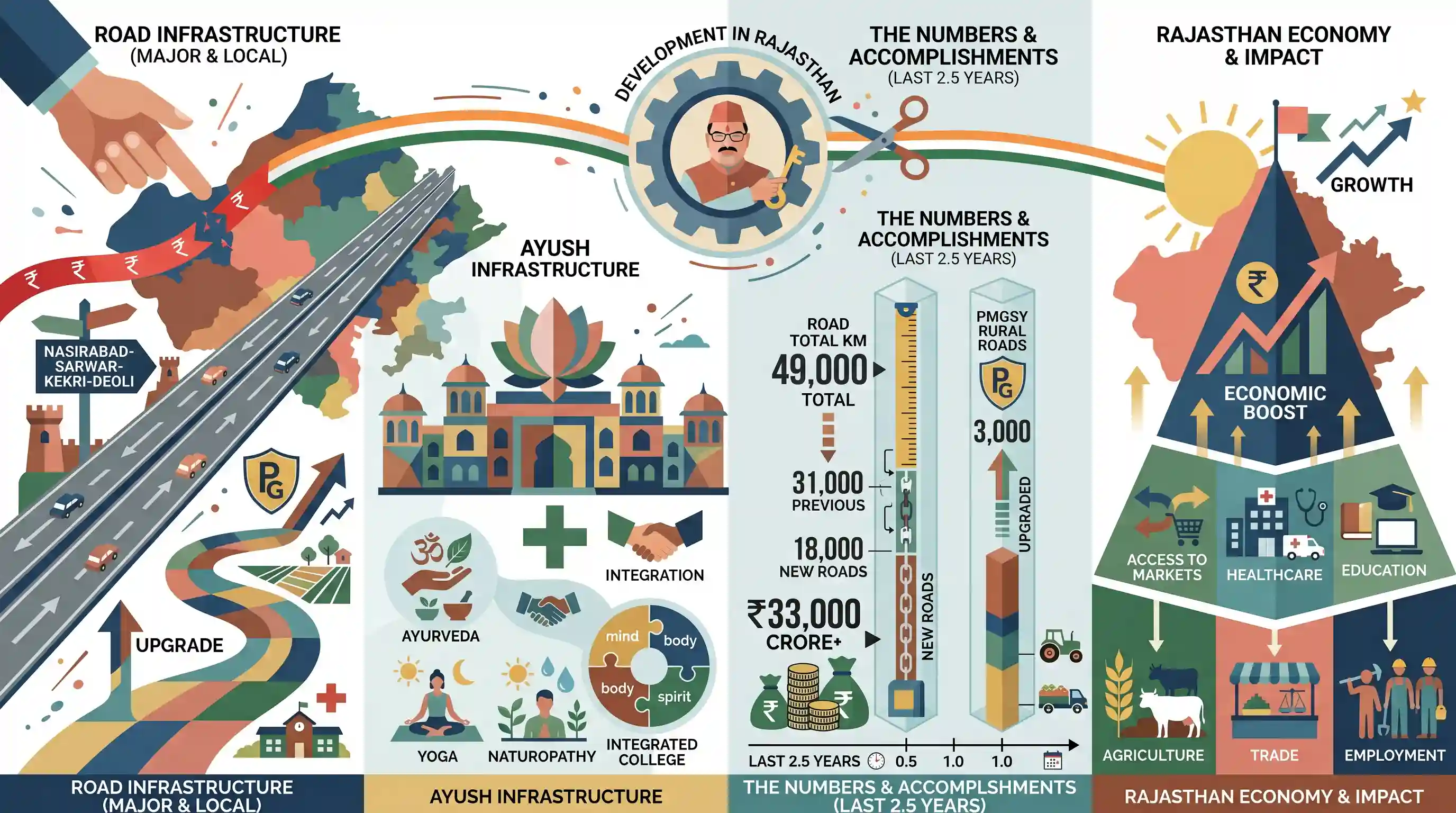
Chief Minister Bhajan Lal Sharma unveiled developmental projects worth ₹880 crore in Kekri, Ajmer. These include the Phase-I four-laning of the Nasirabad-Sarwar-Kekri-Deoli Road and the inauguration of the Government Ayurveda, Yoga and Naturopathy Integrated College. The CM highlighted state-wide accomplishments in physical infrastructure, reporting the development of 49,000 km of roads (including 18,000 km of new roads) costing over ₹33,000 crore over the past 2.5 years, along with 3,000 km of rural roads upgraded under the Pradhan Mantri Gram Sadak Yojana (PMGSY).
Key Points
- Rajasthan Chief Minister Bhajan Lal Sharma inaugurated and laid foundation stones for developmental projects worth ₹880 crore in Kekri, Ajmer district.
- A key project is the Phase-I four-laning of the Nasirabad-Sarwar-Kekri-Deoli Road, alongside other rural and municipal road strengthening projects.
- The Government Ayurveda, Yoga and Naturopathy Integrated College building in the Kekri region was officially inaugurated.
- The state government has constructed and developed nearly 49,000 km of roads over the past two-and-a-half years at an outlay of more than ₹33,000 crore, including 18,000 km of new roads.
- Under the Pradhan Mantri Gram Sadak Yojana (PMGSY), more than 3,000 km of roads have been upgraded, strengthened, and renovated in Rajasthan to boost rural connectivity.
Important Terms
Pradhan Mantri Gram Sadak Yojana

A centrally sponsored scheme launched in 2000 to provide all-weather road connectivity to eligible unconnected rural habitations across India.
UPSC context
GS Paper II & III: Government Schemes, Rural Development, and Infrastructure. Tests understanding of welfare policies and connectivity.
National AYUSH Mission
A centrally sponsored scheme launched in 2014 to promote traditional Indian medicine systems by strengthening healthcare delivery, infrastructure, and educational standards.
UPSC context
GS Paper II: Social Sector/Health. Tests knowledge of public health policies, traditional medicine integration, and healthcare infrastructure.
Government of Rajasthan
The subnational governing authority of Rajasthan, comprising the constitutional executive (Governor), political executive (Chief Minister and Council), and Legislative Assembly.
UPSC context
GS Paper II: State Executive and Legislature. Tests knowledge of federalism, division of power, and state-level governance structures.
Kekri Municipality
An Urban Local Body (ULB) constitutionalized under the 74th Amendment Act, 1992, responsible for local governance, town planning, and public utilities in Kekri.
UPSC context
GS Paper II: Local Self-Government. Tests understanding of urban decentralization, municipal functions, and the 74th Constitutional Amendment Act.
Prelims Trap
PMGSY is currently a 100% Centrally Sector Scheme that target-maps road connectivity using the Gram Panchayat as the base eligibility unit.
PMGSY is now a Centrally Sponsored Scheme (60:40 sharing). Crucially, the target unit is a 'Habitation' (population cluster), not a Gram Panchayat or revenue village.
Static Concepts Connected
What is the design and structural evolution of PMGSY?
- Funding model: Launched as a 100% Central Sector Scheme, it transitioned to a Centrally Sponsored Scheme (60:40 ratio; 90:10 for Himalayan and NE states).
- Targeting unit: Eligible targets are classified as 'Habitations' (distinct population clusters) rather than administrative Gram Panchayats or revenue villages.
- PMGSY-IV launch: Approved for FY 2024-25 to 2028-29 to construct 62,500 km of roads, connecting 25,000 unconnected habitations.
What are the core mandates of the National AYUSH Mission (NAM)?
- Institutional setup: It is a Centrally Sponsored Scheme aiming to improve AYUSH healthcare access by establishing integrated AYUSH hospitals and upgrading educational institutions.
- Medicinal plants: Supports the conservation, processing, and marketing of medicinal plants to build robust supply chains for traditional medicines.
Cross-Topic Patterns
Rural Roads + Agricultural Supply Chains
PMGSY upgrades directly lower transport costs, reducing post-harvest losses and linking smallholders to e-NAM mandis, bridging GS-3 infrastructure with agricultural marketing.
World Bank + State Highway Authorities
External multilateral funding combined with statutory bodies like RSHA highlights the rising trend of Indian states directly leveraging global capital for sub-national infrastructure.

PMGSY-IV's shift in funding patterns and the distinction between 'Habitations' and 'Gram Panchayats' are highly probable MCQ targets.
Linked PYQs · 1
Linked PYQs · 1
- 2023RPSC_PRELIMSGS1
The Rajasthan State Highway Development Program-II project, which includes the upgrading of 11 highways with a length of 801 km, is financed by which agency?
