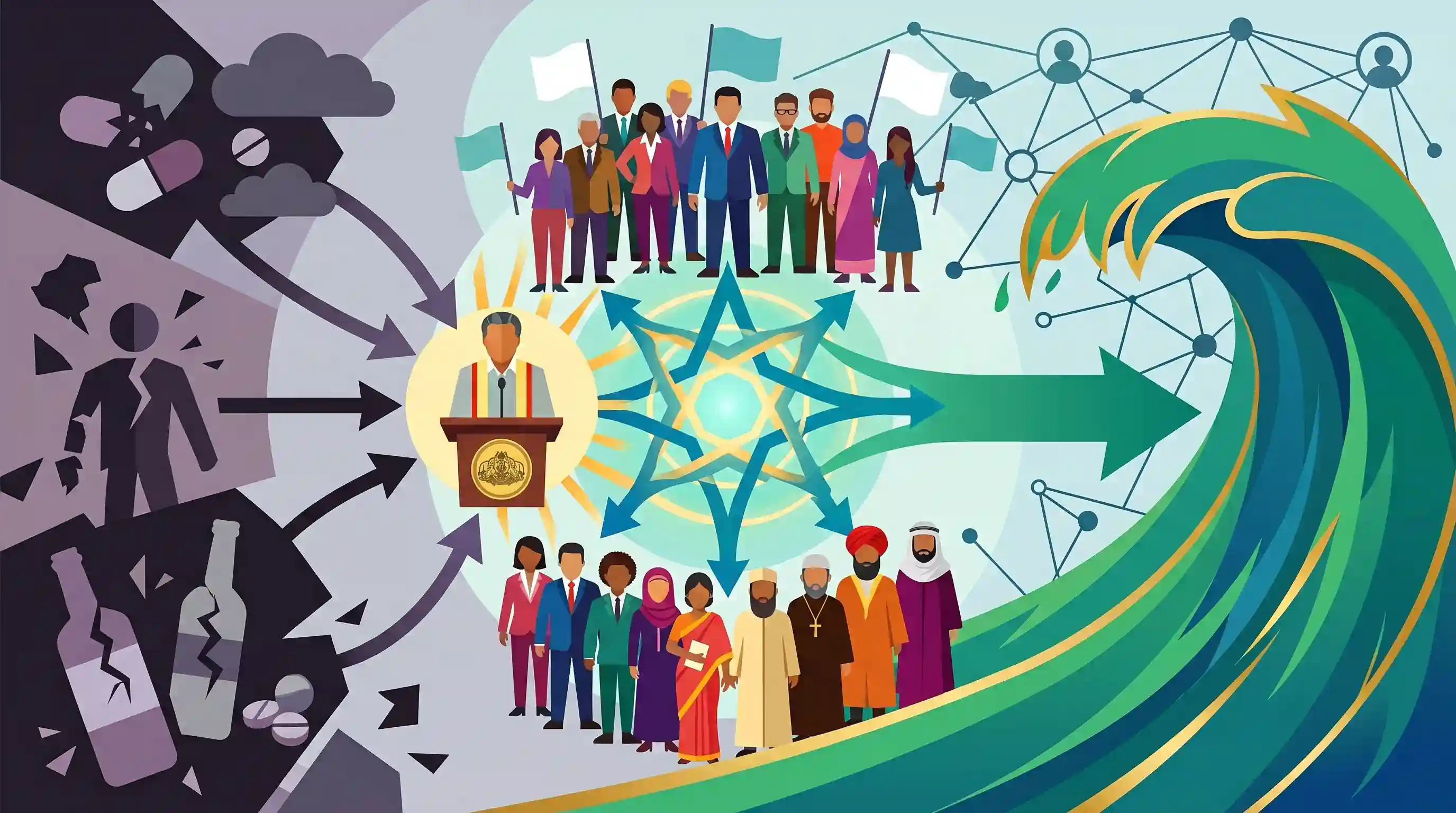
Kerala government engages religious leaders to combat substance abuse
Source:The Hindu ↗
Why It Matters
The article serves as a practical example for GS2 (Governance/Role of Civil Society) and GS3 (Internal Security). It demonstrates how governments can integrate non-state actors, such as religious leaders, into public campaigns to effectively combat organized social evils like drug abuse.
Summary
The Kerala government, led by Chief Minister Pinarayi Vijayan, is convening meetings with religious leaders and political parties to strengthen the state's ongoing anti-drug campaign. The initiative reflects an inclusive governance strategy, leveraging political consensus and the social influence of community leaders to tackle the escalating issue of substance abuse.
Key Points
- Kerala Chief Minister Pinarayi Vijayan announced an all-party meeting and a separate discussion with religious leaders to combat the state's drug menace.
- The initiative aims to strengthen the ongoing anti-drug campaign by fostering political consensus and utilizing the influence of religious and community leaders.
- This highlights a collaborative governance approach involving civil society and non-state actors in addressing complex social and internal security challenges like substance abuse.
Important Terms
Substance Abuse

The harmful or hazardous use of psychoactive substances, including alcohol and illicit drugs, leading to dependency and social-health crises.
UPSC context
GS Paper 2 (Social Justice: Issues relating to health) and GS Paper 3 (Internal Security: Drug menace).
Drug Trafficking
A global illicit trade involving the cultivation, manufacture, distribution, and sale of prohibited substances, often linked to organized crime and money laundering.
UPSC context
GS Paper 3 (Internal Security: Linkages of organized crime with terrorism and money laundering).
Inclusive Governance
A governing paradigm ensuring all societal sections, including marginalized groups and community leaders, participate equitably in decision-making and access public services.
UPSC context
GS Paper 2 (Governance: Important aspects of governance, transparency, and accountability).
Non-State Actors
Individuals or groups, such as religious leaders and NGOs, that are independent of the state but influence political and social governance outcomes.
UPSC context
GS Paper 2 (Role of civil society) and GS Paper 3 (Security challenges from non-state actors).
NDPS Act, 1985
The primary Indian legislation that prohibits the manufacture, sale, and consumption of narcotic drugs and psychotropic substances except for medical or scientific purposes.
UPSC context
GS Paper 2 (Government policies and interventions) and GS Paper 3 (Security).
Vimukthi Mission
Kerala’s comprehensive anti-narcotics campaign aimed at creating an addiction-free state through awareness, treatment, and rehabilitation, involving Kudumbashree and student police.
UPSC context
GS Paper 2 (Social Justice: Welfare schemes for vulnerable sections by the State).
Prelims Trap
The regulation and prohibition of all intoxicating drugs is an exclusive Union subject under the Seventh Schedule.
While the NDPS Act is central, public health is a State subject. Enforcement is shared between Central (NCB) and State police (e.g., NCORD mechanism).
Static Concepts Connected
What is the Constitutional mandate regarding substance abuse?
- Article 47 (DPSP): Article 47 in Part IV directs the State to raise the level of nutrition and the standard of living and to improve public health.
- Prohibition Mandate: It explicitly directs the state to endeavour to bring about prohibition of the consumption of intoxicating drinks and of drugs which are injurious to health.
- Medicinal Exception: The Constitution provides an exception allowing the consumption of these substances strictly for medicinal purposes.
What are the Golden Crescent and Golden Triangle?
- Golden Crescent: Iran, Afghanistan, and Pakistan. A major illicit opium production region located to India's North-West.
- Golden Triangle: Myanmar, Laos, and Thailand. A major illicit opium-producing region located to India's East/South-East.
- India's Vulnerability: India is geographically sandwiched between these two illicit drug hubs, making it highly vulnerable to trafficking and narco-terrorism.
Cross-Topic Patterns
SHGs as Internal Security Multipliers
Kerala utilizes local SHGs (Kudumbashree) for drug awareness. UPSC frequently links grassroots governance and SHGs to solving macro internal security or social crises.
Narco-Terrorism and Border Management
Drug trafficking is rarely an isolated social issue; it directly funds insurgency in the Northeast and terrorism in Punjab/J&K, bridging social issues with border security.

Expect a Mains GS2/GS3 question evaluating the "whole-of-society" (civil society/NGOs) vs "law-enforcement" approach to substance abuse.
Linked PYQs · 3
Linked PYQs · 3
- 2018MainsGS3
India's proximity to two of the world's biggest illicit opium-growing states has enhanced her internal security concerns. Explain the linkages between drug trafficking and other illicit activities such as gunrunning, money laundering and human trafficking. What counter-measures should be taken to prevent the same?
- 2024MainsGS3
Explain how narco-terrorism has emerged as a serious threat across the country. Suggest suitable measures to counter narco-terrorism.
- 2021MainsGS2
Can Civil Society and Non-Governmental Organizations present an alternative model of public service delivery to benefit the common citizen? Discuss the challenges of this alternative model.
