Himachal Pradesh launches thematic garden project at Dehra zoo
Source:newsarenaindia ↗
Why It Matters
The establishment of specialized ecological zones (Ficarium, Bamboosetum) under the Thematic Garden Project represents a significant state-led conservation and eco-tourism initiative. It is highly relevant for HPAS Prelims questions focusing on Himachal Pradesh\'s environmental programs, state geography (Kangra), and biodiversity initiatives.
Summary
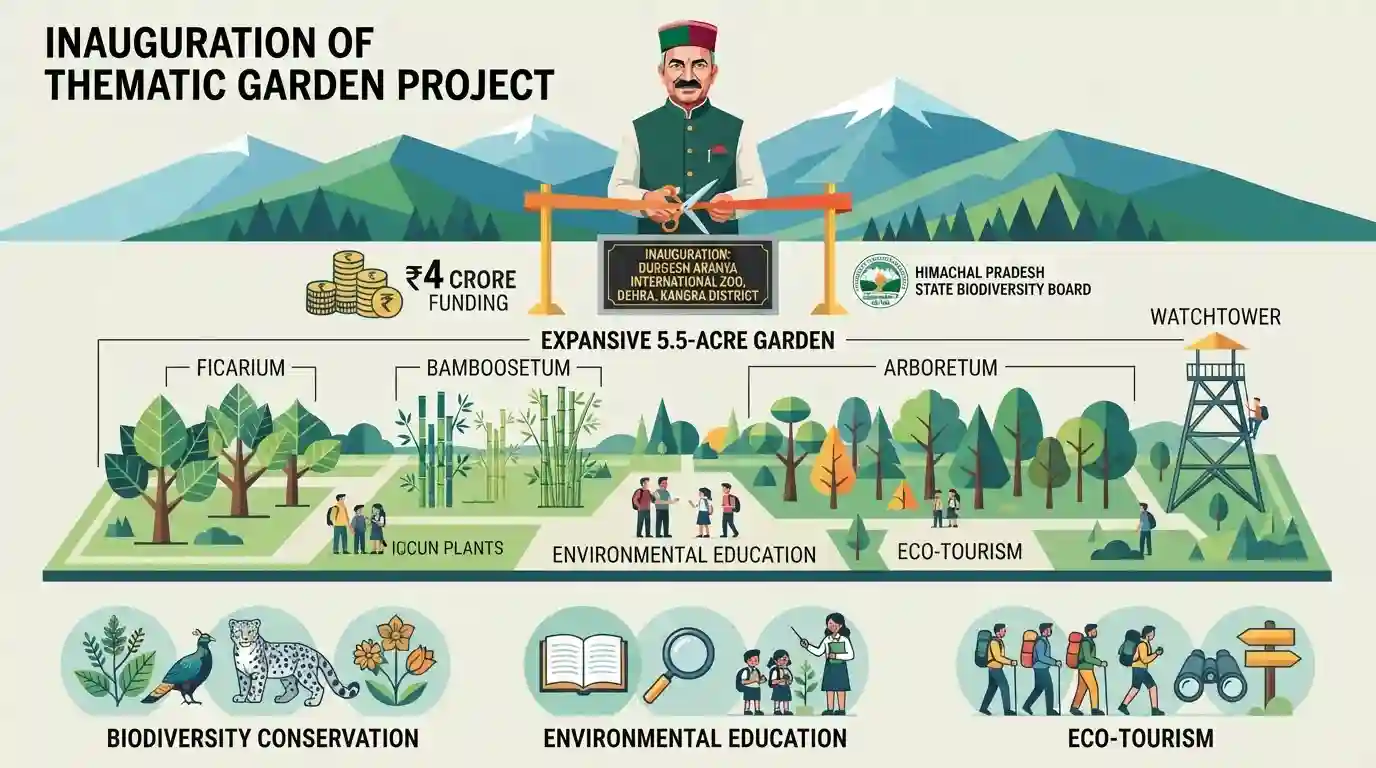
Himachal Pradesh Chief Minister Thakur Sukhvinder Singh Sukhu has inaugurated a Thematic Garden Project at the Durgesh Aranya International Zoo in Dehra, Kangra district. A funding of Rs 4 crore has been allocated, and the project is implemented through the Himachal Pradesh State Biodiversity Board. The expansive 5.5-acre garden features specialized zones like a Ficarium for Ficus species and a Bamboosetum for bamboo varieties, along with an Arboretum and a watchtower. It aims to act as a crucial center for biodiversity conservation, environmental education, and eco-tourism in the state.
Key Points
- Himachal Pradesh CM Thakur Sukhvinder Singh Sukhu launched the Thematic Garden Project at Durgesh Aranya International Zoo in Dehra, Kangra district.
- Rs 4 crore was released for the project, implemented via the Himachal Pradesh State Biodiversity Board (HPSBB).
- The 5.5-acre garden includes a Ficarium (Ficus species), an Arboretum, a watchtower, and a Bamboosetum.
- The project aims to conserve the state\'s rich biodiversity, promote environmental education, scientific research, and boost eco-tourism.
Important Terms
Thematic Garden Project

A 5.5-acre ecological destination at Durgesh Aranya International Zoo in Dehra, Kangra. It integrates a Ficarium, Bamboosetum, and Arboretum to promote biodiversity conservation, experiential learning, and eco-tourism in Himachal Pradesh.
UPSC context
GS-3 (Environment): Relevant for eco-tourism models, ex-situ conservation initiatives, and state-specific biodiversity projects.
Himachal Pradesh State Biodiversity Board (HPSBB)
A statutory regulatory body formed under Section 22 of the Biological Diversity Act, 2002. It advises the state government on biodiversity conservation, sustainable resource use, and equitable benefit-sharing.
UPSC context
GS-3 (Environment): Highlights the role and statutory backing of State Biodiversity Boards under the Biological Diversity Act, 2002.
Chief Wildlife Warden (CWLW)
The statutory authority appointed by state governments under the Wildlife (Protection) Act, 1972. The CWLW heads the state's wildlife wing, manages Protected Areas, and grants permits for restricted hunting.
UPSC context
GS-3 (Environment): Frequently tested in Prelims regarding statutory powers, protected area management, and Schedule I animal hunting permits.
Ficarium
A specialized botanical enclosure or garden dedicated exclusively to cultivating and showcasing species of the Ficus genus, highlighting their ecological, cultural, and conservation significance.
UPSC context
Prelims (Environment): Specific botanical terms and ex-situ conservation facilities are potential standalone objective questions.
Bamboosetum
A cultivated garden or collection specifically designed to display diverse bamboo species. It demonstrates the ecological importance, economic versatility, and sustainability of bamboo.
UPSC context
Prelims (Environment/Agriculture): Important for questions on minor forest produce, bamboo cultivation, and specialized conservation parks.
Prelims Trap
Bamboo is classified as grass and its felling is exempt from permits everywhere.
The 2017 amendment only exempted bamboo grown on non-forest land from felling and transit permits. Forest-grown bamboo remains regulated as forest produce.
Static Concepts Connected
What is the 3-tier structure established by the Biological Diversity Act, 2002?
- National Level: The National Biodiversity Authority (NBA) advises the Central Government and handles requests from foreign individuals/entities for biological resources.
- State Level: State Biodiversity Boards (SBBs) regulate commercial utilization and bio-survey by Indian citizens and corporate bodies.
- Local Level: Biodiversity Management Committees (BMCs) prepare People's Biodiversity Registers (PBRs) to document local biological resources and traditional knowledge.
What is the core difference between Ex-situ and In-situ conservation?
- In-situ Conservation: Conserving species in their natural habitats. Examples include National Parks, Wildlife Sanctuaries, and Biosphere Reserves.
- Ex-situ Conservation: Conserving species outside their natural habitats. Examples include Zoos, Botanical Gardens (Arboretums, Ficariums), Seed Banks, and Cryopreservation facilities.
Cross-Topic Patterns
Botanical Gardens as Climate Refugia
Zoos and thematic gardens (Ficariums, Bamboosetums) are transitioning from mere tourism hubs to critical ex-situ genetic banks for climate-vulnerable endemic flora.
Green Certification for Ecological Parks
The push for IGBC green certification in zoological parks (like Durgesh Aranya) highlights a trend merging ex-situ conservation goals with sustainable, low-emission infrastructure.

Expect a multi-statement question linking ex-situ conservation facilities (arboretums, seed banks) with SBB mandates under the BD Act 2002.
Linked PYQs · 5
Linked PYQs · 5
- 2025HPAS_PRELIMSGS1
Where was the 7th meeting of the National Board for Wildlife was held ?
- 2025HPAS_PRELIMSGS1
Consider the following statements : (1) Kibbar is the largest wildlife sanctuary in Himachal Pradesh. (2) Kheerganga National Park was established in 1994 in Himachal Pradesh. (3) Tarla wildlife sanctuary of Himachal Pradesh has an area of 46.4 km². (4) Chail wildlife sanctuary of Himachal Pradesh was established in 1962. Choose the correct answer from the options given below :
- 2023HPAS_PRELIMSGS1
Institute of Forest Biodiversity is located at :
- 2025HPAS_PRELIMSGS1
Match List I with List II : | List-I (Wildlife Sanctuary) | List-II (District) | |---|---| | (a) Kias | (i) Kullu | | (b) Tarla | (ii) Shimla | | (c) Tundah | (iii) Chamba | | (d) Bandli | (iv) Mandi | Choose the correct answer from the options given below : Code: (a) (b) (c) (d)
- 2023HPAS_PRELIMSGS1
Match List I with List II : | List-I (District) | List-II (Wildlife Sanctuary) | |---|---| | (a) Kinnaur | (i) Rupi Bhaba | | (b) Chamba | (ii) Sechu Tuan Nala | | (c) Mandi | (iii) Kibber | | (d) Lahaul and Spiti | (iv) Nargu | Choose the correct answer from the options given below : Code: (a) (b) (c) (d)
