Regional linguistic dialects preservation and cultural heritage
Source:The Hindu ↗
Why It Matters
Linguistic diversity and the preservation of dialects are recurrent themes in UPSC Prelims (e.g., questions matching dialects/languages to regions or communities like Halbi, Ho, and Kui) and Mains GS1 (Indian Society and Culture). The specific mention of the 'Arebashe' dialect and its linguistic roots (Kannada, Tulu, Konkani) serves as excellent fodder for Prelims MCQs on regional culture.
Summary
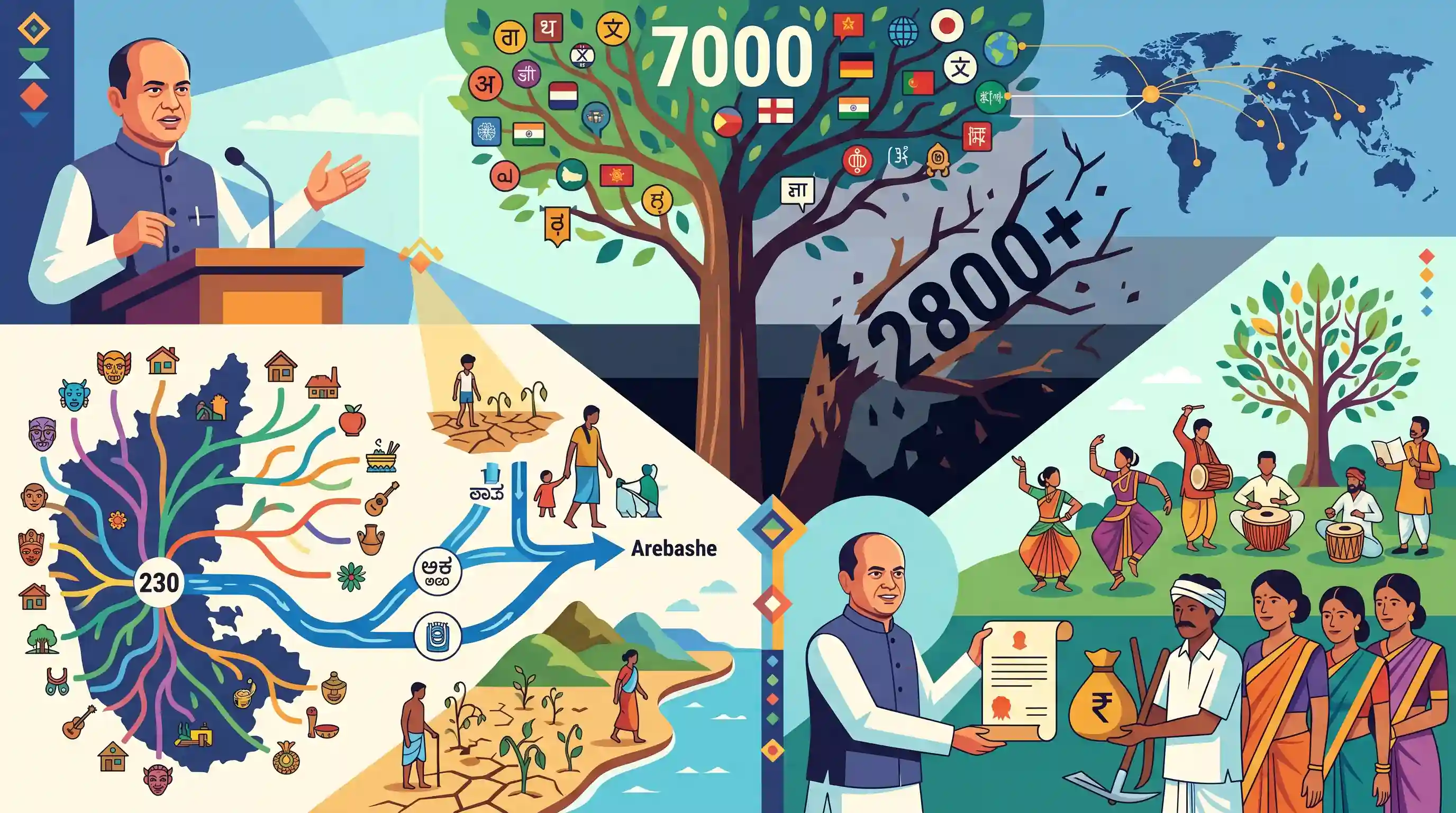
Karnataka Chief Minister Siddaramaiah has emphasized the critical need to preserve regional dialects to safeguard cultural identity. Speaking at an event organized by the Arebashe Samskruthika Mathu Sahitya Academy, he highlighted that Kannada is enriched by approximately 230 distinct dialects. He specifically noted the significance of 'Arebashe', a dialect born from the amalgamation of Kannada, Tulu, and Konkani, spoken by a community that migrated from Sakleshpur to Sullia due to historical droughts. With over 2,800 of the world's 7,000 languages having already vanished, the CM underscored the global urgency of linguistic conservation and announced land and financial grants for the local Nadagowda community to support their heritage.
Key Points
- Karnataka CM Siddaramaiah highlighted the urgent need to protect regional dialects, noting that Karnataka has 230 dialects that enrich the primary language, Kannada.
- The CM specifically praised the 'Arebashe' dialect, a unique amalgamation of Kannada, Tulu, and Konkani languages.
- Arebashe is spoken by the Arebashe Gowdas, a community that historically migrated from Sakleshpur to Sullia during severe drought years.
- He warned about the global decline in linguistic diversity, pointing out that approximately 2,845 out of 7,000 world languages have already vanished.
- The state government promised land and an allocation of ₹50 lakh to the Nadagowda community in Kodagu district to help preserve their cultural footprint.
Important Terms
Arebashe Samskruthika Mathu Sahitya Academy

A Karnataka government body established in 2011 to preserve and promote the language, literature, and culture of the Arebashe-speaking community.
UPSC context
Relevant for GS Paper I (Indian Culture) regarding state-led initiatives for linguistic and cultural preservation.
Arebashe
A Kannada dialect spoken by the Gowda community in Kodagu and Dakshina Kannada, formed by the blending of Kannada, Tulu, and Konkani.
UPSC context
Tests knowledge of regional linguistic diversity and the influence of migration on language (GS Paper I - Society/Culture).
Arebashe Gowdas
A socio-linguistic group in Karnataka, primarily Vokkaliga Gowdas, who migrated from Sakleshpur to Sullia and speak the Arebashe dialect.
UPSC context
Important for understanding ethnic and linguistic subdivisions within major Indian states (GS Paper I - Social Empowerment).
Nadagowda community
A traditional administrative title for village or regional heads in Karnataka, now identifying specific sub-communities particularly in the Kodagu and Sullia regions.
UPSC context
Relevant for GS Paper I (History/Culture) concerning traditional social structures and their contemporary state recognition.
Endangered Languages
Languages at risk of extinction, defined by UNESCO as those spoken by fewer than 10,000 people or lacking intergenerational transmission.
UPSC context
Critical topic for GS Paper I (Culture) and GS Paper II (Social Justice/Government Policies) regarding linguistic rights.
Linguistic Diversity
The presence of numerous variations in language (dialects) within a region, reflecting historical migration, geography, and social interaction.
UPSC context
A core theme in GS Paper I (Indian Society) and the Eighth Schedule of the Indian Constitution.
Prelims Trap
The SPPEL scheme automatically protects all Indian languages and dialects not listed in the Eighth Schedule.
SPPEL specifically targets languages/mother tongues spoken by fewer than 10,000 people. Many non-8th Schedule languages have millions of speakers (e.g., Bhili, Tulu).
Static Concepts Connected
What are the constitutional provisions and evolution of the Eighth Schedule?
- Constitutional Basis: Articles 344(1) and 351 of the Constitution mandate the protection and promotion of recognized official languages.
- Amendment Additions: Originally 14 languages; 21st Amendment added Sindhi; 71st added Konkani, Manipuri, Nepali; 92nd added Bodo, Dogri, Maithili, Santhali.
- Inclusion Benefits: Inclusion brings Sahitya Akademi recognition, funding for translation, and allows MPs/MLAs to speak the language in Parliament.
What is the institutional framework for protecting endangered Indian languages?
- SPPEL Scheme: Launched in 2013 by the Ministry of Education, it documents, archives, and promotes languages spoken by fewer than 10,000 people.
- Nodal Agency: The Central Institute of Indian Languages (CIIL), located in Mysuru, acts as the nodal coordinating agency for SPPEL.
- Global Framework: UNESCO tracks vanishing dialects globally via the World Atlas of Languages and declared 2022-2032 the International Decade of Indigenous Languages.
Cross-Topic Patterns
Climate geography + Linguistic evolution
The Arebashe dialect formed due to community migration during historical droughts, linking environmental geography and climate-induced migration directly with intangible cultural heritage evolution.
Tulu's demand for 8th Schedule status
Tulu, a major linguistic influence on Arebashe, frequently features in current affairs due to its prolonged, ongoing demand for Eighth Schedule inclusion and official state language status.

Expect a Match-the-Following question in 2026 pairing regional/endangered dialects (Arebashe, Kui, Halbi) with their parent states.
Linked PYQs · 3
Linked PYQs · 3
- 2021PrelimsGS1
With reference to India, the terms 'Halbi, Ho and Kui' pertain to
- 2024PrelimsGS1
The Constitution (71st Amendment) Act, 1992 amends the Eighth Schedule to the Constitution to include which of the following languages? 1. Konkani 2. Manipuri 3. Nepali 4. Maithili Select the correct answer using the code given below:
- 2014PrelimsGS1
Consider the following languages: 1. Gujarati 2. Kannada 3. Telugu Which of the above has/have been declared as 'Classical Language/Languages' by the Government?
