Karnataka agricultural price crash and central procurement demands
Source:The Hindu ↗
Why It Matters
Highlights the practical limitations of declaring an MSP without robust procurement mechanisms. It also illustrates the intersection of agricultural pricing, import policies, and alternative usage of crops (like maize for ethanol production) in stabilizing farm incomes.
Summary
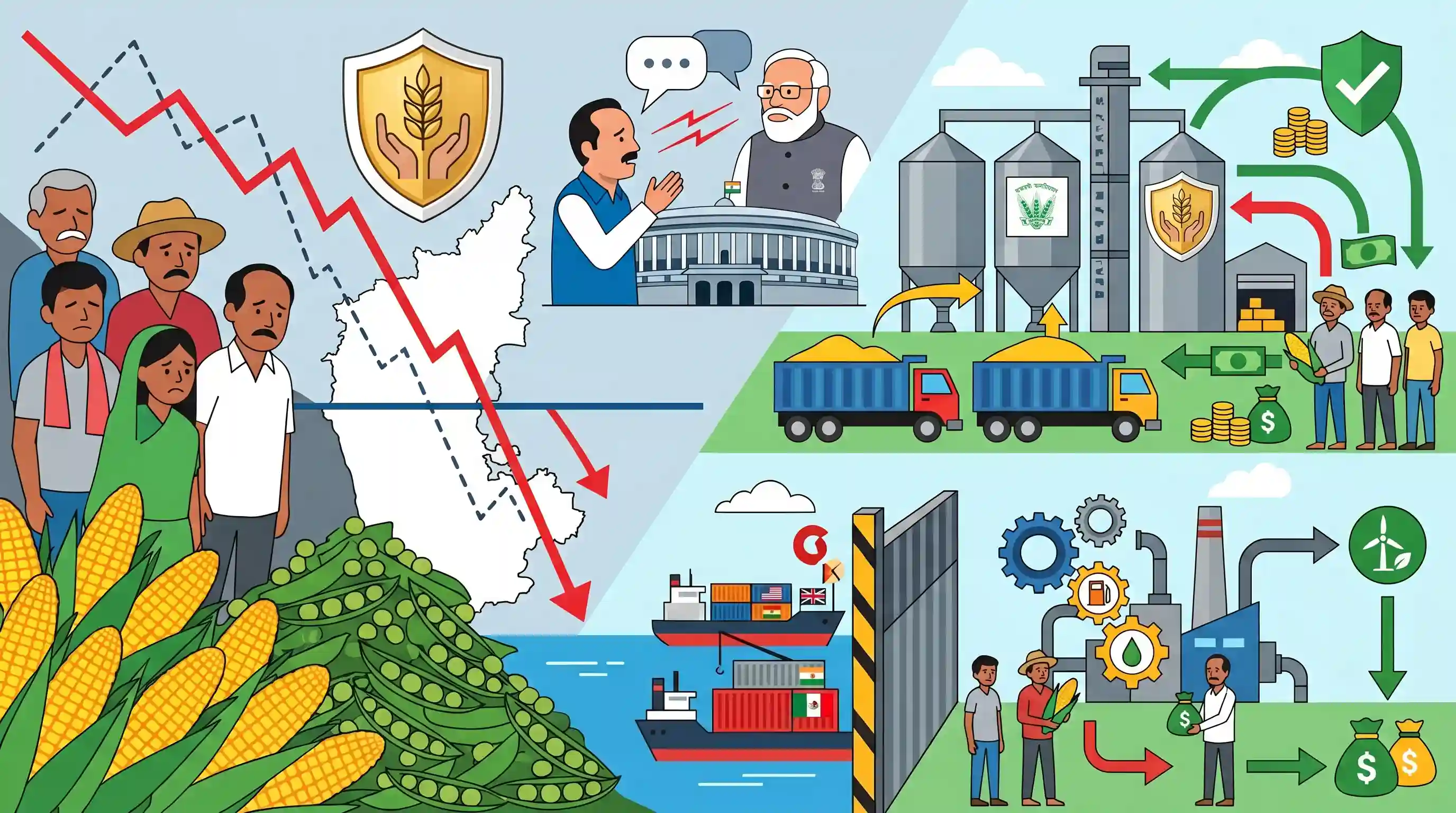
Karnataka Chief Minister Siddaramaiah has sought Prime Minister Narendra Modi's urgent intervention to address severe farmer distress caused by crashing agricultural prices. The prices of maize and green gram (moong) in the state have plummeted well below the Minimum Support Price (MSP) declared by the Centre. With Karnataka expecting a massive maize surplus, the CM demanded that central agencies like FCI and NAFED immediately begin procurement under the Price Support Scheme. Furthermore, he urged the Centre to impose restrictions on maize imports and mandate ethanol plants to procure maize directly from farmers to ensure that government biofuel incentives actually benefit the agricultural community.
Key Points
- Market prices for maize and green gram in Karnataka have crashed significantly below the Union government-declared Minimum Support Prices (MSP).
- Karnataka CM Siddaramaiah urged PM Narendra Modi to direct agencies like FCI and NAFED to procure the crops at MSP under the Price Support Scheme.
- The State has an estimated marketable surplus of 32 lakh tonnes of maize, surpassing local industrial absorptive capacity.
- The CM requested mandating ethanol plants to procure maize directly from farmers or FPOs to ensure benefits reach them, alongside increasing Karnataka\'s ethanol allocation.
- A demand was also raised to restrict maize imports to prevent further supply-demand distortions and price drops.
Important Terms
Minimum Support Price (MSP)

The guaranteed floor price at which the government purchases 22 mandated crops from farmers, recommended by CACP to protect against price volatility and ensure remunerative returns.
UPSC context
GS-3 (Agriculture); essential for understanding government price-support interventions and their impact on cropping patterns and food security.
Price Support Scheme (PSS)
A component of the PM-AASHA umbrella scheme where nodal agencies procure pulses, oilseeds, and copra at MSP when market prices fall below the support level.
UPSC context
GS-3 (Agriculture/Schemes); tests knowledge of physical procurement mechanisms for non-cereal crops and price stabilization strategies.
National Agricultural Cooperative Marketing Federation of India (NAFED)
The apex cooperative marketing body in India (est. 1958) that acts as a central nodal agency for procuring agricultural commodities under the Price Support Scheme.
UPSC context
GS-3 (Marketing); relevant for cooperative marketing and the institutional framework designed to eliminate intermediaries in agricultural trade.
Food Corporation of India (FCI)
A statutory body (est. 1965) responsible for procuring foodgrains at MSP, maintaining strategic buffer stocks, and distributing grains via the Public Distribution System (PDS).
UPSC context
GS-3 (Food Security); critical for topics on food management, storage infrastructure, and the financial burden of agricultural subsidies.
Ethanol Blending Programme (EBP)
A government initiative to blend ethanol—produced from feedstocks like maize and sugarcane—with petrol to reduce oil imports and provide farmers with an alternate market.
UPSC context
GS-3 (Energy/Agriculture); connects biofuels policy to energy security and the diversification of farm income through agricultural byproducts.
Prelims Trap
"The Price Support Scheme (PSS) mandates the physical procurement of all 22 MSP-mandated crops, including major cereals."
PSS, a component of PM-AASHA, specifically targets the physical procurement of pulses, oilseeds, and copra. General cereals like wheat and paddy are procured under standard FCI operations, not PSS.
Static Concepts Connected
What are the three operational components of PM-AASHA?
- Price Support Scheme: Physical procurement of pulses, oilseeds, and copra at MSP by central nodal agencies (like NAFED and FCI) with state support.
- Price Deficiency Payment: Direct payment of the difference between the MSP and the selling/modal price to pre-registered farmers. It involves no physical procurement of crops.
- Private Procurement Scheme: A pilot scheme involving the private sector to procure oilseeds at MSP from select districts, compensating them for service charges.
Which feedstocks are permitted for 1G ethanol production under the National Biofuel Policy?
- Sugar-based feedstocks: Includes sugarcane juice, sugar beet, sweet sorghum, and B-heavy/C-heavy molasses.
- Starch-based feedstocks: Includes starch-rich crops like maize, cassava, and damaged/surplus food grains (wheat, broken rice) declared unfit for human consumption.
Cross-Topic Patterns
Food-vs-Fuel debate in Maize
Mandating ethanol plants to buy maize directly from farmers shifts agricultural incentives. This mirrors global food-vs-fuel debates and impacts the domestic poultry sector, which relies heavily on maize as feed.
Trade tariffs vs. Domestic Support (MSP)
Demands to restrict imports to keep domestic prices above MSP highlight the ongoing friction between protecting farmers and fulfilling industrial demand without violating WTO Aggregate Measurement of Support (AMS) limits.

Expect a 2026 question linking Maize to three fronts: PM-AASHA procurement rules, 1G ethanol feedstock, and food-vs-fuel inflation.
Linked PYQs · 4
Linked PYQs · 4
- 2018MainsGS3
What do you mean by Minimum Support Price (MSP)? How will MSP rescue the farmers from the low income trap?
- 2024MainsGS3
Elucidate the importance of buffer stocks for stabilizing agricultural prices in India. What are the challenges associated with the storage of buffer stock? Discuss.
- 2020PrelimsGS1
Which of the following factors/policies were affecting the price of rice in India in the recent past? 1. Minimum Support Price 2. Government's trading 3. Government's stockpiling 4. Consumer subsidies Select the correct answer using the code given below:
- 2018PrelimsGS1
Consider the following: 1. Areca nut 2. Barley 3. Coffee 4. Finger millet 5. Groundnut 6. Sesamum 7. Turmeric The Cabinet Committee on Economic Affairs has announced the Minimum Support Price for which of the above?
