Karnataka Alleges Centre Blocked Finance Commission Grants
Source:The Hindu ↗
Why It Matters
The article is a practical illustration of issues in Indian fiscal federalism (Article 280), disputes over the devolution of taxes, the non-binding nature of Finance Commission recommendations on the Centre, and legislative friction when Governors reserve state bills for the President's consideration (Article 200/201).
Summary
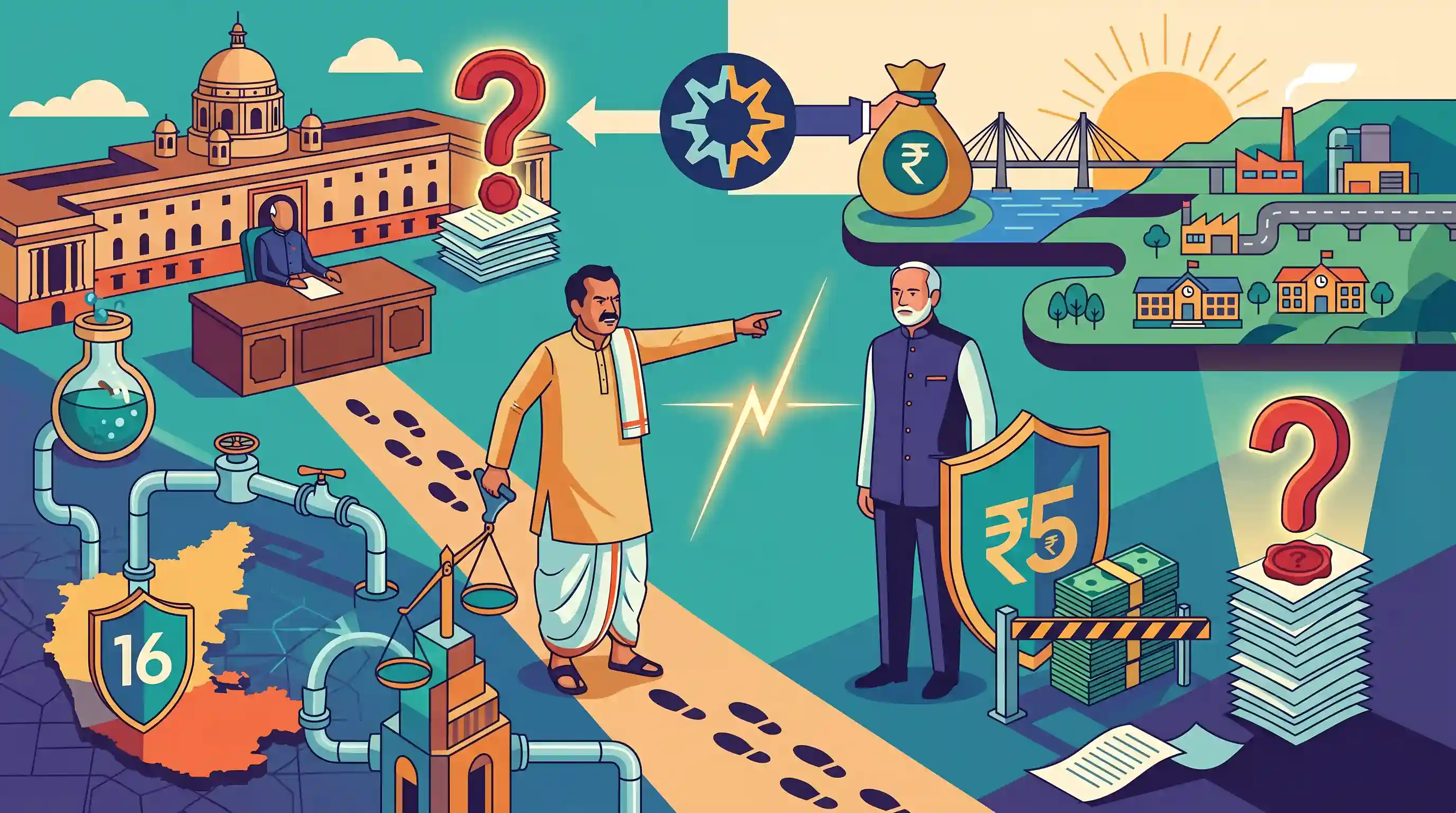
Karnataka Chief Minister Siddaramaiah has heavily criticized Union Minister Pralhad Joshi for allegedly failing to secure ₹11,495 crore in special grants for the state as recommended by the 15th Finance Commission. Siddaramaiah outlined plans to travel to New Delhi to seek President Droupadi Murmu's intervention regarding several state Bills currently pending Presidential assent. Furthermore, he plans to lobby the 16th Finance Commission and NITI Aayog for a fairer tax devolution share and request an additional ₹5,000 crore central grant for the development of the Kalyan Karnataka region. The development highlights ongoing friction in Centre-State fiscal and legislative relations.
Key Points
- Karnataka Chief Minister Siddaramaiah accused the Union government and Union Minister Pralhad Joshi of depriving the state of ₹11,495 crore in special grants recommended by the 15th Finance Commission.
- The CM plans to visit New Delhi to seek President Droupadi Murmu's intervention regarding several state Bills that have been reserved and are pending her assent.
- The state government intends to appeal to the 16th Finance Commission and NITI Aayog for increased allocations and to demand a special grant of ₹5,000 crore from the Centre for the development of the Kalyan Karnataka region.
- Political tensions also involved references to historical regional issues, such as the Santosh Hegde committee report on illegal mining in Ballari.
Important Terms
15th Finance Commission

A constitutional body (Art 280) chaired by N.K. Singh that recommended a 41% vertical devolution of central taxes to states for the 2021-2026 period.
UPSC context
GS Paper 3: Indian Economy; GS Paper 2: Federalism. Tests understanding of vertical vs horizontal devolution criteria.
Fiscal Federalism
The constitutional distribution of financial powers and responsibilities between the Union and State governments, primarily through tax sharing (Art 270) and grants-in-aid (Art 275).
UPSC context
GS Paper 2/3. Critical for understanding Centre-State financial relations and the divisible pool of taxes.
16th Finance Commission
The newly constituted body chaired by Arvind Panagariya tasked with recommending the revenue-sharing formula between the Centre and States for the 2026-2031 period.
UPSC context
GS Paper 3: Current Affairs. Relevant for upcoming changes in tax devolution and cooperative federalism.
Article 371J
A special provision added via the 98th Amendment (2012) granting special status to Karnataka's Kalyan-Karnataka region for equitable development, job reservations, and educational opportunities.
UPSC context
GS Paper 2: Indian Constitution. Tests knowledge of special provisions for specific regions (Part XXI).
Presidential Assent (Article 201)
Governed by Article 201, it allows the Governor to reserve a state bill for the President, who may grant, withhold, or return it for reconsideration.
UPSC context
GS Paper 2: Federalism. Focuses on legislative friction and the role of the Governor and President.
NITI Aayog
A non-constitutional think tank (est. 2015) that replaced the Planning Commission to foster cooperative federalism through a bottom-up policy approach.
UPSC context
GS Paper 2: Statutory/Regulatory/Quasi-judicial bodies. Evaluates the shift from centralized to collaborative planning.
Prelims Trap
The Union Government is constitutionally bound to disburse special grants recommended by the Finance Commission.
Under Article 281, the Finance Commission's recommendations are purely advisory. The Centre is not legally required to accept or implement state-specific grant recommendations.
Static Concepts Connected
What are the President's powers over a reserved State Bill under Article 201?
- Presidential Options: The President can assent, withhold assent, or return the bill (if not a Money Bill) to the state legislature for reconsideration.
- Re-passage Rule: Unlike Union bills, if a state legislature re-passes a returned bill, the President is not constitutionally bound to give assent.
- No Time Limit: The Constitution prescribes no time limit for the President to take action on a reserved state bill.
What special provisions are granted under Article 371J for the Kalyan Karnataka region?
- 98th Amendment: Inserted by the 98th Constitutional Amendment Act (2012) to address regional backwardness.
- Development Board: Requires the Governor to establish a separate development board with equitable fund allocation for the region.
- Local Reservations: Ensures reservations in educational institutions and state government jobs for local domiciles.
Cross-Topic Patterns
Article 200/201 + Supreme Court litigation
Multiple states (Kerala, Punjab, TN) approaching the SC against Governors endlessly delaying or reserving bills makes the Governor-President legislative pipeline a critical focus area.
Finance Commission vs. Article 371 regions
Demands for specialized funding (e.g., Kalyan Karnataka under 371J) frequently overlap with FC memorandums, testing the balance between horizontal devolution and targeted constitutional interventions.

Article 201 (Presidential veto on State bills) combined with the advisory nature of FC grants is highly likely for Prelims 2026.
Linked PYQs · 5
Linked PYQs · 5
- 2025MainsGS2
Examine the evolving pattern of Centre-State financial relations in the context of planned development in India. How far have the recent reforms impacted the fiscal federalism in India?
- 2024MainsGS2
What changes has the Union Government recently introduced in the domain of Centre-State relations ? Suggest measures to be adopted to build the trust between the Centre and the States and for strengthening federalism.
- 2021MainsGS2
How have the recommendations of the 14th Finance Commission of India enabled the States to improve their fiscal position?
- 2022MainsGS2
Discuss the essential conditions for exercise of the legislative powers by the Governor. Discuss the legality of re-promulgation of ordinances by the Governor without placing them before the Legislature.
- 2025MainsGS3
Mineral resources are fundamental to the country's economy and these are exploited by mining. Why is mining considered an environmental hazard? Explain the remedial measures required to reduce the environmental hazard due to mining.
