Jal Jeevan Mission implementation review in Uttarakhand hills
Source:garhwal-post ↗
Why It Matters
The Jal Jeevan Mission is a flagship national program. Its implementation in Uttarakhand underscores the unique challenges of building sustainable water infrastructure in hilly terrains, highlighting the critical integration of groundwater recharge and source rejuvenation with rural drinking water schemes.
Summary
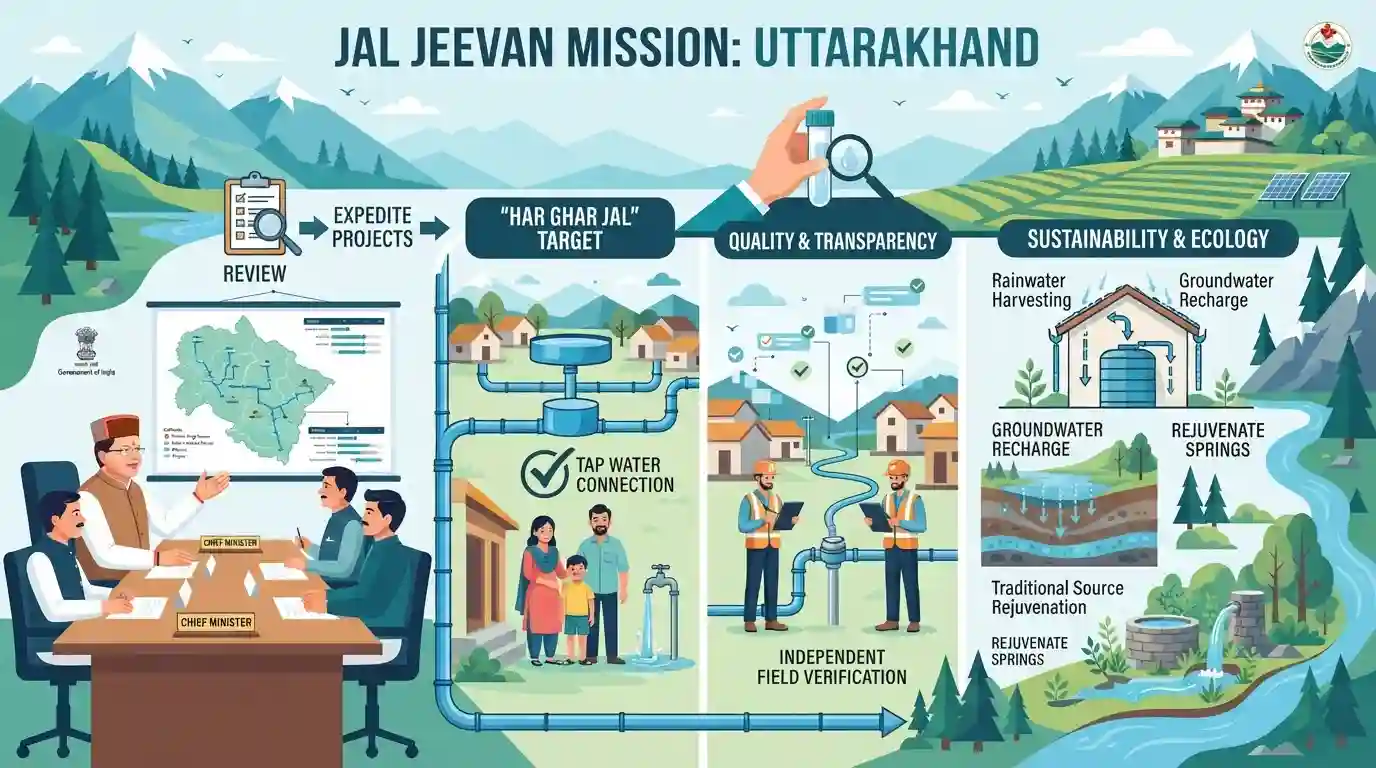
Uttarakhand Chief Minister Pushkar Singh Dhami conducted a review of the Jal Jeevan Mission (JJM), directing officials to expedite ongoing projects to meet the 'Har Ghar Jal' target. The review highlighted the necessity of providing safe, quality drinking water and the importance of independent field verification for transparency. Additionally, recognizing the ecological sensitivities of Uttarakhand, the CM emphasized the need for rainwater harvesting, groundwater recharge, and the rejuvenation of traditional water sources in hilly regions to ensure the long-term sustainability of the water supply.
Key Points
- Uttarakhand Chief Minister Pushkar Singh Dhami reviewed the progress of the Jal Jeevan Mission, emphasizing the timely completion of the 'Har Ghar Jal' targets across the state.
- The CM directed officials to ensure the regular supply of safe and quality drinking water to rural households and mandated third-party field verification of completed works.
- Special focus was laid on the conservation and rejuvenation of natural drinking water sources in hilly areas, along with promoting rainwater harvesting and groundwater recharge to ensure sustainability.
- Strict instructions were issued to immediately restore roads and paths dug up for laying water pipelines to prevent inconvenience to local residents.
Important Terms
Jal Jeevan Mission (JJM)

A flagship centrally sponsored scheme launched in 2019 to provide safe, adequate drinking water via functional household tap connections to all rural Indian households, while ensuring source sustainability through water conservation.
UPSC context
Crucial for GS-II (Government Policies) and GS-III (Water Management). Tests knowledge of rural infrastructure, water security, and SDG-6.
Har Ghar Jal
The core target of the Jal Jeevan Mission, aiming to supply 55 litres of clean tap water per capita per day to every rural household regularly and sustainably.
UPSC context
Relevant to GS-II (Welfare Schemes). Evaluates understanding of public health initiatives, rural empowerment, and metrics for achieving universal water access.
State Level Scheme Sanctioning Committee (SLSSC)
An institutional state-level committee under the Jal Jeevan Mission tasked with reviewing, considering, and approving proposals for rural tap water supply schemes and projects within a state.
UPSC context
Important for GS-II (Governance). Demonstrates the decentralized administrative mechanisms and cooperative federalism essential for implementing national infrastructure projects.
State Water and Sanitation Mission (SWSM)
An apex state-level institution, usually headed by the Chief Secretary, responsible for coordinating, monitoring, and providing policy guidance for the implementation of rural drinking water and sanitation programs like JJM.
UPSC context
Relevant to GS-II (State Governance). Highlights the institutional frameworks enabling the execution of nationwide welfare missions at regional levels.
Prelims Trap
JJM focuses exclusively on providing functional household tap connections without addressing water source sustainability.
JJM is not just about pipe infrastructure; it mandates source sustainability measures like rainwater harvesting and greywater management to ensure long-term viability.
Static Concepts Connected
What are the traditional water harvesting structures of the Himalayan region?
- Naulas: Subterranean aquifers with sloped roofs and porous floors traditionally used in Uttarakhand for capturing seepage water.
- Dharas: Natural mountain crest springs channeled through carved spouts, acting as primary drinking water sources in hilly terrains.
- Khatris: Horizontal tunnels dug in hard rock to tap seepages, commonly found in Himachal Pradesh.
How does drinking water factor into India's National Multidimensional Poverty Index (MPI)?
- Core Indicator: Access to safe drinking water is a core indicator evaluated under the 'Standard of Living' dimension.
- Deprivation Criteria: A household is considered deprived if the primary drinking water source is unsafe or requires a 30-minute walk or longer.
- Weightage: The drinking water indicator holds a 1/21 weightage in the overall MPI calculation developed by NITI Aayog.
Cross-Topic Patterns
JJM, Himalayan Ecology & Climate Resilience
Linking tap water access directly to climate adaptation; drying Himalayan springs necessitates aggressive groundwater recharge under JJM to prevent infrastructure failure during dry seasons.
MPI Governance & Rural Infrastructure
Schemes like JJM directly improve India's National MPI standard-of-living metrics, demonstrating how targeted rural infrastructure spending yields multi-sectoral poverty reduction.

Expect a multi-statement question in 2026 linking JJM's new 2028 target with traditional Himalayan water systems (Naulas/Dharas) and MPI.
Linked PYQs · 3
Linked PYQs · 3
- 2025UKPSC_PRELIMSGS1
Which of the following is not an indicator for the dimension of Standard of Living in India's National Multidimensional Poverty Index?
- 2025UKPSC_PRELIMSGS1
Consider the following statements and select the correct answer from the options given below : Statement 1 : Uttarakhand is highly vulnerable to climate change. Statement 2 : Climate change is causing water stress and depleting biodiversity in Uttarakhand.
- 2025UKPSC_PRELIMSGS1
Arrange the following social welfare schemes in chronological order: i. Integrated Rural Development Programme (IRDP) ii. Rural Employment Generation Programme (REGP) iii. Prime Minister Rojgar Yojana (PMRY) iv. Rural Landless Employment Guarantee Programme (RLEGP)
