Uttarakhand Reaffirms Commitment to Decentralized Doorstep Governance
Source:indianmasterminds ↗
Why It Matters
The article provides valuable insights into state-level citizen-centric administration, public grievance redressal mechanisms, and regional development initiatives in Uttarakhand, alongside landmark legislations (like UCC and the anti-copying law) frequently tested in the UKPSC PCS Prelims.
Summary
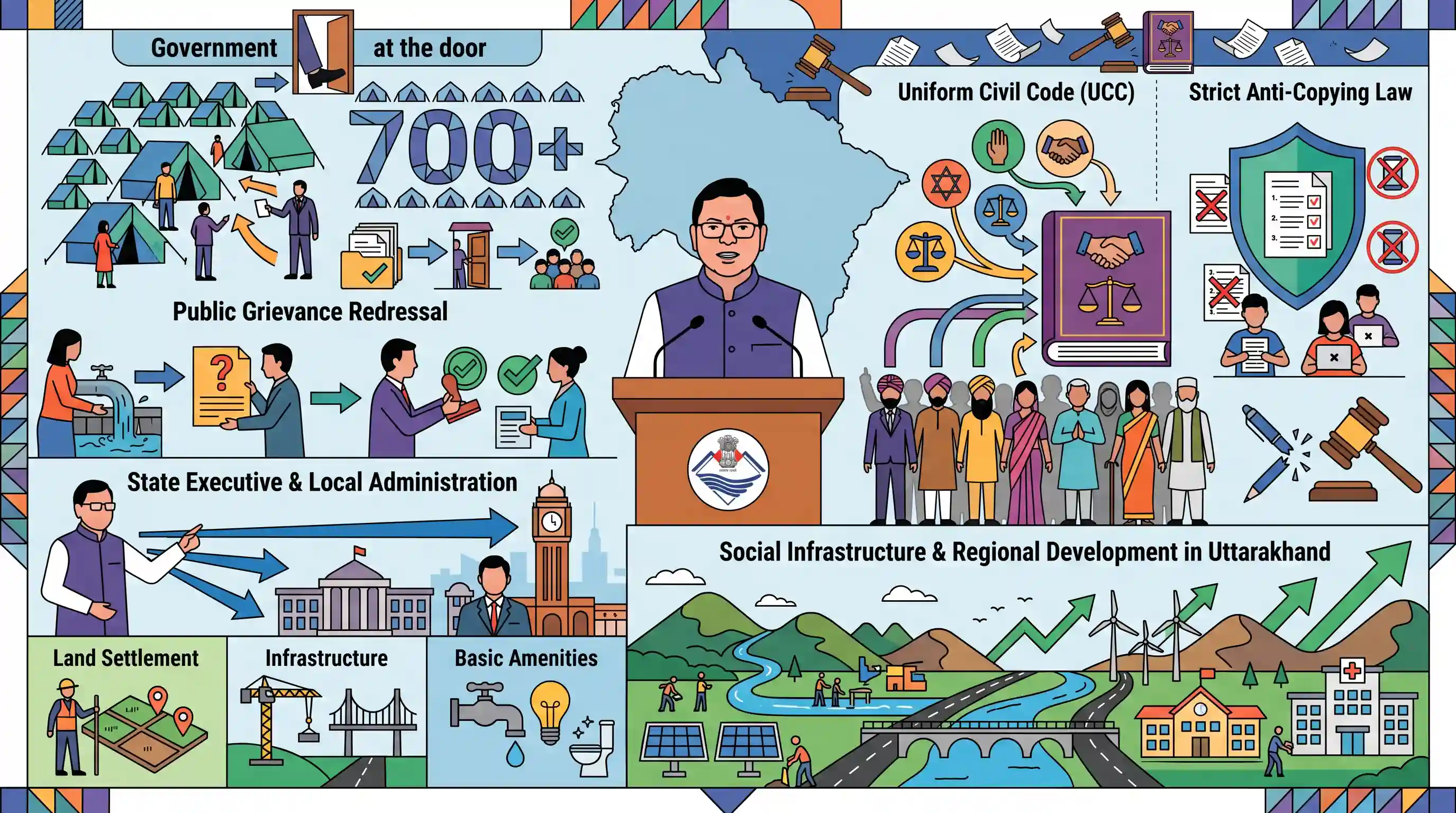
Uttarakhand Chief Minister Pushkar Singh Dhami reviewed public grievances and reiterated the government's commitment to decentralized, doorstep governance during a public service camp in Sahaspur, Dehradun. Under the 'Jan-Jan Ki Sarkar, Jan-Jan Ke Dwar' campaign, the state has organized over 700 camps to resolve administrative issues on the spot. CM Dhami highlighted major reform milestones, such as the Uniform Civil Code and the strict anti-copying law, while giving direct orders to state departments to resolve local land settlement, infrastructure, and basic amenity issues in Dehradun.
Key Points
- Uttarakhand CM Pushkar Singh Dhami participated in a public service camp under the 'Jan-Jan Ki Sarkar, Jan-Jan Ke Dwar' campaign in Sahaspur, Dehradun, highlighting 'doorstep governance'.
- Under the first phase of this initiative, approximately 700 Jan Seva camps were organized across the state in 65 days, drawing over 5 lakh participants and facilitating administrative resolutions on-site.
- CM Dhami emphasized milestone policy reforms implemented in Uttarakhand, including the Uniform Civil Code (UCC), the country's strictest anti-copying law, and stringent anti-corruption measures.
- Specific public welfare and developmental instructions were issued, such as MDDA installing solar lights in Karbari Grant, and the Revenue Department resolving settlement issues in Atakfarm and Central Hope Town within 15 days.
- Infrastructure developments like CC roads in Selakui, a park named after Dr. Shyama Prasad Mukherjee, a cremation ground near Bhauwala Bridge, and medical facilities in Barowala were approved.
Important Terms
Uniform Civil Code (UCC) of Uttarakhand

A landmark legislation passed in 2024 to establish a common set of personal laws governing marriage, divorce, inheritance, and live-in relationships for all residents, except Scheduled Tribes.
UPSC context
GS Paper II (Polity): Underlines debates on Article 44, gender justice, personal laws, and state legislative powers.
Uttarakhand Anti-Copying Law
An exceptionally stringent law introduced in 2023 that mandates severe penalties, including life imprisonment and property confiscation, to curb paper leaks and cheating in state recruitment exams.
UPSC context
GS Paper II (Governance): Evaluates structural reforms to secure transparency and institutional integrity in public examinations.
Jan-Jan Ki Sarkar, Jan-Jan Ke Dwar Campaign
A decentralized governance initiative in Uttarakhand featuring village-level public camps designed to deliver essential welfare scheme benefits and resolve administrative issues directly at citizens' doorsteps.
UPSC context
GS Paper II (Governance): Tests citizen-centric administration, decentralized public service delivery, and grievance redressal models.
Seva, Sushasan and Samarpan Programme
A comprehensive outreach campaign focusing on public service, transparency, and sustainable development to review government progress and drive Uttarakhand towards a fully developed state by 2035.
UPSC context
GS Paper II (Governance): Examines performance accountability of the executive and strategic visions for state-level good governance.
Global Investors Summit
Officially 'Destination Uttarakhand', this premium investment summit showcases the state's investor-friendly policies, promotes ease of doing business, and acts as a catalyst for employment and industrial development.
UPSC context
GS Paper III (Economy): Analyzes state-led investment attraction, fiscal policies, and strategies to boost regional economic growth.
Mussoorie Dehradun Development Authority (MDDA)
A statutory parastatal body established in 1984, responsible for implementing master plans, managing land use, and developing urban infrastructure in Dehradun, Mussoorie, and surrounding areas.
UPSC context
GS Paper II (Urban Governance): Focuses on the role of specialized urban authorities, master planning, and sustainable urbanization.
Prelims Trap
The Uttarakhand Uniform Civil Code applies uniformly to all residents, including Scheduled Tribes, across the state.
The Uttarakhand UCC Act explicitly exempts Scheduled Tribes (defined under Article 366(25)) from its application to protect their customary rights.
Static Concepts Connected
What is the constitutional basis and legislative competence for a State to enact a Uniform Civil Code?
- Article 44 DPSP: Directs the State to secure a Uniform Civil Code for all citizens throughout the territory of India.
- Concurrent List Entry 5: Covers marriage, divorce, and succession, allowing both Parliament and State Assemblies to legislate on personal laws.
- Article 254(2) Assent: A State UCC repugnant to Central laws (e.g., Indian Succession Act) requires Presidential assent to take effect.
Cross-Topic Patterns
State UCC vs Federal Supremacy
State-level personal law codification tests Article 254(2), balancing regional legislative autonomy with federal uniformity under central personal law statutes.
Sevottam Model and Doorstep Governance
Physical grievance camps operationalize the Second ARC's citizen-centric recommendations, bridging access deficits inherent in purely digital portals like CPGRAMS.

Questions in 2026 may analyze the legislative competence of states to enact UCCs under Concurrent List Entry 5 vis-a-vis tribal exemptions.
Linked PYQs · 2
Linked PYQs · 2
- 2025UKPSC_PRELIMSGS1
Consider the following statements with reference to Uttarakhand and choose the correct answer: 1. The executive of Uttarakhand includes Governor as the head of the state. 2. It also includes the Chief Minister and his/her council of ministers.
- 2025UKPSC_PRELIMSGS1
Consider the following statements about Uttarakhand Human Rights Commission and choose the correct option from the options given below: 1. Uttarakhand Human Rights Commission came into existence on May 13, 2013. 2. The objectives of UHRC was to bring about greater accountability and transparency in governance.
