Uttarakhand Reviews MSME Growth and Startup Investment Expansion
Source:indiatimes ↗
Why It Matters
State-specific policy updates, industrial metrics, and regional planning initiatives (such as industrial parks in Chamoli, Pauri, Almora and flatted factories) are highly relevant for UKPSC PCS Prelims state economy questions.
Summary
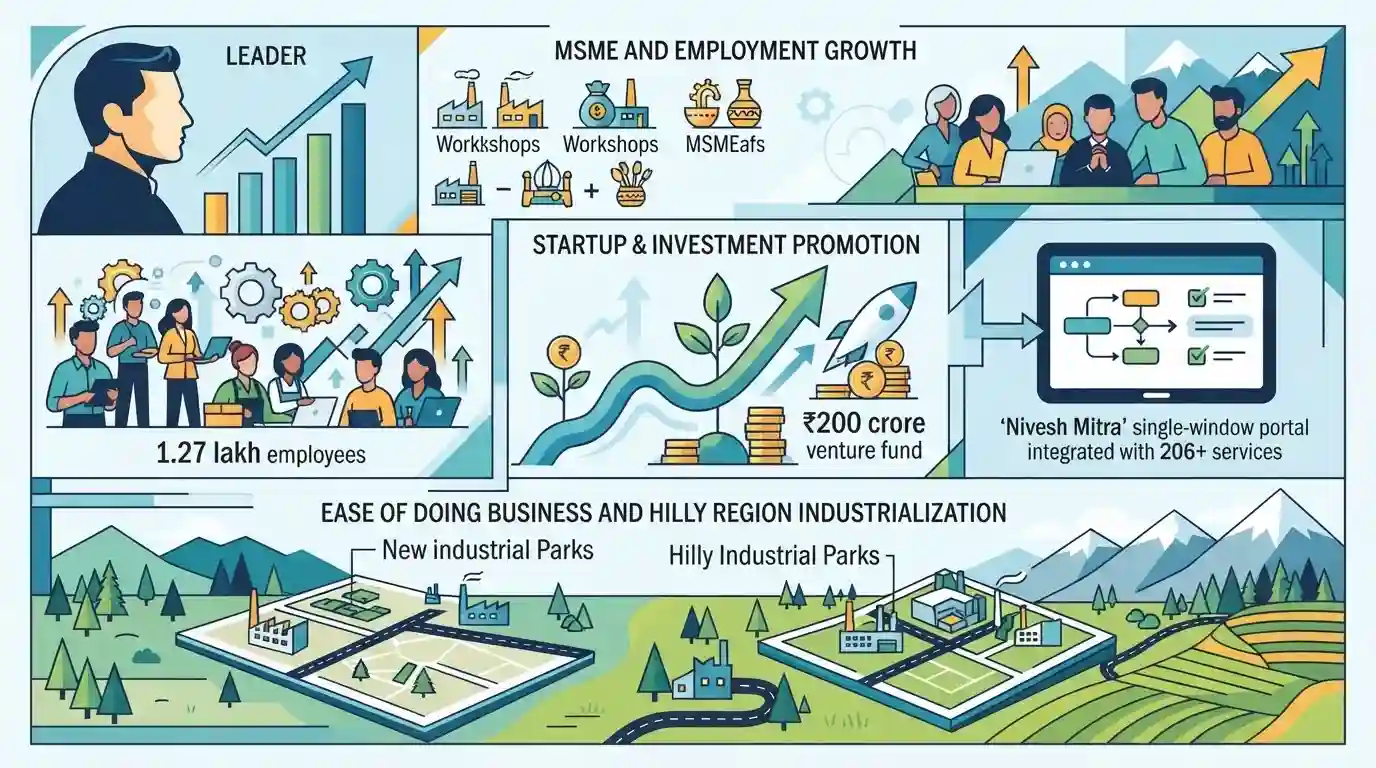
Uttarakhand Chief Minister Pushkar Singh Dhami reviewed business concerns and highlighted the state's efforts to boost the MSME sector, start-ups, and employment. The state government has seen the establishment of over 29,000 new MSME units, providing direct employment to 1.27 lakh people. Prominent initiatives include a ₹200 crore venture fund for startups, the 'Nivesh Mitra' investor facilitation system, a single-window portal integrated with 206+ services, and planned industrial parks in the hill districts of Chamoli, Pauri, and Almora.
Key Points
- Uttarakhand CM Pushkar Singh Dhami chaired an interactive session with business and industrial representatives in Haldwani to address concerns over GST procedures, mandi fees, and infrastructure.
- Over 29,000 new MSME units have been established in Uttarakhand in recent years, generating direct employment for around 1.27 lakh people.
- To improve ease of doing business, the state's single-window portal has been strengthened, now hosting 206+ services across 26 major government departments online.
- A 'Nivesh Mitra' system has been rolled out to facilitate grievance redressal and process management for investors and entrepreneurs.
- To extend industrial development to the hill districts, land has been identified for special industrial parks in Chamoli, Pauri, and Almora.
- Flatted factories are being developed in Haridwar, with more planned in Selaqui and Pantnagar to optimize space and industrial growth.
- A dedicated ₹200 crore venture fund has been instituted by the state government to support startups and youth-led entrepreneurship.
Important Terms
Nivesh Mitra system

An investor facilitation and query redressal platform introduced in Uttarakhand to resolve entrepreneur concerns and expedite approvals, enhancing the state's investment environment.
UPSC context
UKPSC Mains Paper III; tests knowledge of investment promotion and Ease of Doing Business in Uttarakhand.
Single Window Clearance System
A digital platform established by the Uttarakhand government to streamline industrial approvals, integrate multi-department services, and provide online clearances to local and global investors.
UPSC context
UKPSC Mains Paper III; tests administrative reforms, industrial facilitation, and Ease of Doing Business (EoDB).
Uttarakhand Venture Fund
A state-backed ₹200 crore alternative investment fund set up to address early-stage capital requirements, promote private investments, and strengthen the startup ecosystem in Uttarakhand.
UPSC context
UKPSC Mains Paper III; evaluations of state schemes promoting entrepreneurship, innovation, and youth self-reliance.
Uttarakhand MSME Policy 2023
A policy framework offering financial incentives, capital and interest subsidies, and stamp duty concessions to promote balanced regional development and employment through MSMEs.
UPSC context
UKPSC Mains Paper III; crucial for questions on industrialization in hilly regions and state economic policies.
Prelims Trap
The ₹200 crore Uttarakhand Venture Fund directly disburses debt-free grants to entrepreneurs without intermediary financial funds.
The state government does not disperse funds directly to startups; it acts as a Limited Partner (LP) contributing to SEBI-registered Alternative Investment Funds (AIFs).
Static Concepts Connected
What is SIDCUL and its role in Uttarakhand's economic landscape?
- Establishment: Incorporated in 2002 as a state government enterprise to develop industrial infrastructure and manage industrial estates.
- Key Estates: Developed major Integrated Industrial Estates (IIEs) in Selaqui, Haridwar, Pantnagar, Sitarganj, and Kotdwar.
- Facilitation: Administers the single-window facilitation mechanism to accelerate clearances for new enterprises in the state.
How does the Uttarakhand MSME Policy categorize regions for fiscal incentives?
- Geographical Slabs: Divides the state into five categories (A, B, B+, C, and D) based on geographical terrain and industrial backwardness.
- Category A: Covers remote hilly districts like Chamoli, Pithoragarh, and Rudraprayag, offering them the highest percentage of capital subsidies.
- Category D: Includes industrially developed plains like Haridwar and Udham Singh Nagar, which receive minimal fiscal incentives.
Cross-Topic Patterns
Hill industrialization vs. mountain migration
Establishing industrial parks in Chamoli, Pauri, and Almora directly targets "ghost villages" (Palayan) by mandating local employment, linking economic policy to demographic stabilization.
Land scarcity & SIDCUL vertical expansion
Uttarakhand's fragile Himalayan terrain limits horizontal land expansion. Eco-efficient "flatted factories" in plains balance industrial growth with ecological conservation.

Questions on SIDCUL's flatted factories, Hill Industrial Parks (Chamoli, Pauri, Almora), and the Venture Fund model are highly probable.
Linked PYQs · 3
Linked PYQs · 3
- 2025UKPSC_PRELIMSGS1
According to Uttarakhand Economic Survey 2024-25, what was the projected growth rate of the Gross State Domestic Product (at constant prices) of Uttarakhand in 2024-25?
- 2024UKPSC_PRELIMSGS1
What percentage (approximately) of Uttarakhand is plain area ?
- 2024UKPSC_PRELIMSGS1
UTDB is established in Uttarakhand to promote:
